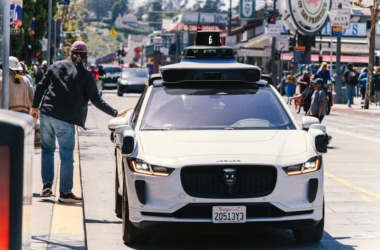

Meta announced Thursday it will eliminate 10% of its workforce — approximately 8,000 employees — beginning May 20, 2026, as the company accelerates its push into artificial intelligence. The layoffs represent the latest in a series of workforce reductions across the tech industry as companies restructure around AI capabilities while facing growing public skepticism about automation.
According to a memo to employees, Meta will also scrap plans to hire for 6,000 open roles, marking one of the largest single workforce reductions in the company’s history. The cuts follow several smaller job reductions that Meta said were necessary to improve efficiency while focusing on generative AI development.
The Scale of AI Workforce Transformation
The workforce impact of AI extends far beyond individual company layoffs. Google’s latest analysis of 1,302 real-world AI implementations across leading organizations reveals what the company calls “the fastest technological transformation we’ve seen.” The analysis, expanded from an initial list of 101 use cases published two years ago, shows AI deployment across virtually every major organization.
“Production AI and agentic systems are now deployed in meaningful ways across virtually every one of the thousands of organizations,” Google reported. The vast majority of implementations showcase what Google terms “agentic AI” — systems capable of autonomous decision-making and task execution built with tools like Gemini Enterprise and Security Command Center.
Microsoft’s partner ecosystem data indicates companies are moving “quickly from experimentation to production” with AI, seeking “measurable business outcomes” rather than pilot programs. Microsoft describes this shift as “Frontier Transformation,” where AI becomes “a repeatable, governed capability embedded into the flow of work, business processes and customer engagement.”
Growing Public Resistance to Automation
Despite corporate enthusiasm for AI implementation, public sentiment toward the technology continues to deteriorate. Recent polling data shows AI with worse favorability ratings than Immigration and Customs Enforcement (ICE), with nearly two-thirds of respondents reporting they used ChatGPT or Copilot within the past month despite negative opinions.
Generation Z shows particularly strong resistance to AI adoption, with sentiment growing more negative over time as young workers encounter AI systems in educational and workplace settings. A Quinnipiac poll found substantial opposition to AI integration across multiple demographics.
The disconnect between corporate AI adoption and public acceptance reflects what industry observers call “software brain” — a worldview that reduces complex human activities to algorithmic processes. This perspective, while driving technological advancement, often fails to account for worker concerns about job displacement and autonomy.
Enterprise AI Adoption Accelerates
Companies continue expanding AI implementations despite workforce concerns. Canva CEO Melanie Perkins described how the design platform has pushed “even more aggressively into integrating AI” with new features that allow users to simply describe desired outputs and have AI generate presentations and documents from various data sources including Slack and email.
“Canva users love the product and also the huge inroads it was making into the business world,” Perkins noted, explaining that non-designer users “didn’t seem nearly as threatened by AI as professionals using other creative software — they may have even felt empowered.”
Microsoft’s framework for “Frontier Transformation” focuses on two key elements: intelligence grounded in company-specific data and business context, and trust through observable, managed, and secured AI systems. The company emphasizes “enriching employee experiences” and “reinventing customer engagement” through AI implementation.
Job Categories Most Affected
The current wave of AI-driven workforce changes primarily impacts knowledge workers in technology, design, content creation, and customer service roles. Meta’s layoffs specifically target positions deemed redundant as the company automates processes through AI systems.
Google’s use case analysis reveals AI deployment across functions including:
- Content generation and marketing automation
- Customer service and support systems
- Data analysis and business intelligence
- Software development and code generation
- Design and creative production workflows
Unlike previous automation waves that primarily affected manufacturing and routine manual labor, current AI systems target cognitive work previously considered automation-resistant. This shift explains much of the workforce anxiety surrounding AI adoption.
Skills Gap and Retraining Challenges
As companies implement AI systems, demand grows for workers capable of managing, training, and integrating these technologies. Microsoft emphasizes that successful AI transformation requires “identity, data protection, compliance, monitoring and change management” capabilities.
The skills gap presents both challenge and opportunity. While AI eliminates some roles, it creates demand for:
- AI system administrators and prompt engineers
- Data governance and compliance specialists
- Human-AI interaction designers
- AI ethics and safety auditors
- Cross-functional AI integration managers
Companies report difficulty finding workers with these emerging skill sets, even as they reduce headcount in traditional roles.
What This Means
The AI workforce transformation represents a fundamental shift in how companies organize human labor around intelligent systems. Meta’s 8,000-person reduction signals that even AI-forward companies view current staffing levels as unsustainable given automation capabilities.
The disconnect between corporate AI enthusiasm and public skepticism suggests potential political and social friction ahead. As more companies follow Meta’s lead in restructuring around AI, workforce displacement may accelerate faster than retraining and social safety net adaptation.
For workers, the data indicates AI will reshape rather than simply eliminate jobs. Success will increasingly depend on developing complementary skills that enhance rather than compete with AI systems. Companies that manage this transition thoughtfully — balancing efficiency gains with workforce development — may gain competitive advantages in talent retention and public perception.
FAQ
How many jobs is AI expected to eliminate? While specific numbers vary by industry, Meta’s 10% workforce reduction and Google’s documentation of 1,302 AI implementations suggest significant displacement across knowledge work sectors. Most economists predict AI will transform rather than eliminate most jobs, but the transition period may involve substantial workforce disruption.
Which industries are most affected by AI workforce changes? Technology, design, content creation, customer service, and data analysis roles face the most immediate impact. Companies like Meta, Google, and Microsoft are leading the transformation, with effects spreading to organizations adopting their AI tools and platforms.
What skills should workers develop to remain relevant? Focus on AI collaboration, data governance, human-AI interaction design, and cross-functional integration skills. Workers who can manage, audit, and enhance AI systems rather than compete with them show the strongest job security in the current transition.