
Key takeaways
- Precision agriculture uses AI to make farming more data-driven — exactly when and where to irrigate, fertilize, spray, or harvest.
- Satellites (Planet, Sentinel, Landsat) and drones provide imagery at field level; ML models turn pixels into actionable insights on crop health, weeds, water stress, and yield prediction.
- Farm equipment is increasingly automated — John Deere’s See & Spray kills weeds selectively, saving 66%+ of herbicide compared to broadcast spraying.
- Livestock monitoring uses AI-powered cameras and sensors to detect illness early, track feed intake, and monitor behaviour.
- Deployment is uneven — large operations in wealthy countries adopt fastest; smallholder farms face cost and connectivity barriers.
Why AI in farming
Agriculture has extreme variability — each field, season, and crop is different. Traditional uniform treatments (spray the whole field the same amount) are wasteful. Data-driven precision — treat each square meter according to its actual needs — reduces costs, environmental impact, and labour. AI is the engine that turns raw observations into those per-square-meter decisions.

The FAO estimates global food production must rise 50-70% by 2050 to meet demand, while climate change and resource pressures complicate existing methods. AI-assisted precision farming is one of the levers for the productivity gains required. For the ML foundations, see our machine learning primer.
Remote sensing and crop monitoring
Satellite imagery
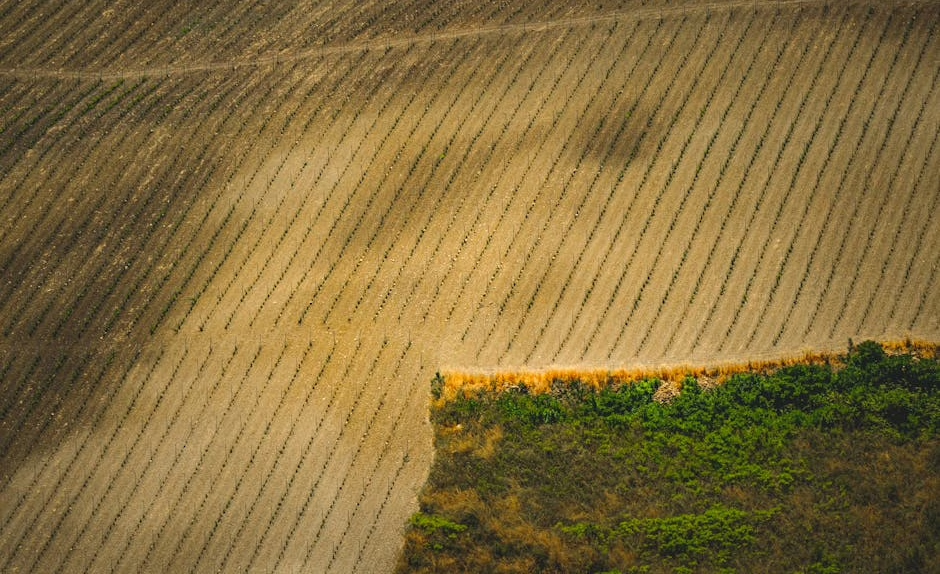
Sentinel-2 (ESA, free) provides 10-meter resolution imagery every few days globally. Planet‘s SkySat and Doves provide higher-resolution commercial imagery. ML models analyze imagery for vegetation indices (NDVI, EVI), crop type identification, water stress, disease, and yield estimation.
Drones
Drones fly low, collect very-high-resolution imagery (sub-centimeter), and can carry multispectral, thermal, or LIDAR sensors. Used for plant-by-plant inspection, precise herbicide targeting, livestock surveys, and infrastructure inspection (irrigation, fencing).
Ground sensors
Soil moisture, soil conductivity, weather, and micro-climate sensors provide continuous ground-truth data. Paired with remote sensing, they calibrate satellite/drone observations and fill in gaps.
Yield prediction
Combining satellite, weather, and management data with historical yields, ML models predict crop yield weeks or months before harvest. Commodity traders, insurance companies, and governments use these predictions for hedging, pricing, and food-security planning.
Precision field operations
Variable-rate application
Modern equipment adjusts fertilizer, seed density, irrigation, and pesticide application by location within a field. AI analyzes historical data and real-time sensors to optimize application rates per area. Savings on inputs (fertilizer can be 25-40% of row-crop operating costs) and environmental benefits both improve.
Targeted weed and pest control
John Deere’s See & Spray uses computer vision to distinguish crop plants from weeds in real time, spraying herbicide only where needed. Trials show 66%+ reduction in herbicide use compared to broadcast spraying. Similar systems from Blue River, Carbon Robotics (mechanical laser weeders), and others are commercializing. See our computer vision primer for the underlying techniques.
Autonomous equipment
Tractors with autonomous navigation have been commercial for years. Fully autonomous farm equipment — no operator cab at all — is in limited deployment (John Deere’s autonomous 8R, Monarch Tractor, CNH’s New Holland autonomous). Regulatory and liability frameworks are the main gating factor in the US and EU; some regions are further along than others.
Harvest timing and logistics
AI predicts optimal harvest windows by crop maturity, weather, and market conditions. Coordination across harvesting equipment, trucking, and storage optimizes large-farm logistics.
Livestock and aquaculture
Beyond crop agriculture, AI is deployed in animal operations:
- Individual animal monitoring: Cameras and wearables track dairy cow behaviour, detect lameness, predict calving, flag illness early. Companies like Connecterra, Cainthus, and Ever.Ag lead this space.
- Feed optimization: ML models predict how much each animal will eat based on weather, age, health, and production goals.
- Aquaculture: Fish-farm operators use underwater cameras with ML to estimate fish weight, detect disease, and optimize feeding. Reduces feed costs (largest aquaculture cost) and environmental impact (overfeeding).
- Poultry management: Automated video analysis detects flock behaviour anomalies, welfare issues, and early disease signs.
The smallholder challenge
Most of the world’s farmers operate on smallholder plots (under 2 hectares). AI tools designed for large industrial operations do not automatically transfer. Cost, connectivity, language, and literacy barriers all matter. Programs from FAO, CGIAR research institutes, and digital-agriculture startups are adapting tools — SMS-based advice services, smartphone apps for disease diagnosis (PlantVillage, Plantix), and community-based delivery — to reach smaller farmers. The gap is closing but remains significant.
Practical barriers to adoption
- Rural connectivity. Precision tools depend on data transfer. Many agricultural regions still lack reliable broadband.
- Equipment cost. Autonomous tractors and high-end imaging systems are expensive. Return on investment is real but not universal.
- Integration friction. Data from equipment, satellites, and farm management systems often does not interoperate. Proprietary ecosystems (Deere, CNH, Kubota) both enable and constrain adoption.
- Agronomy expertise. Raw ML outputs need interpretation by agronomists. Tools that provide outputs without actionable recommendations often sit unused.
- Weather variability. A great model year does not guarantee a great next year. Adoption decisions are risk-sensitive in an industry already exposed to many risks.
Environmental and policy context
Precision agriculture is often framed as environmentally positive — less fertilizer runoff, reduced pesticide use, better water management. In practice, precision tools can also intensify production pressure in ways that offset environmental gains. EU Farm-to-Fork strategy, US Inflation Reduction Act provisions for conservation, and climate-smart agriculture initiatives are pushing adoption with subsidies. For broader industry trends, see our ai industry coverage.
Where generative AI fits
LLMs are finding niche use in agricultural extension — answering farmers’ questions, translating technical agronomy content, helping diagnose problems from phone photos (vision-language models). Not a central part of precision agriculture but a growing layer that makes expertise more accessible. Research into agricultural foundation models (trained on satellite imagery, equipment telematics, and agronomic data) is ongoing.
Frequently asked questions
Can AI really tell when a field needs water?
Yes, within useful accuracy. Soil-moisture sensors combined with weather forecasts and crop-growth models predict irrigation needs per zone. In practice, most deployments are decision-support tools — the irrigator still approves the schedule — rather than fully autonomous irrigation. Water savings of 10-30% compared to calendar-based irrigation are commonly reported.
Is precision agriculture only for large farms?
Historically yes, but this is changing. Lower-cost sensors, smartphone-based tools, shared-service models (co-ops that share equipment), and satellite-based services (useful at any farm size) are bringing precision techniques to smaller farms. The gap between big-farm and small-farm adoption remains but is narrowing.
Will robots replace farmers?
No farm is run by robots alone, and none is on the near horizon. What robots change is which tasks require labour. Manual weeding, hand-picking low-value crops, and routine monitoring are the areas most automated. Judgment tasks — deciding what to plant, how to respond to a disease outbreak, when to invest in new equipment — remain human. Labour shortages are a major driver of automation adoption; the displacement question is more about wages and demographics than about “replacement”.