
The autonomous vehicle industry is experiencing unprecedented momentum in 2024, with Tesla and Waymo leading the charge toward fully self-driving cars. According to recent reports, Uber has committed over $10 billion to autonomous vehicle technology, with $7.5 billion earmarked for purchasing robotaxis over the next few years. This massive investment signals a fundamental shift in how we’ll experience transportation in the coming decade.
Meanwhile, Tesla continues to refine its Full Self-Driving (FSD) capabilities, while Waymo expands its commercial robotaxi operations across multiple cities. These developments aren’t just about the technology itself—they’re reshaping how everyday drivers interact with their vehicles and what we can expect from our daily commutes.
ADAS Features Making Driving Safer Today
Advanced Driver Assistance Systems (ADAS) are no longer luxury features reserved for premium vehicles. Today’s ADAS technology includes adaptive cruise control, lane-keeping assistance, automatic emergency braking, and blind-spot monitoring—features that are becoming standard across vehicle lineups.
From a user experience perspective, these systems work best when they feel invisible. The most effective ADAS implementations provide gentle guidance rather than jarring interventions. Tesla’s Autopilot, for instance, uses subtle steering adjustments and smooth acceleration changes that feel natural to drivers.
Key ADAS features improving daily driving:
- Traffic-aware cruise control that maintains safe following distances
- Lane centering that reduces fatigue on long highway drives
- Cross-traffic alerts that prevent parking lot accidents
- Driver attention monitoring that ensures hands remain on the wheel
The challenge for automakers is calibrating these systems to match driver expectations. Too aggressive, and drivers disable them; too passive, and they provide little safety benefit.
Tesla’s FSD Progress and Real-World Performance
Tesla’s Full Self-Driving beta has evolved significantly, with the latest versions showing improved performance in complex urban environments. The system now handles unprotected left turns, construction zones, and school zones with greater confidence than previous iterations.
However, the user experience still requires active supervision. Tesla owners report that FSD works best on familiar routes where the system has encountered similar scenarios before. The technology excels on highways and well-marked suburban roads but still struggles with unmarked parking lots and complex intersections in older city centers.
Tesla FSD strengths:
- Smooth highway merging and lane changes
- Consistent performance in good weather
- Regular over-the-air updates that improve functionality
- Integration with Tesla’s Supercharger network for autonomous charging
Areas needing improvement:
- Performance in heavy rain or snow
- Navigation through construction zones
- Recognition of temporary traffic signals
- Handling of emergency vehicles
Waymo’s Robotaxi Service Expansion
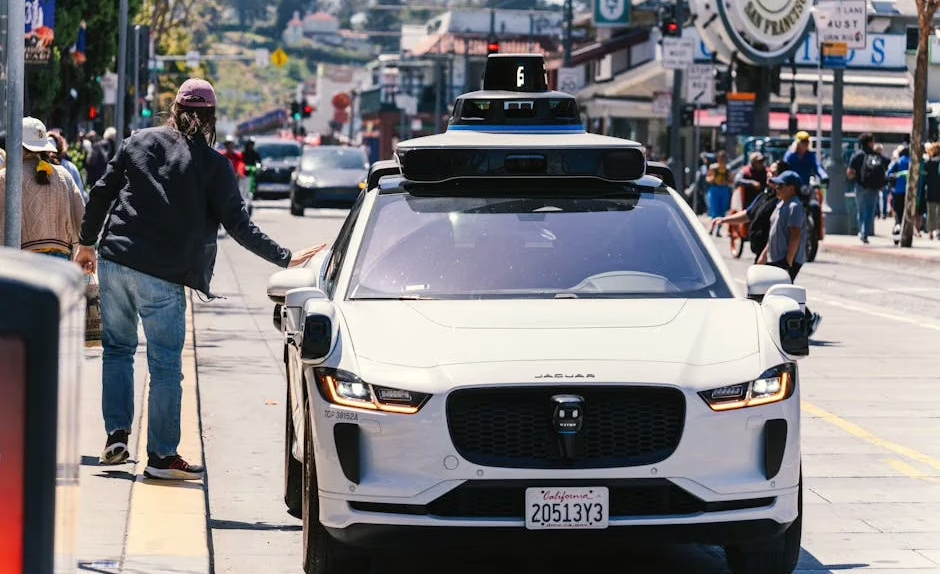
Waymo has taken a different approach, focusing on geographically limited but fully autonomous operations. Their robotaxis operate without human drivers in Phoenix, San Francisco, and Los Angeles, providing a glimpse into the future of urban transportation.
The user experience with Waymo differs significantly from Tesla’s approach. Passengers use a smartphone app to summon a vehicle, similar to Uber or Lyft, but without a human driver. The vehicles feature 360-degree cameras, lidar sensors, and detailed mapping that enables precise navigation.
Waymo’s advantages:
- True hands-free operation in designated areas
- Consistent performance regardless of driver skill
- Professional maintenance and cleaning
- Insurance and liability handled by the service
The limitation is geographic coverage. While Tesla’s system works (with supervision) anywhere, Waymo’s service is restricted to carefully mapped areas where the technology has been extensively tested.
EV Integration and Autonomous Technology
Electric vehicles and autonomous driving technology are naturally complementary. EVs provide the instant torque, precise control, and quiet operation that enhance autonomous driving systems. The absence of engine noise also makes it easier for passengers to communicate with voice assistants and enjoy entertainment during autonomous rides.
Battery-powered vehicles also benefit from the efficiency gains that autonomous systems can provide. Predictive routing, optimized acceleration patterns, and coordinated traffic flow can extend EV range by 15-20% compared to human drivers.
EV-autonomous synergies:
- Regenerative braking integration with autonomous systems
- Thermal management optimization during autonomous operation
- Charging coordination that routes vehicles to available stations
- Grid integration for vehicle-to-grid energy storage
Uber’s $10 Billion Autonomous Investment Strategy
According to TechCrunch, Uber’s massive investment in autonomous vehicle technology represents a strategic shift back toward asset ownership after years of maintaining an asset-light model. The company is taking equity stakes in autonomous vehicle developers while committing to purchase thousands of robotaxis.
This approach allows Uber to maintain its platform model while securing access to autonomous technology from multiple suppliers. Rather than developing the technology in-house, Uber is positioning itself as the distribution network for various autonomous vehicle manufacturers.
Uber’s autonomous partnerships include:
- WeRide for robotaxi technology
- Wayve for AI-driven autonomous systems
- Nuro for autonomous delivery vehicles
- Aurora (former Uber ATG acquisition)
This strategy reduces Uber’s technology development risk while ensuring they have multiple autonomous vehicle options as the technology matures.
What This Means for Everyday Drivers
The autonomous vehicle revolution will unfold gradually, with different technologies becoming available at different times and price points. In the near term, expect more sophisticated ADAS features that handle routine driving tasks while requiring human oversight.
Timeline expectations:
- 2024-2025: Enhanced ADAS features in mainstream vehicles
- 2025-2027: Limited autonomous taxi services in major cities
- 2027-2030: Broader autonomous vehicle availability
- 2030+: Widespread adoption of fully autonomous vehicles
For consumers, the key is understanding which features provide immediate value versus future promises. Today’s ADAS technology already reduces driver fatigue and improves safety, making it worthwhile even before full autonomy arrives.
The transition will also vary by use case. Highway driving will likely become autonomous before urban navigation, and ride-sharing services may adopt the technology before private ownership.
FAQ
Q: Are Tesla’s self-driving features safe for daily use?
A: Tesla’s Autopilot and FSD require constant driver attention and are designed as assistance features, not replacement for human drivers. They work best on highways and well-marked roads but still need human oversight in complex situations.
Q: How much do Waymo robotaxi rides cost compared to Uber?
A: Waymo pricing is generally comparable to premium ride-sharing services, typically 10-20% higher than standard Uber rides but competitive with Uber’s premium options. Costs vary by location and demand.
Q: When will autonomous vehicles be available for purchase?
A: Limited autonomous features are available now in vehicles from Tesla, Mercedes, and others. Fully autonomous vehicles for private purchase are expected to become available in select markets between 2027-2030, with broader availability in the following decade.