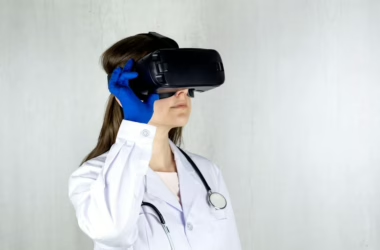

AI adoption in healthcare accelerated dramatically in 2024-2026, with over 1,300 real-world deployments across leading medical organizations and significant advances in FDA-approved diagnostic tools. According to Google Cloud’s comprehensive analysis, healthcare organizations now represent one of the fastest-growing segments for AI implementation, particularly in clinical decision support and diagnostic imaging.
The healthcare AI market has moved beyond experimental pilots into production systems that directly impact patient care. Major hospital systems are deploying AI-powered diagnostic tools, drug discovery platforms, and clinical workflow automation at unprecedented scale.
Clinical AI Tools Gain FDA Momentum
The FDA has significantly expanded its approval pathway for AI-enabled medical devices, with particular emphasis on diagnostic imaging and clinical decision support systems. Mammography AI tools have emerged as a leading application area, addressing longstanding disparities in women’s healthcare.
Forbes reports that AI-powered mammogram analysis systems are helping radiologists detect breast cancer earlier and more accurately. These systems use deep learning algorithms trained on millions of mammogram images to identify suspicious patterns that human radiologists might miss.
“Artificial intelligence is widely heralded as a transformative force in medicine, promising to accelerate drug discovery and enhance clinical research,” according to research published by Michelle R. Kaufman, PhD. The technology shows particular promise in addressing gender-based healthcare disparities, where AI developers are working to correct systematic biases in medical research.
Hospital Infrastructure Transforms for AI Integration
Healthcare organizations are rebuilding their technology infrastructure to support AI-powered clinical workflows. The shift requires significant investment in data integration platforms, computing resources, and staff training.
NIH research indicates that successful AI implementation in healthcare depends on multi-modal data integration spanning genomics, demographic, clinical, and phenotypic information. Hospitals are deploying Internet of Things (IoT) devices, mobile health platforms, and cloud-based analytics to create comprehensive patient data ecosystems.
The infrastructure transformation extends beyond traditional IT systems. Medical centers are implementing AI-augmented healthcare delivery models that fundamentally change how clinicians interact with patient data and make treatment decisions.
Key Infrastructure Components
- Cloud-based AI platforms for scalable model deployment
- Edge computing devices for real-time clinical decision support
- Integrated EHR systems with AI-powered analytics
- Secure data pipelines for multi-institutional research collaboration
Drug Discovery Partnerships Accelerate AI Adoption
Pharmaceutical companies are forming strategic partnerships to leverage AI for drug discovery and development. Regeneron’s collaboration with TriNetX exemplifies how major pharmaceutical companies are expanding their data-driven capabilities through AI partnerships.
These collaborations focus on leveraging real-world evidence from electronic health records to identify drug targets, predict clinical trial outcomes, and accelerate regulatory approval timelines. The partnerships represent a shift from traditional lab-based research toward AI-powered analysis of patient data at scale.
Drug discovery AI applications include:
- Molecular design using generative AI models
- Clinical trial optimization through patient matching algorithms
- Safety monitoring with real-world evidence analysis
- Biomarker discovery from multi-omics datasets
Enterprise AI Platforms Enable Healthcare Scale
Tech giants are positioning their AI platforms specifically for healthcare applications. NVIDIA and Google Cloud’s collaboration demonstrates how enterprise AI infrastructure is being optimized for medical use cases.
The partnership includes new NVIDIA Vera Rubin-powered instances on Google Cloud, specifically designed for healthcare AI workloads. These platforms support everything from diagnostic imaging analysis to drug discovery simulations that previously required weeks but now complete in hours.
Google’s Gemini Enterprise Agent Platform, combined with NVIDIA’s AI infrastructure, enables healthcare organizations to deploy agentic AI systems that can manage complex clinical workflows autonomously. These systems represent a significant evolution from simple diagnostic tools toward comprehensive AI assistants for healthcare professionals.
Platform Capabilities
- Confidential computing for sensitive health data
- Multi-modal AI supporting text, image, and genomic data
- Agentic workflows for automated clinical processes
- Distributed deployment across hospital networks
Regulatory Framework Evolves for AI Medicine
The FDA has adapted its regulatory framework to accommodate the rapid pace of AI development in healthcare. New approval pathways allow for continuous learning algorithms that improve performance over time, rather than static software that requires complete revalidation for updates.
This regulatory evolution enables healthcare AI companies to deploy systems that learn from real-world usage while maintaining safety standards. The approach balances innovation speed with patient protection, allowing beneficial AI tools to reach clinical practice faster.
Regulatory developments include:
- Software as Medical Device (SaMD) guidelines for AI tools
- Predetermined change protocols for algorithm updates
- Real-world performance monitoring requirements
- Bias assessment standards for AI diagnostic tools
What This Means
The healthcare AI transformation represents a fundamental shift in how medical care is delivered, moving from reactive treatment toward predictive, personalized medicine. The convergence of FDA regulatory clarity, enterprise AI infrastructure, and real-world deployment experience has created conditions for sustained growth in medical AI applications.
For healthcare organizations, the challenge now shifts from proving AI’s potential to scaling successful implementations across entire health systems. The organizations leading this transformation are those investing in comprehensive data infrastructure and clinical workflow integration, rather than deploying AI tools in isolation.
The next phase will likely focus on interoperability standards that allow AI systems from different vendors to work together seamlessly, creating integrated clinical decision support ecosystems that span the entire patient care journey.
FAQ
How many FDA-approved AI medical devices are currently available?
The FDA has approved over 500 AI-enabled medical devices as of 2024, with the majority focused on diagnostic imaging applications like radiology, pathology, and ophthalmology. The approval rate has accelerated significantly since 2022.
What types of hospitals are successfully implementing AI systems?
Large academic medical centers and integrated health systems are leading AI adoption, primarily because they have the data infrastructure and technical resources required for implementation. Community hospitals are increasingly adopting cloud-based AI solutions that require less local technical expertise.
How do healthcare AI systems protect patient privacy?
Healthcare AI platforms use techniques like federated learning, differential privacy, and confidential computing to analyze patient data without exposing individual records. Many systems are designed to learn from aggregated patterns while keeping personal health information encrypted and locally stored.