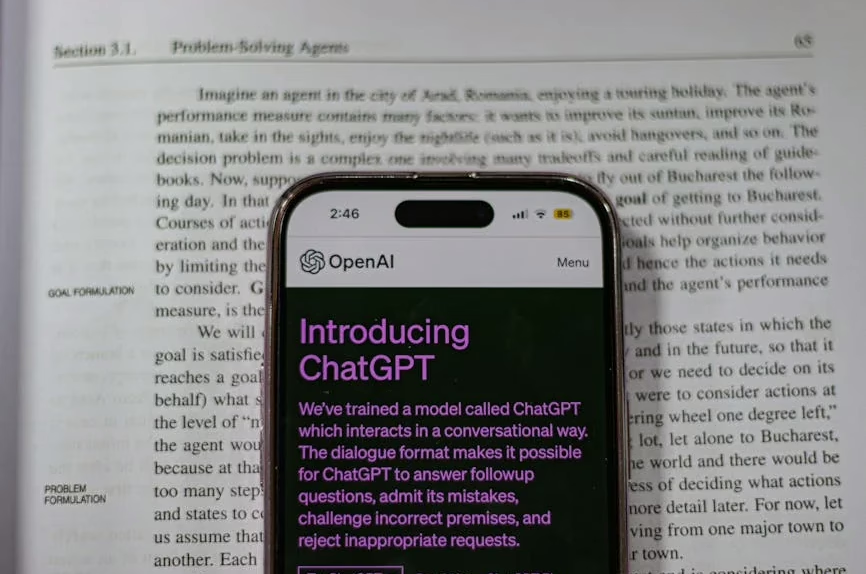

OpenAI on Tuesday launched ChatGPT Images 2.0, a new image generation model that can produce multiple images from single prompts and accurately render text in multiple languages including Chinese and Hindi. The model marks a significant advancement over previous AI image generators, which historically struggled with text rendering and produced garbled words like “burrto” instead of “burrito” on restaurant menus.
Major Technical Breakthrough in Text Rendering
The new model represents a dramatic improvement in text generation quality within images. According to TechCrunch, when prompted to create a Mexican restaurant menu, Images 2.0 produced text that “could immediately be used in a restaurant without customers noticing that something’s off.” This contrasts sharply with DALL-E 3’s output from two years ago, which generated nonsensical menu items like “enchuita,” “churiros,” and “margartas.”
Traditional diffusion models struggled with text because they reconstruct images from noise, making text—which represents a small portion of image pixels—difficult to learn accurately. “The diffusion models are reconstructing a given input,” Asmelash Teka Hadgu, founder and CEO of Lesan AI, told TechCrunch in 2024. “We can assume writings on an image are a very, very tiny part, so the image generator learns the patterns that cover more of these pixels.”
OpenAI declined to specify the underlying architecture powering Images 2.0, but researchers have explored autoregressive models as alternatives to diffusion, which function more like large language models and make predictions about image composition.
Enhanced Capabilities and Global Availability
Images 2.0 integrates with ChatGPT’s reasoning capabilities, allowing it to search the internet for recent information and generate multiple related images simultaneously. Wired reported that the model can create comprehensive outputs like “an entire study booklet” from a single prompt.
The model features a knowledge cutoff of December 2025, enabling more current and accurate information in generated images. In testing, Wired found that Images 2.0 could generate detailed San Francisco weather infographics with accurate meteorological data and recognizable landmarks including the Ferry Building, Castro Theater, Painted Ladies houses, and Transamerica Pyramid.
Customization options have expanded significantly. Users can now generate images in aspect ratios ranging from 3:1 wide to 1:3 tall, with size adjustments specified directly in prompts. The model is available globally for ChatGPT and Codex users, with enhanced features for paying subscribers.
Industry Context and Competition
The launch occurs amid significant developments across the AI image generation landscape. TechCrunch reported that ComfyUI, a node-based workflow tool for controlling diffusion models, raised $30 million at a $500 million valuation. The startup addresses limitations in prompt-based solutions like Midjourney and DALL-E, where small changes can produce completely different outputs.
“If you think about your typical prompt-based solution, like Midjourney or ChatGPT, you ask for something, it [gets only] 60% – 80% there,” Yoland Yan, ComfyUI’s co-founder and CEO, told TechCrunch. “But to change that remaining 20%, you have to try this slot machine.”
Meanwhile, researchers continue addressing bias issues in text-to-image models. A recent arXiv study found that prompts like “doctor” or “CEO” frequently yield lighter-skinned outputs in models like Stable Diffusion and DALL-E, while lower-status roles show more diversity. The researchers proposed a lightweight framework for mitigating representational bias through prompt-level interventions without model retraining.
Enterprise Adoption Accelerates
Generative AI adoption in enterprise settings has reached unprecedented scale. Google’s blog documented 1,302 real-world use cases across leading organizations, representing what the company calls “the fastest technological transformation we’ve seen.” The majority showcase agentic AI applications built with tools like Gemini Enterprise and Security Command Center.
Production AI and agentic systems are now deployed across virtually every organization, with Google reporting that thousands of companies are implementing meaningful AI workflows. The transformation spans industries from healthcare and finance to manufacturing and creative services.
What This Means
Images 2.0’s text rendering breakthrough addresses one of the most persistent limitations in AI image generation. The ability to produce restaurant menus, infographics, and multilingual content with professional quality opens new commercial applications across marketing, education, and content creation.
The integration with ChatGPT’s reasoning capabilities suggests a convergence between text and image AI that could reshape creative workflows. However, the competitive landscape remains fragmented, with specialized tools like ComfyUI gaining traction among professionals who need granular control over generation processes.
Bias mitigation remains an ongoing challenge as these tools reach broader audiences. The research community’s focus on inference-time solutions rather than model retraining indicates recognition that fairness interventions must be accessible to end users, not just AI developers.
FAQ
How does ChatGPT Images 2.0 compare to Midjourney and Stable Diffusion?
Images 2.0 excels at text rendering within images and can generate multiple related images from single prompts. Midjourney and Stable Diffusion focus more on artistic style and quality, while ComfyUI offers granular workflow control that these prompt-based systems lack.
Can Images 2.0 generate text in languages other than English?
Yes, the model supports text generation in multiple languages including Chinese and Hindi. This represents a significant advancement over previous models that primarily worked with English text.
Is Images 2.0 available for free users?
The model is available globally for ChatGPT and Codex users, with enhanced features reserved for paying subscribers. OpenAI has not specified which capabilities require paid subscriptions.