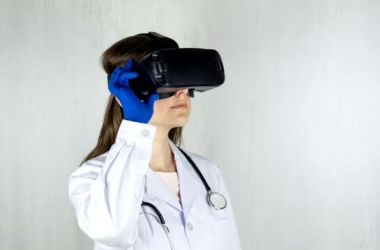

The FDA has cleared Clarity Health’s AI-powered breast cancer screening tool for clinical use, marking another milestone in healthcare AI adoption as hospitals and pharmaceutical companies accelerate AI deployments across diagnosis, drug discovery, and patient care. According to Forbes, the National Cancer Institute has validated the tool’s clinical credibility for analyzing completed mammograms and assessing future cancer risk.
The approval comes as healthcare organizations face mounting pressure to improve screening rates — CDC data shows 23% of eligible women skip recommended mammograms, while traditional mammography still misses one in eight breast cancers. Clarity Health’s AI system addresses these gaps by enhancing existing screening without adding radiation exposure or requiring additional procedures.
AI Radiology Tools Transform Women’s Healthcare
AI applications in radiology are particularly impactful for women’s healthcare, where systematic research bias has historically limited treatment advances. According to research published by Michelle R. Kaufman, AI developers must work to “rectify a long-standing inequity in medical research: the systemic bias against women.”
The Clarity Health system exemplifies this progress by providing risk assessment capabilities that complement traditional mammography. The tool analyzes completed mammogram images using machine learning algorithms trained on diverse patient populations, helping clinicians identify high-risk patients who may benefit from additional screening or preventive interventions.
Mammography remains underutilized despite being the gold standard — a recent MedStar survey found 59% of eligible women skip annual mammograms. The American College of Physicians recently recommended delaying routine mammograms until age 50 and screening every other year, a change the American College of Radiology warned “may contribute to thousands of additional breast cancer deaths each year.”
Drug Discovery Partnerships Accelerate AI Integration
Pharmaceutical companies are expanding AI partnerships to accelerate drug discovery timelines and improve clinical trial outcomes. Regeneron announced a partnership with TriNetX to expand data-driven drug discovery and digital health capabilities, leveraging TriNetX’s real-world evidence platform.
The partnership enables Regeneron to access anonymized patient data from healthcare networks, accelerating identification of potential drug targets and patient populations for clinical trials. TriNetX’s platform aggregates data from over 400 million patients across global healthcare organizations, providing pharmaceutical companies with insights into treatment patterns and patient outcomes.
AI-powered drug discovery platforms are reducing development timelines from 10-15 years to potentially 3-5 years for certain therapeutic areas. Companies like Insilico Medicine are using machine learning to identify novel drug compounds and predict their efficacy before entering costly clinical trials.
Clinical Trial Optimization
AI tools are streamlining clinical trial design and patient recruitment. Machine learning algorithms analyze patient records to identify eligible participants, reducing recruitment timelines from months to weeks. The technology also helps predict trial outcomes and optimize dosing protocols based on patient characteristics.
Pharmaceutical companies report 30-40% improvements in clinical trial efficiency when using AI-powered patient matching and protocol optimization tools. These improvements translate to faster drug approvals and reduced development costs.
Hospital AI Deployments Scale Across Specialties
Hospital systems are deploying AI tools across multiple specialties, from emergency medicine to surgical planning. According to NIH research, “The increasing availability of multi-modal data (genomics, economic, demographic, clinical and phenotypic) coupled with technology innovations in mobile, internet of things (IoT), computing power and data security herald a moment of convergence between healthcare and technology.”
Healthcare organizations are implementing AI-augmented systems that analyze genomic data, wearable device outputs, and electronic health records to provide personalized treatment recommendations. These platforms require robust infrastructure to handle multi-modal data processing and ensure patient privacy compliance.
Major hospital networks report deploying AI tools for:
- Diagnostic imaging: Automated detection of abnormalities in CT scans, MRIs, and X-rays
- Predictive analytics: Early warning systems for sepsis, cardiac events, and patient deterioration
- Workflow optimization: Staffing predictions, bed management, and surgical scheduling
- Clinical decision support: Drug interaction warnings and treatment protocol recommendations
Implementation Challenges
Hospital AI deployments face significant infrastructure and training challenges. Healthcare IT systems must integrate with existing electronic health records while maintaining HIPAA compliance and data security standards. Staff training programs are essential for successful adoption, as Biocon CEO Shreehas Tambe warned of potential errors if AI health technology platforms are used by someone “still getting a hang of it.”
Interoperability remains a major barrier, with many hospitals operating legacy systems that require expensive upgrades to support AI integration. Healthcare organizations are investing heavily in cloud infrastructure and data standardization to enable AI deployment across departments.
Consumer Health AI Tools Enter Market
Tech giants are launching consumer-facing AI health tools, with OpenAI and Amazon introducing platforms in January 2026 for basic health questions and symptom assessment. According to Alex Zhavoronkov, CEO of Insilico Medicine, AI can help consumers with “basic health questions to save time spent with real-life doctors.”
These consumer tools aim to triage non-emergency health concerns and provide preliminary guidance before patients seek professional medical care. The platforms use large language models trained on medical literature and clinical guidelines to answer health-related questions and recommend appropriate care levels.
Regulatory oversight for consumer health AI remains limited compared to clinical tools requiring FDA approval. The distinction between informational health content and medical advice creates compliance challenges for technology companies entering healthcare markets.
What This Means
The healthcare AI market is experiencing rapid expansion across three key areas: clinical diagnosis tools receiving FDA approval, pharmaceutical AI partnerships accelerating drug discovery, and hospital-wide AI deployments improving patient care efficiency. The Clarity Health FDA clearance demonstrates regulatory pathways for AI diagnostic tools, potentially encouraging more companies to pursue clinical validation.
However, implementation challenges around infrastructure, training, and interoperability suggest healthcare AI adoption will be gradual rather than revolutionary. Success depends on healthcare organizations’ ability to integrate AI tools with existing workflows while maintaining patient safety and data security standards.
The emergence of consumer health AI tools from major tech companies signals broader market expansion beyond clinical settings. This trend may democratize basic health information access while raising questions about regulatory oversight and the appropriate boundaries between AI guidance and professional medical care.
FAQ
What types of AI tools has the FDA approved for healthcare use?
The FDA has cleared various AI tools including diagnostic imaging systems, clinical decision support software, and risk assessment platforms like Clarity Health’s breast cancer screening tool. Each tool requires clinical validation and demonstrates specific medical benefits before receiving approval.
How are hospitals implementing AI across different departments?
Hospitals deploy AI for diagnostic imaging analysis, predictive analytics for patient deterioration, workflow optimization for staffing and scheduling, and clinical decision support for treatment recommendations. Implementation requires significant infrastructure upgrades and staff training programs.
What role does AI play in pharmaceutical drug discovery?
AI accelerates drug discovery by analyzing patient data to identify drug targets, predicting compound efficacy, optimizing clinical trial design, and improving patient recruitment. Companies report 30-40% efficiency improvements in clinical trials when using AI-powered tools.