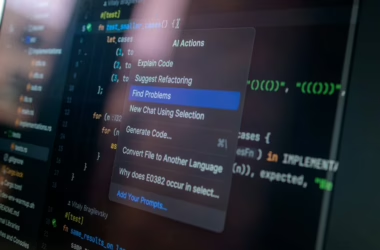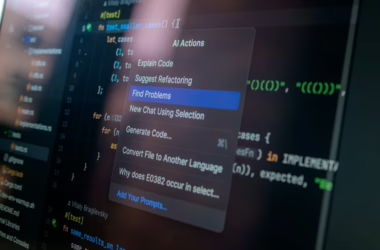

Google CEO Sundar Pichai revealed that AI now generates 75% of the code at Google, marking a significant milestone in the company’s internal AI adoption as it simultaneously launched two new autonomous research agents designed to compete with enterprise AI workflows. The disclosure came as Google unveiled Deep Research and Deep Research Max agents on Monday, which can search both web data and private enterprise information through a single API call.
According to Pichai’s announcement on X, the new agents represent “the most significant upgrade to autonomous research agent capabilities since the product’s debut.” The agents are built on Google’s Gemini 3.1 Pro model and include native chart generation, infographics creation, and support for the Model Context Protocol (MCP) to connect third-party data sources.
Internal AI Adoption Reaches 75% Code Generation
The 75% figure represents a dramatic acceleration in Google’s internal use of AI for software development. This level of AI-generated code adoption positions Google as one of the most AI-integrated technology companies globally, with implications for both productivity gains and competitive advantage in AI development cycles.
The statistic suggests Google’s engineering teams are using AI tools for the majority of their coding tasks, from routine functions to more complex development work. This internal adoption rate provides Google with real-world data on AI coding capabilities that likely informs improvements to its external AI products and services.
While Pichai did not specify which AI systems generate this code or provide a timeline for reaching this percentage, the figure aligns with Google’s broader push to integrate AI across all business operations. The company has been positioning itself as an “AI-first” organization since 2016.
Deep Research Agents Target Enterprise Workflows
Google’s new Deep Research and Deep Research Max agents represent a direct challenge to enterprise research workflows in finance, life sciences, and market intelligence sectors. The agents can autonomously conduct multi-source research that traditionally required hours or days of human analyst time.
According to Google’s blog announcement, the agents can fuse open web data with proprietary enterprise information through the Gemini API. This capability allows organizations to combine public research with internal data sources for comprehensive analysis.
The Model Context Protocol integration enables connections to arbitrary third-party data sources, expanding the agents’ research capabilities beyond Google’s ecosystem. Native chart and infographics generation within research reports eliminates the need for separate visualization tools.
API-Only Availability Limits Consumer Access
The new research agents are currently available only through Google’s API, not in the consumer Gemini app. This restriction has drawn criticism from users who expected broader access to the enhanced research capabilities.
User feedback on X highlighted frustration with the API-only release, with some describing it as “punishing Gemini App Pro subscribers.” Google has not announced plans to integrate the research agents into consumer-facing products.
DeepMind Spinoff Advances AI Drug Discovery
Separately, Isomorphic Labs, Google DeepMind’s biotech spinoff, announced it will soon begin human trials of drugs designed using Nobel Prize-winning AlphaFold AI technology. Company president Max Jaderberg confirmed the clinical trial timeline at WIRED Health in London, though specific dates were not provided.
According to Wired’s coverage, this represents a delayed timeline from CEO Demis Hassabis’s previous commitment to have AI-designed drugs in clinical trials by the end of 2025. The trials will test whether AlphaFold’s protein structure predictions can translate into safe and effective therapeutic compounds.
Isomorphic Labs, founded in 2021, uses DeepMind’s AlphaFold platform for drug discovery. AlphaFold 3, released in 2024, advanced beyond modeling proteins in isolation to predicting DNA, RNA, and other molecular interactions crucial for drug development.
Government AI Partnerships Under Discussion
Google DeepMind has engaged in talks with UK government officials about potential AI projects, according to Financial Times reporting. Morgan McSweeney, a senior government advisor, held discussions with DeepMind representatives, though specific project details remain undisclosed.
These conversations reflect growing government interest in leveraging AI capabilities for public sector applications. The UK government has been actively courting AI companies to establish partnerships that could enhance public services while maintaining data security and privacy standards.
What This Means
Google’s 75% AI code generation rate signals a fundamental shift in software development practices at scale. This level of AI integration provides Google with competitive advantages in development speed and potentially code quality, while generating valuable training data for improving AI coding capabilities.
The enterprise focus of Deep Research agents indicates Google’s strategy to capture high-value business customers who require sophisticated research capabilities. By combining web and proprietary data sources, Google positions itself against competitors like Anthropic’s Claude and OpenAI’s research tools.
The progression from AlphaFold’s protein predictions to human drug trials represents a critical test of AI’s potential in life sciences. Success could validate AI-driven drug discovery and accelerate pharmaceutical development timelines industry-wide.
FAQ
How does Google’s 75% AI code generation compare to industry standards?
Google’s 75% figure significantly exceeds publicly reported AI coding adoption rates at most technology companies. While many firms use AI coding assistants, few have disclosed such high percentages of AI-generated code in production systems.
When will Deep Research agents be available in consumer Gemini apps?
Google has not announced plans to integrate Deep Research capabilities into consumer Gemini applications. The agents currently remain API-only products targeting enterprise and developer customers.
What makes AlphaFold-designed drugs different from traditional drug discovery?
AlphaFold uses AI to predict protein structures and molecular interactions, potentially identifying drug candidates faster than traditional laboratory methods. The upcoming human trials will test whether these AI predictions translate into safe and effective treatments.
Related news
- Google DeepMind hires Cambridge academic for new ‘Philosopher’ role – varsity.co.uk – Google News – AGI
- $40 Billion from Google. $25 Billion from Amazon. Anthropic is now the most fought-over AI company on Earth – Mint – Google News – Google
- Google Cloud Next 2026 Bets The Agentic Enterprise On Specialized Silicon – Forbes Tech
Sources
- Google CEO Sundar Pichai says AI generates 75% codes at the company: Why this number matters – The Times of India – Google News – Google
- Google’s new Deep Research and Deep Research Max agents can search the web and your private data – VentureBeat
- Google CEO Sundar Pichai says 75% of the company’s code is AI-generated – Fast Company – Google News – Google
- AI-Designed Drugs by a DeepMind Spinoff Are Headed to Human Trials – Wired
- Morgan McSweeney held talks with Google DeepMind over AI project – Financial Times Tech