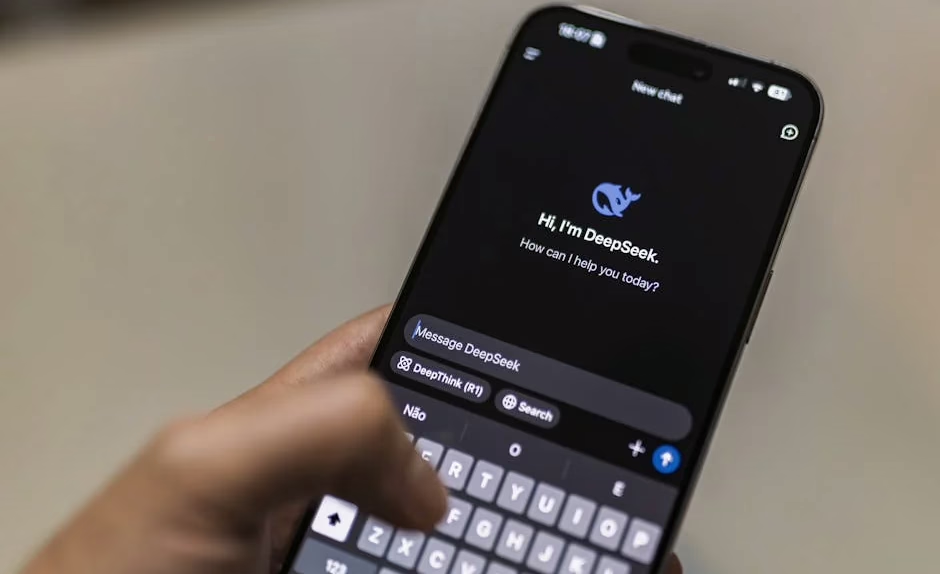

DeepSeek released its V4 model on Monday, delivering near state-of-the-art performance at one-sixth the cost of proprietary alternatives like GPT-5.5 and Opus 4.7. The 1.6-trillion-parameter model arrives under an MIT license alongside Xiaomi’s MiMo-V2.5 series, marking what industry observers call the “second DeepSeek moment” in open source AI.
According to DeepSeek’s announcement, the V4 model matches or exceeds closed-source systems while offering API access at dramatically reduced costs. Hugging Face now hosts the complete model weights for commercial use.
DeepSeek-V4 Delivers Frontier Performance at Fraction of Cost
The V4 release represents 484 days of development since DeepSeek’s V3 launch, with researcher Deli Chen describing it as a “labor of love” in a social media post. The Mixture-of-Experts architecture achieves performance levels previously exclusive to proprietary models while maintaining open source accessibility.
VentureBeat reported that DeepSeek-V4 surpasses some benchmarks set by the world’s most advanced closed-source systems. The model’s API pricing structure makes it accessible to enterprises and individual developers who previously couldn’t afford frontier AI capabilities.
DeepSeek’s approach builds on the company’s January 2025 breakthrough with its R1 model, which initially established the startup as a major force in open source AI development.
Xiaomi MiMo-V2.5 Excels at Agentic Task Automation
Xiaomi simultaneously launched its MiMo-V2.5 and MiMo-V2.5-Pro models, both optimized for agentic “claw” tasks that power automated systems like OpenClaw and NanoClaw. According to VentureBeat, these models rank among the most token-efficient options for enterprise automation.
The Pro version achieves 63.8% performance on Xiaomi’s ClawEval benchmark while maintaining low token consumption. This efficiency translates to cost savings for enterprises using usage-based billing models, particularly as services like Microsoft’s GitHub Copilot shift toward token-based pricing.
Both MiMo models are available through Hugging Face under MIT licensing, enabling commercial deployment without licensing restrictions. The models support tasks including marketing content generation, account management, email organization, and scheduling automation.
OpenAI Contributes Privacy-Focused Open Source Tools
OpenAI released Privacy Filter, a 1.5-billion-parameter model designed to detect and redact personally identifiable information before data reaches cloud servers. The tool, available on Hugging Face under Apache 2.0 licensing, addresses enterprise concerns about data privacy in AI workflows.
The company also open-sourced Symphony, an orchestration framework that converts project management boards into control planes for coding agents. OpenAI’s blog post details how Symphony increased pull request velocity by 500% on some internal teams.
These releases continue OpenAI’s renewed commitment to open source development, following last year’s launch of the gpt-oss model family after years of focusing primarily on proprietary offerings.
Enterprise Adoption Accelerates Across Industries
Google’s latest data reveals 1,302 real-world generative AI implementations across leading organizations, demonstrating widespread enterprise adoption of both proprietary and open source models. Google’s blog post highlights deployments using tools like Gemini Enterprise and AI Hypercomputer infrastructure.
The proliferation of open source alternatives like DeepSeek-V4 and Xiaomi’s MiMo series provides enterprises with cost-effective options for implementing AI capabilities without vendor lock-in. Organizations can now deploy frontier-class models locally or on private clouds while maintaining full control over their data and infrastructure.
This trend toward “Sovereign AI” allows companies and governments to develop AI capabilities independent of major cloud providers, reducing dependency on external services for critical applications.
Technical Architecture and Implementation Details
DeepSeek-V4 employs a Mixture-of-Experts design that activates specific model components based on input requirements, optimizing computational efficiency. The architecture supports context lengths up to 1 million tokens while maintaining inference speed competitive with smaller models.
Xiaomi’s MiMo models utilize specialized training for agentic workflows, with particular optimization for multi-step task completion and tool usage. The models integrate with existing agent frameworks through standard APIs, enabling drop-in replacement of proprietary alternatives.
OpenAI’s Privacy Filter uses bidirectional token classification, reading text from both directions to identify PII with higher accuracy than traditional approaches. The model runs efficiently on standard laptops or in web browsers, eliminating the need for cloud-based processing of sensitive data.
What This Means
The convergence of high-performance open source models from DeepSeek, Xiaomi, and OpenAI signals a fundamental shift in AI accessibility. Enterprises no longer need to choose between cutting-edge performance and cost control — they can achieve both through open source alternatives.
This democratization of frontier AI capabilities will likely accelerate innovation across industries while reducing barriers to entry for smaller organizations. The availability of specialized models for privacy protection and agentic tasks addresses specific enterprise needs that general-purpose models couldn’t efficiently handle.
The competitive pressure from open source releases may force proprietary model providers to reduce pricing or increase performance to maintain market position, ultimately benefiting all users of AI technology.
FAQ
How do DeepSeek-V4’s costs compare to proprietary models?
DeepSeek-V4 offers API access at approximately one-sixth the cost of GPT-5.5 and Opus 4.7 while delivering comparable performance. The model is also available for free download and local deployment under MIT licensing.
Can enterprises use these open source models commercially?
Yes, all mentioned models (DeepSeek-V4, Xiaomi MiMo-V2.5, OpenAI Privacy Filter) are released under permissive licenses (MIT or Apache 2.0) that allow commercial use, modification, and redistribution without restrictions.
What makes Xiaomi’s MiMo models particularly suitable for automation tasks?
The MiMo series is specifically optimized for agentic “claw” tasks with high token efficiency. The Pro version achieves 63.8% performance on automation benchmarks while using fewer tokens than competing models, reducing operational costs for automated workflows.
Related news
- Elon Musk and Sam Altman are going to court over OpenAI’s future – MIT Technology Review
- Elon Musk and Sam Altman’s court battle over the future of OpenAI – The Verge