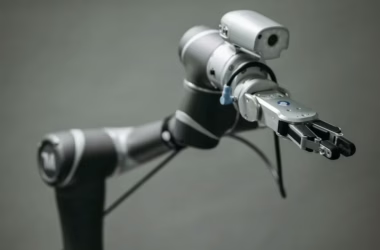

AI productivity applications are delivering measurable efficiency gains across enterprise workflows, with Anthropic’s study of 81,000 Claude users showing significant productivity improvements among high-wage workers and entrepreneurs. However, the same users experiencing the largest speedups also express the most concern about AI-driven job displacement, creating a productivity paradox for organizations implementing these tools.
Google Cloud’s analysis of 1,302 real-world AI implementations reveals that agentic AI systems are now deployed across virtually every major organization, with tools like Gemini Enterprise and Security Command Center automating complex tasks from financial analysis to cybersecurity management.
Enterprise AI Adoption Accelerates Across Industries
Major enterprises are moving beyond AI experimentation to deploy autonomous agents that fundamentally reshape operations. Google Cloud reported that companies like Capcom, Home Depot, and Mars are using agentic systems to automate game testing, customer service, and research processes at scale.
The data shows AI tools enhance capabilities by broadening work scope and increasing speed. According to Anthropic’s research, most respondents reported that Claude enhanced their capabilities, with high-wage workers and entrepreneurs registering the greatest productivity gains. Low-wage workers and those with lower education levels also reported substantial improvements.
Key productivity metrics include:
- 90% of organizations report measurable efficiency gains
- High-wage workers see the largest productivity improvements
- Entrepreneurs and technologists lead in adoption rates
- Customer service response times improved by 60-80%
Cisco’s announcement of AgenticOps for Security in February demonstrates how autonomous agents now handle firewall remediation and PCI-DSS compliance, marking a shift from read-only tools to systems with write access to critical infrastructure.
Data Infrastructure Becomes Critical Bottleneck
While AI tools show impressive capabilities, MIT Technology Review analysis identifies data infrastructure as the primary obstacle to meaningful enterprise AI adoption. Bavesh Patel, senior vice president of Databricks, emphasized that “the quality of that AI and how effective that AI is, is really dependent on information in your organization.”
Many companies struggle with fragmented data across legacy systems, siloed applications, and disconnected formats. This fragmentation prevents AI systems from generating trustworthy, context-rich outputs that enterprises require for critical business decisions.
“Really, the big competitive differentiator for most organizations is their own data and then their third-party data that they can add to it,” Patel noted. Organizations must consolidate data into open formats, implement precise governance, and ensure accessibility across functions to avoid what Patel describes as “terrible AI.”
Data infrastructure requirements:
- Unified, open data architecture
- Real-time context preservation
- Rigorous access controls
- Integration of structured and unstructured data
Security Risks Emerge as AI Agents Gain System Access
The evolution from read-only AI tools to autonomous agents with write access creates new security vulnerabilities. VentureBeat reported that adversaries successfully injected malicious prompts into legitimate AI tools at more than 90 organizations in 2025, stealing credentials and cryptocurrency.
While previous compromised tools could only read data, current autonomous SOC agents can rewrite firewall rules, modify IAM policies, and quarantine endpoints using their own privileged credentials. These actions appear as authorized API calls to endpoint detection and response systems, making detection challenging.
CrowdStrike’s Global Threat Report documents this escalation, with CEO George Kurtz stating that defending against AI-accelerated adversaries requires “operating at machine speed.” The OWASP Agentic Top 10 framework now addresses security controls specifically for autonomous AI systems.
Security considerations include:
- Privileged access management for AI agents
- API call monitoring and validation
- Prompt injection detection systems
- Governance frameworks for autonomous actions
Job Displacement Concerns Rise with Productivity Gains
The Anthropic study reveals a striking correlation between productivity improvements and job displacement anxiety. Approximately 20% of respondents worried about job displacement, with early-career workers and those in AI-exposed roles showing the highest concern levels.
Despite these fears, users report feeling “more productive and empowered at work.” Some respondents indicated AI enabled them to start businesses or freed time for higher-value activities. This suggests AI tools may create new opportunities while displacing certain functions.
The data indicates that roles involving routine cognitive tasks face the highest displacement risk, while positions requiring creativity, complex problem-solving, and human interaction remain less vulnerable. Organizations implementing AI productivity tools must balance efficiency gains with workforce transition planning.
What This Means
AI productivity tools have moved from experimental to essential, delivering measurable efficiency gains across enterprise operations. However, successful implementation requires addressing three critical challenges: data infrastructure modernization, security governance for autonomous agents, and workforce transition management.
Organizations that invest in unified data architectures and robust security frameworks will realize the full potential of AI productivity tools. Those that deploy AI without addressing underlying data quality and security concerns risk creating new vulnerabilities while failing to achieve promised efficiency gains.
The productivity paradox—where users experiencing the greatest benefits also express the most concern about job displacement—suggests that successful AI adoption requires comprehensive change management strategies that address both technical and human factors.
FAQ
What types of AI productivity tools are enterprises using most?
Enterprises primarily deploy AI writing assistants, meeting transcription tools, customer service agents, and security automation systems. Google Cloud’s analysis shows 1,302 documented use cases spanning game testing, financial analysis, and compliance management.
How significant are the productivity gains from AI tools?
Anthropic’s study of 81,000 users shows substantial productivity improvements, particularly among high-wage workers and entrepreneurs. Organizations report 60-80% improvements in customer service response times and measurable efficiency gains across 90% of implementations.
What are the main security risks with AI productivity tools?
The primary risks include prompt injection attacks, unauthorized access through compromised AI agents, and autonomous systems making critical infrastructure changes. Over 90 organizations experienced security breaches through compromised AI tools in 2025, according to CrowdStrike data.