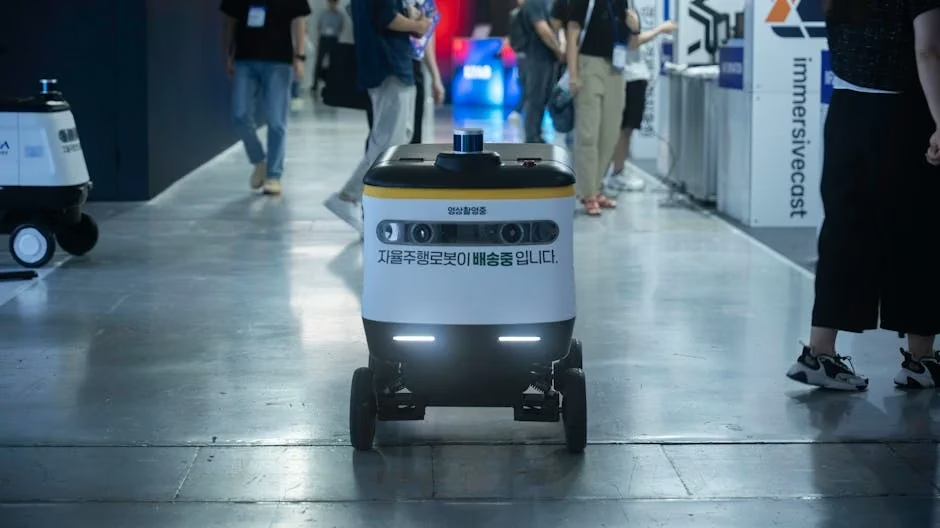

AI agent systems are rapidly evolving from experimental prototypes to enterprise-grade autonomous platforms, with the global AI agents market projected to reach $200 billion by 2030. Major technology companies including Google DeepMind, OpenAI, and Anthropic are making significant strategic investments in agentic workflows, signaling a fundamental shift toward autonomous task execution that could reshape entire industries.
The convergence of advanced language models, tool integration capabilities, and sophisticated workflow automation is creating unprecedented opportunities for businesses to deploy AI agents that can operate independently across complex multi-step processes. This technological evolution represents more than incremental improvement—it’s positioning autonomous agents as the next major revenue driver in the AI ecosystem.
Enterprise Adoption Accelerates Revenue Opportunities
The enterprise market for AI agent systems is experiencing explosive growth, driven by organizations seeking to automate complex workflows that traditionally required human oversight. McKinsey estimates that autonomous AI agents could generate $2.6 trillion in annual economic value across industries by 2030, with the largest opportunities in customer service, software development, and business process automation.
Key market drivers include:
- Reduced operational costs: Companies report 40-60% cost savings in automated workflows
- 24/7 availability: Agents operate continuously without human intervention
- Scalability: Single agent systems can handle thousands of simultaneous tasks
- Integration capabilities: Modern agents connect with existing enterprise software ecosystems
Venture capital funding for AI agent startups has surged 340% year-over-year, with notable investments including $100 million in Series A funding for agent platform companies. This funding surge indicates strong investor confidence in the commercial viability of autonomous agent technologies.
Google DeepMind’s Strategic Philosophy Investment
Google DeepMind’s recent hiring of a philosopher to work on machine consciousness represents a calculated strategic move that extends beyond academic curiosity. This investment signals the company’s recognition that autonomous agents approaching human-level reasoning capabilities require ethical frameworks that could become competitive differentiators in enterprise markets.
The business implications are significant:
- Regulatory compliance: Philosophical frameworks help navigate emerging AI governance requirements
- Enterprise trust: Companies deploying conscious-level agents need ethical assurance for stakeholders
- Competitive positioning: Google is establishing thought leadership in responsible AI development
- Risk mitigation: Proactive ethical development reduces potential liability exposure
This strategic approach follows Google’s broader pattern of investing in long-term AI safety research while maintaining commercial competitiveness. The company’s AI division generated $31.4 billion in revenue in 2023, positioning it to make substantial R&D investments that smaller competitors cannot match.
Autonomous Tool Integration Drives Market Differentiation
The ability of AI agents to autonomously select and utilize external tools represents a critical competitive advantage in the evolving market. Companies developing sophisticated tool integration capabilities are commanding premium valuations and attracting enterprise customers willing to pay higher subscription fees for enhanced functionality.
Leading tool integration capabilities include:
- API orchestration: Agents automatically connect with third-party services
- Database management: Autonomous data retrieval and analysis across multiple sources
- Code execution: Real-time programming and debugging capabilities
- Multi-modal processing: Integration of text, image, and audio processing tools
Startups focusing on tool-enabled agents have raised over $2.8 billion in funding this year, with average Series A valuations reaching $150 million. This represents a 250% increase from comparable companies in 2022, demonstrating strong market demand for autonomous tool utilization capabilities.
The revenue model for tool-integrated agents typically follows a usage-based pricing structure, with companies charging $0.10-$2.00 per task execution depending on complexity. Enterprise customers report ROI improvements of 200-400% when deploying tool-enabled agents for routine business processes.
Workflow Automation Creates New Business Models
Agentic workflows are enabling entirely new business models that monetize autonomous task execution across industries. Companies are moving beyond traditional software licensing toward outcome-based pricing models where customers pay for completed workflows rather than software access.
Emerging revenue streams include:
Workflow-as-a-Service (WaaS)
Companies like Zapier and Microsoft Power Automate are expanding into autonomous agent territory, offering pre-built workflow templates that operate without human intervention. Microsoft reported $3.2 billion in Power Platform revenue for 2023, with autonomous workflows representing the fastest-growing segment.
Task Completion Marketplaces
New platforms are emerging where businesses can purchase completed tasks from AI agents, creating marketplace dynamics similar to freelance platforms but with autonomous execution. Early platforms report transaction volumes exceeding $50 million annually.
Industry-Specific Agent Solutions
Vertical-focused companies are developing specialized agents for healthcare, finance, and manufacturing, commanding premium pricing due to industry expertise and compliance capabilities.
The shift toward outcome-based pricing models is particularly attractive to enterprise customers who prefer predictable costs tied to business results rather than usage metrics.
Cybersecurity Concerns Shape Investment Strategies
Anthropic’s decision to withhold its ‘Mythos’ AI system due to cybersecurity concerns highlights the complex relationship between autonomous agent capabilities and market deployment strategies. This cautious approach, while potentially limiting short-term revenue opportunities, may prove strategically advantageous as regulatory frameworks develop.
Key cybersecurity considerations affecting market dynamics:
- Enterprise security requirements: Large customers demand extensive security audits before deployment
- Regulatory compliance: Emerging AI governance frameworks require safety demonstrations
- Insurance implications: Companies deploying autonomous agents face new liability considerations
- Competitive differentiation: Security-first approaches may command premium pricing
Cybersecurity-focused AI agent companies have attracted $1.4 billion in venture funding this year, with enterprise customers willing to pay 30-50% premiums for security-certified autonomous systems. This trend suggests that safety and security considerations will become primary competitive factors rather than obstacles to commercialization.
What This Means
The AI agent systems market is transitioning from experimental technology to mainstream business infrastructure, creating substantial investment opportunities and competitive advantages for early adopters. Companies that successfully deploy autonomous agents are reporting significant operational improvements and cost reductions, while technology providers are establishing new revenue models that could generate hundreds of billions in annual value.
The strategic investments by major technology companies in philosophical frameworks, security systems, and tool integration capabilities indicate that autonomous agents will become increasingly sophisticated and commercially viable. Organizations that begin developing agent deployment strategies now will be positioned to capitalize on this technological shift as it accelerates over the next 24 months.
For investors and business leaders, the key insight is that AI agent systems represent more than technological advancement—they’re creating entirely new categories of business value that will reshape competitive dynamics across industries. The companies that successfully navigate the balance between capability development and responsible deployment will likely capture the largest market opportunities in this emerging ecosystem.
FAQ
Q: What is the expected ROI for businesses deploying AI agent systems?
A: Companies typically report 200-400% ROI improvements within 12 months of deployment, primarily through reduced operational costs and increased processing capacity. Enterprise customers see average cost savings of 40-60% in automated workflows.
Q: How much funding has the AI agent market attracted in 2024?
A: AI agent startups have raised over $2.8 billion in venture funding this year, with average Series A valuations reaching $150 million. This represents a 340% year-over-year increase in funding activity.
Q: What are the main business models for AI agent companies?
A: Leading business models include usage-based pricing ($0.10-$2.00 per task), Workflow-as-a-Service subscriptions, outcome-based pricing for completed workflows, and industry-specific agent solutions commanding premium rates.
Further Reading
- AI Agents Need Their Own Desk, and Git Worktrees Give Them One – Towards Data Science
Photo by Stephen Leonardi on Pexels