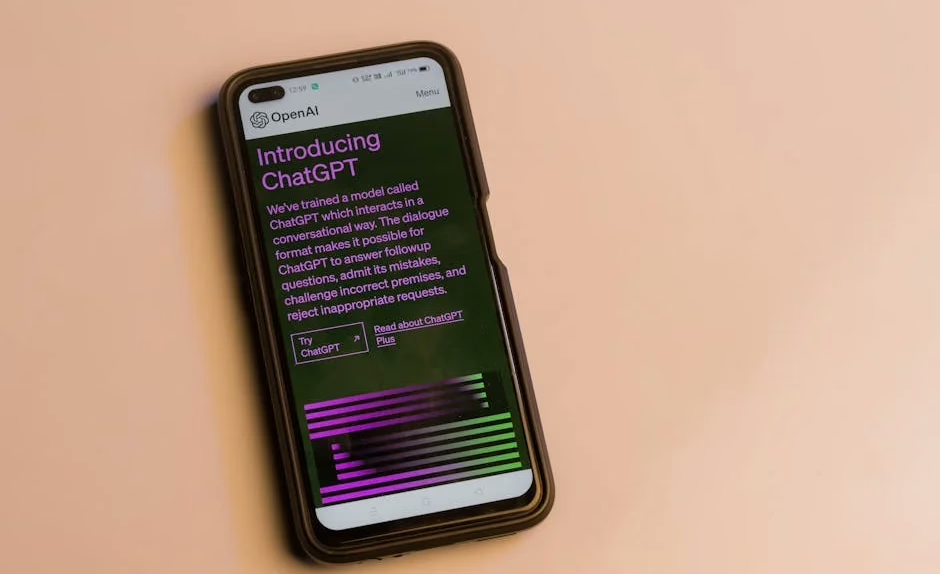

OpenAI released GPT-5.5 and GPT-5.5-Cyber on May 7, marking significant progress toward artificial general intelligence with enhanced reasoning capabilities and specialized cybersecurity features. The models represent what researchers describe as convergence toward a unified “brain” structure as AI systems improve at modeling reality.
GPT-5.5 Introduces Advanced Reasoning Capabilities
GPT-5.5 delivers what OpenAI calls “GPT-5-class reasoning” through three new voice-enabled models in their API. According to OpenAI’s announcement, GPT-Realtime-2 can “handle harder requests and carry the conversation forward naturally,” while GPT-Realtime-Translate supports live translation across 70+ input languages into 13 output languages.
The release includes GPT-Realtime-Whisper for streaming speech-to-text transcription that processes speech as speakers talk. OpenAI positioned these capabilities as enabling “voice experiences that feel more natural, respond more intelligently, and take action in real time.”
GPT-5.5-Cyber targets defenders of critical infrastructure through OpenAI’s Trusted Access for Cyber (TAC) framework. The company stated this specialized model supports “cybersecurity workflows that help protect the broader ecosystem” with “proportional safeguards and access to empower cyber defenders.”
Research Shows AI Models Converging Toward Unified Architecture
MIT research from 2024 revealed that major AI models are “secretly converging to the same thinking core” as they scale and improve performance. According to analysis published in Towards Data Science, this convergence occurs because “if they are all correct then they MUST be creating a very similar representation of reality.”
The phenomenon challenges assumptions that models trained on different data types would develop distinct reasoning approaches. Instead, researchers found that as models become more capable at reasoning, they arrive at similar structural representations of how the world works.
This “Platonic Representation Hypothesis” suggests there’s an optimal way to model reality that all sufficiently advanced AI systems naturally discover. The research indicates this convergence becomes more evident as models improve beyond early reasoning capabilities.
Smaller Models Achieve Competitive Performance
Zyphra’s release of ZAYA1-8B demonstrates that smaller, more efficient models can match larger systems’ performance on key benchmarks. The 8-billion parameter model with only 760 million active parameters achieved competitive results against GPT-5-High and DeepSeek-V3.2, according to VentureBeat’s coverage.
The model was trained entirely on AMD Instinct MI300 GPUs, proving these chips represent “a viable alternative to the preferential position Nvidia has maintained” among AI developers. Zyphra released ZAYA1-8B under an Apache 2.0 license, making it freely available for enterprise and individual use.
This achievement supports the broader trend of “intelligence density” — extracting maximum capability from minimal computational resources. The approach contrasts with major labs’ focus on ever-larger models requiring massive compute infrastructure.
Security Challenges Emerge with Agent Capabilities
As AI systems gain agent-like capabilities including tool use and persistent memory, security researchers identify expanded attack surfaces beyond traditional prompt injection. According to Gravitee’s 2026 State of AI Agent Security report, 88% of organizations reported confirmed or suspected AI agent security incidents in the past year.
The research distinguishes four distinct attack surfaces for AI agents: prompt inputs, tool execution, memory storage, and inter-agent communication. This represents a fundamental shift from earlier AI security models focused primarily on text generation safeguards.
Only 14.4% of agentic systems received full security and IT approval before deployment, highlighting the gap between rapid capability advancement and security framework development. A separate Apono report found 98% of cybersecurity leaders report friction between accelerating AI adoption and meeting security requirements.
What This Means
These developments signal AGI research is entering a new phase characterized by architectural convergence, efficiency breakthroughs, and expanded real-world capabilities. The combination of OpenAI’s reasoning advances, evidence of model convergence, and successful small-scale implementations suggests the field is moving beyond pure scale toward more sophisticated approaches to intelligence.
The security challenges accompanying agent capabilities indicate the need for parallel advancement in AI safety frameworks. As models gain tool use and memory, traditional prompt-based security measures prove insufficient for the expanded attack surfaces these capabilities create.
The success of smaller models like ZAYA1-8B demonstrates that AGI progress doesn’t require exponentially larger systems, potentially democratizing advanced AI capabilities beyond organizations with massive compute resources.
FAQ
What makes GPT-5.5 different from previous OpenAI models?
GPT-5.5 introduces real-time voice capabilities with advanced reasoning, live translation across 70+ languages, and specialized cybersecurity features through GPT-5.5-Cyber. These represent the first voice models with “GPT-5-class reasoning” according to OpenAI.
Why are AI models converging to similar architectures?
MIT research suggests that as AI models become better at reasoning and modeling reality, they naturally converge toward the same optimal representation of how the world works. Since there’s only one reality to model accurately, sufficiently advanced systems discover similar structural approaches.
How do AI agents create new security risks?
Unlike traditional AI that only generates text, agents can execute actions through tools, store persistent memory, and coordinate with other systems. This creates four distinct attack surfaces compared to the single prompt-based attack vector of earlier AI systems.