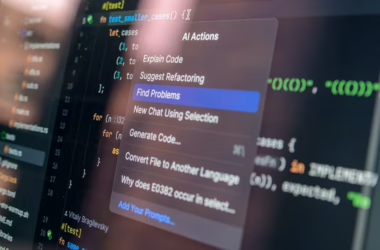

AI coding startup Cursor is in advanced talks to raise at least $2 billion in new funding at a $50 billion pre-money valuation, according to TechCrunch sources. The round, led by returning investors Thrive and Andreessen Horowitz, would nearly double the company’s previous $29.3 billion post-money valuation from just six months ago, highlighting the explosive growth in enterprise AI tooling demand.
The funding surge comes as Cursor projects ending 2026 with an annualized revenue run rate exceeding $6 billion, representing a potential tripling of revenue over the next 10 months. This aggressive growth trajectory reflects broader market momentum in AI development tools, with strategic investor Nvidia also expected to participate in the oversubscribed round.
Enterprise AI Market Expansion Drives Massive Valuations
The AI development tools sector is experiencing unprecedented investor interest, with multiple companies achieving billion-dollar valuations within months. Cursor’s revenue growth from $2 billion annualized in February 2026 to projected $6 billion by year-end demonstrates the rapid enterprise adoption of AI-powered coding solutions.
Key market indicators include:
- Revenue acceleration: Cursor’s 200%+ projected growth rate
- Competitive positioning: Strong performance against Anthropic’s Claude Code and OpenAI’s Codex
- Margin improvement: Recent achievement of gross margin profitability through proprietary models
- Strategic backing: Nvidia’s continued investment signals hardware-software integration trends
The company’s transition from negative to positive gross margins, achieved through its proprietary Composer model and integration with cost-effective alternatives like China’s Kimi, represents a critical inflection point for AI tooling business models.
Strategic Partnerships Reshape AI Application Landscape
Meanwhile, Anthropic launched Claude Design, marking its aggressive expansion beyond core language models into design and prototyping tools traditionally dominated by Figma, Adobe, and Canva. The move signals a broader trend of AI foundation model companies vertically integrating into application layers.
Claude Design, powered by the new Claude Opus 4.7 vision model, enables users to create interactive prototypes, marketing materials, and presentations through conversational prompts. The timing coincides with Anthropic’s remarkable revenue growth, reaching $30 billion annualized by April 2026, up from $9 billion at the end of 2025.
Strategic implications:
- Market expansion: AI companies moving beyond infrastructure into end-user applications
- Competitive pressure: Traditional design tool providers face AI-native competition
- IPO preparation: Anthropic’s early talks with Goldman Sachs, JPMorgan, and Morgan Stanley for potential October 2026 public offering
Infrastructure Security Solutions Address Enterprise Concerns
The enterprise AI agent market is maturing with sophisticated security frameworks. NanoCo’s partnership with Vercel introduces standardized approval systems for autonomous agents, addressing critical enterprise concerns about AI system permissions and oversight.
NanoClaw 2.0’s infrastructure-level security approach ensures human approval for sensitive actions across 15 messaging platforms, from DevOps infrastructure changes to financial transactions. This development addresses the fundamental enterprise challenge of balancing AI agent utility with operational security.
Enterprise adoption drivers:
- Risk mitigation: Infrastructure-level approval systems prevent accidental AI actions
- Integration flexibility: Native approval workflows in existing messaging platforms
- Compliance requirements: Standardized human oversight for regulated industries
Global Competition Intensifies in Fintech AI
The competitive landscape extends globally, with Australian fintech Airwallex rejecting Stripe’s $1.2 billion acquisition offer in 2018 proving prescient. According to TechCrunch, Airwallex now claims over $1.3 billion in annualized revenue with 85% year-over-year growth, processing nearly $300 billion in transaction volume.
CEO Jack Zhang’s decision to decline Stripe’s 600x revenue multiple offer demonstrates the long-term value creation potential in AI-powered financial infrastructure. The company’s vision of enabling global business operations as local entities resonates with increasing cross-border commerce demands.
Market dynamics:
- Valuation multiples: AI-enabled fintech commands premium valuations
- Geographic expansion: Australian companies competing globally with Silicon Valley giants
- Revenue scaling: 100x growth rates becoming standard for successful AI startups
Investment Patterns Signal Market Maturation
Venture capital deployment in AI startups reflects increasing investor confidence in sustainable business models. The participation of strategic investors like Nvidia alongside traditional VCs indicates hardware-software convergence driving next-generation AI applications.
Battery Ventures’ entry as a new investor in Cursor’s round demonstrates the broadening investor base beyond traditional AI-focused funds. This diversification suggests mainstream enterprise software investors recognize AI tooling as a fundamental platform shift rather than a niche technology category.
Investment trends:
- Round sizes: $2+ billion rounds becoming standard for leading AI companies
- Valuation growth: 70%+ increases between funding rounds within 6-month periods
- Strategic participation: Hardware companies investing in complementary software platforms
What This Means
The convergence of massive funding rounds, strategic partnerships, and enterprise adoption signals the AI industry’s transition from experimental technology to core business infrastructure. Cursor’s potential $50 billion valuation reflects investor confidence in AI development tools becoming as essential as cloud computing platforms.
For enterprises, the maturation of security frameworks like NanoClaw 2.0 removes significant adoption barriers for autonomous AI agents. The combination of powerful capabilities with robust oversight mechanisms enables broader deployment across sensitive business functions.
The competitive landscape is rapidly consolidating around companies that can demonstrate sustainable unit economics and clear paths to profitability. Anthropic’s IPO preparation and Airwallex’s rejection of acquisition offers suggest the most successful AI companies are choosing independence to capture long-term value creation.
FAQ
What is driving the massive valuations in AI startups?
Rapid revenue growth rates of 200-300% annually, combined with large addressable markets and proven enterprise adoption, justify premium valuations as investors compete for market-leading positions.
How are AI companies achieving profitability?
Companies like Cursor are developing proprietary models and leveraging cost-effective third-party alternatives to reduce inference costs while maintaining pricing power with enterprise customers.
What security concerns exist with enterprise AI agents?
Autonomous agents require broad system permissions to be useful, creating risks of accidental damage. New approval frameworks ensure human oversight for sensitive actions while maintaining agent utility.
Further Reading
Sources
- Microsoft AI Partnerships Move Deeper Into Factory Floors And Valuation Debate – Yahoo Finance – Google News – Microsoft
- Sources: Cursor in talks to raise $2B+ at $50B valuation as enterprise growth surges – TechCrunch
- Should my enterprise AI agent do that? NanoClaw and Vercel launch easier agentic policy setting and approval dialogs across 15 messaging apps – VentureBeat