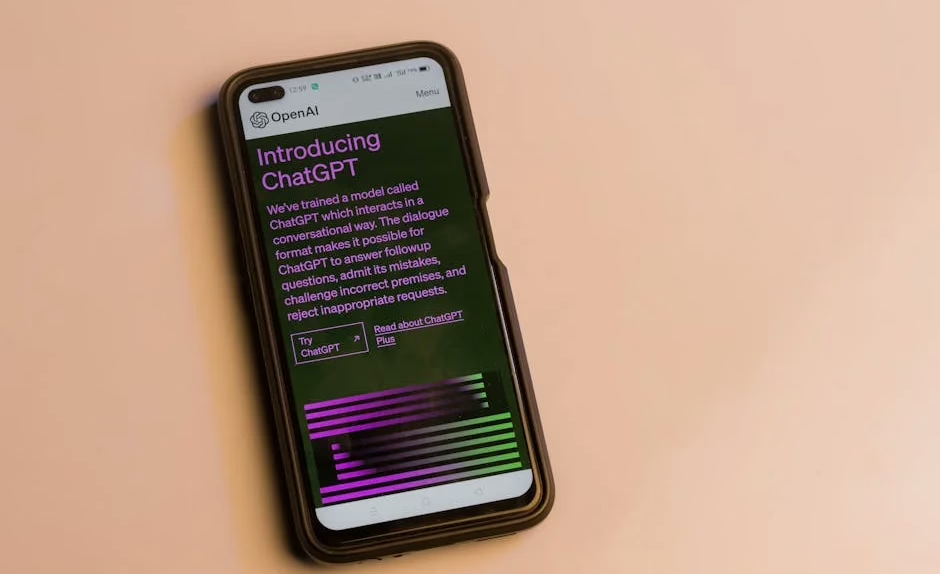

OpenAI has officially launched ChatGPT Images 2.0, featuring the new `gpt-image-2` model that generates multilingual text, full infographics, and complex visual content with unprecedented accuracy. Simultaneously, Sam Altman’s World project expanded its iris-scanning verification system to Tinder globally and other platforms, marking a significant convergence of AI generation and human verification technologies. According to VentureBeat, the new image model has been secretly tested on LM Arena AI under the codename “duct tape” for several weeks, demonstrating remarkable capabilities in generating realistic user interfaces, reproducing public figures, and creating complex visual layouts.
Technical Architecture of ChatGPT Images 2.0
The `gpt-image-2` model represents a fundamental architectural advancement over its predecessor GPT-Image-1.5, which was released in December 2025. The new model demonstrates significant improvements in instruction following, color accuracy, and lighting consistency across generated images.
Key technical capabilities include:
- Multilingual text rendering within images with high fidelity
- Complex infographic generation with multiple data visualization elements
- Character model creation from multiple viewing angles
- Floor plan and architectural diagram synthesis
- Image grid generation for creating sets of related visual content
The model’s training methodology appears to incorporate enhanced multimodal understanding, allowing it to perform web research and integrate findings directly into visual outputs. This represents a significant leap in cross-modal reasoning capabilities, where textual information is seamlessly translated into visual representations.
According to VentureBeat, early users have been particularly impressed with the model’s ability to generate “insanely realistic” user interfaces and screenshots from popular platforms, suggesting sophisticated training on interface design patterns and visual consistency principles.
World ID Integration and Zero-Knowledge Proof Architecture
World’s expansion into mainstream applications leverages zero-knowledge proof-based authentication to create what the company terms “proof of human” verification systems. The technical foundation relies on cryptographic iris scanning through spherical devices called Orbs, which convert unique iris patterns into anonymous cryptographic identifiers.
The verification process involves several technical components:
- Biometric data capture through specialized optical sensors in the Orb devices
- Cryptographic hashing that converts iris patterns into unique, non-reversible identifiers
- Zero-knowledge protocols that verify human identity without storing personal biometric data
- Blockchain-based verification through the World ID system
According to Wired, 18 million people have now been verified through the Orb system, representing a 50% increase from 12 million users in the previous year. This growth trajectory indicates increasing acceptance of biometric verification technologies among consumers.
The integration with Tinder, following a successful pilot program in Japan, demonstrates the practical application of these cryptographic protocols in consumer-facing applications. The Verge reports that verified users receive five free boosts as an incentive, effectively gamifying the adoption of biometric verification.
Enterprise Applications and Platform Integrations
Beyond consumer applications, World’s verification technology is expanding into enterprise environments through partnerships with Zoom and DocuSign. These integrations address growing concerns about AI agent proliferation in business communications and document verification processes.
The Zoom integration allows meeting organizers to require World ID verification before participants can join calls, addressing the increasing challenge of distinguishing between human participants and AI agents in video conferences. This represents a significant technical milestone in real-time identity verification for distributed communication platforms.
DocuSign’s integration suggests applications in legal document verification, where proving human identity becomes crucial for contract validity and regulatory compliance. The zero-knowledge architecture ensures that sensitive legal processes maintain privacy while establishing human authenticity.
According to TechCrunch, Tools for Humanity plans to extend verification into “event and concert ticketing systems, business organizations, email, and other arenas of public life,” indicating a comprehensive strategy for human verification infrastructure.
Performance Metrics and Benchmarking Results
While specific performance metrics for ChatGPT Images 2.0 haven’t been fully disclosed, early testing on LM Arena AI provides insights into the model’s capabilities. The platform serves as a neutral testing ground where AI models compete anonymously, allowing for unbiased performance evaluation.
Key performance indicators observed include:
- Text rendering accuracy across multiple languages and character sets
- Spatial reasoning for complex layout generation and element positioning
- Style consistency across different image generation tasks
- Prompt adherence for complex, multi-part instructions
The model’s ability to generate “long blocks of text or disparate text panels within the same image” suggests significant improvements in spatial understanding and text-image integration compared to previous iterations. This capability is particularly relevant for technical documentation, educational materials, and business presentation generation.
The integration of web research capabilities into image generation represents a novel approach to multimodal information synthesis, where the model can query external data sources and incorporate findings into visual outputs.
Research Implications and Academic Contributions
The convergence of advanced image generation and biometric verification represents significant contributions to multiple research domains. ChatGPT Images 2.0’s architectural improvements likely incorporate recent advances in diffusion models and attention mechanisms for improved visual-textual alignment.
The zero-knowledge proof implementation in World ID contributes to privacy-preserving authentication research, demonstrating practical applications of cryptographic protocols in consumer technology. This work advances the field of decentralized identity verification while maintaining user privacy through mathematical guarantees rather than policy promises.
The combination of these technologies addresses the fundamental challenge identified by Altman: “We are also heading to a world now where there’s going to be more stuff generated by AI than by humans.” This observation highlights the critical need for human-AI distinction mechanisms as generative AI capabilities continue advancing.
The technical approach of using biometric verification to establish human authenticity while simultaneously deploying more sophisticated AI generation tools creates an interesting technological equilibrium where verification and generation capabilities advance in parallel.
What This Means
The simultaneous launch of ChatGPT Images 2.0 and World ID’s platform expansion represents a strategic response to the authenticity paradox in AI development. As generation capabilities become more sophisticated, the need for reliable human verification becomes more critical.
From a technical perspective, the `gpt-image-2` model’s capabilities suggest significant architectural improvements in multimodal reasoning and cross-domain knowledge integration. The ability to perform web research and incorporate findings into visual outputs indicates progress toward more autonomous AI systems capable of complex information synthesis.
The World ID expansion demonstrates the practical viability of privacy-preserving biometric systems in mainstream applications. The zero-knowledge architecture provides a technical solution to the competing demands of identity verification and privacy protection, potentially establishing new standards for decentralized authentication systems.
For the broader AI research community, these developments highlight the increasing importance of AI safety and human-AI interaction research. The need for reliable human verification systems becomes more urgent as AI capabilities approach human-level performance in various domains.
FAQ
Q: How does ChatGPT Images 2.0 differ from previous image generation models?
A: ChatGPT Images 2.0 introduces the `gpt-image-2` model with enhanced multilingual text rendering, complex infographic generation, and web research integration capabilities, representing significant improvements in instruction following and visual-textual alignment over GPT-Image-1.5.
Q: What makes World ID’s verification system technically secure?
A: World ID uses zero-knowledge proof-based authentication that converts iris scans into anonymous cryptographic identifiers without storing personal biometric data, ensuring privacy through mathematical guarantees rather than policy promises.
Q: Why is human verification becoming important for AI applications?
A: As AI-generated content becomes increasingly sophisticated and prevalent, distinguishing between human and AI activity becomes critical for maintaining trust in digital platforms, preventing fraud, and ensuring authentic human interaction in various applications.