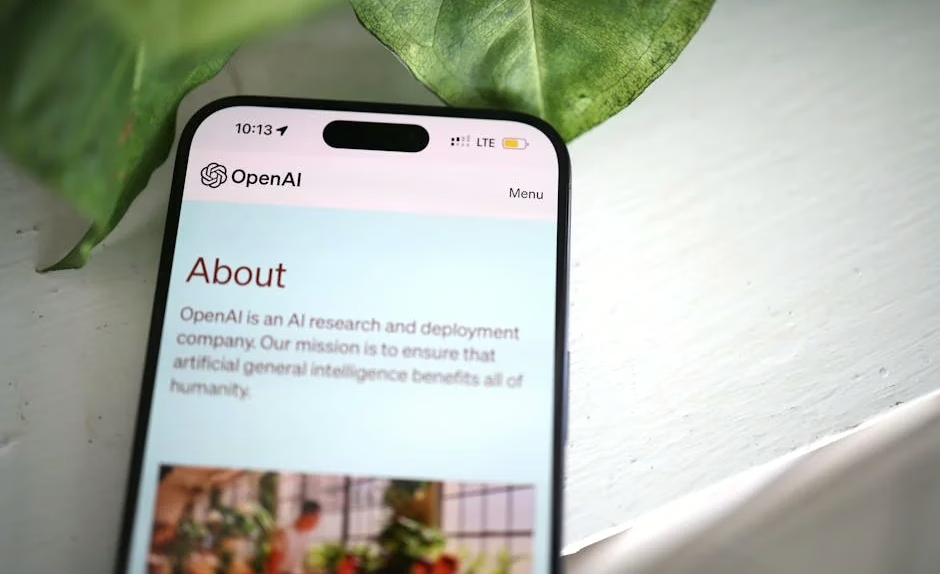

Elon Musk and Sam Altman began their high-stakes jury trial on April 27th in Northern California federal court, with Musk seeking up to $134 billion in damages and demanding OpenAI’s return to nonprofit status. According to MIT Technology Review, Musk alleges that Altman and OpenAI president Greg Brockman deceived him into funding the company by promising to maintain its nonprofit mission, only to later restructure as a for-profit enterprise.
Musk took the stand Tuesday as the first witness, portraying his OpenAI involvement as an effort to save humanity, before returning Wednesday for continued testimony. The Tesla CEO cofounded OpenAI with Altman in 2015 but left in 2018 after a power struggle.
Core Legal Claims and Stakes
Musk’s lawsuit centers on allegations that OpenAI abandoned its founding mission to develop AI benefiting humanity in favor of profit maximization. The Verge reports that Musk seeks removal of Altman and Brockman from their leadership roles and wants OpenAI to cease operating as a public benefit corporation.
The case could have sweeping consequences for OpenAI ahead of its anticipated IPO. According to court filings, Musk has requested that any damages be awarded to OpenAI’s nonprofit arm rather than to him personally.
Nine jurors will deliver an advisory verdict to guide the judge’s final decision on Musk’s claims. Key witnesses expected to testify include former OpenAI chief scientist Ilya Sutskever, former CTO Mira Murati, and Microsoft CEO Satya Nadella.
OpenAI’s Defense Strategy
OpenAI has dismissed the lawsuit as baseless retaliation designed to harm a competitor. In a statement on X, the company said “This lawsuit has always been a baseless and jealous bid to derail a competitor” aimed at boosting Musk’s own AI ventures including xAI and its Grok chatbot.
The company argues that Musk’s claims stem from his departure from OpenAI in 2018 following internal conflicts over the company’s direction. OpenAI maintains that its transition to a capped-profit model was necessary to secure the massive funding required for AI development and remains aligned with its mission to ensure artificial general intelligence benefits humanity.
Musk’s Pre-Trial Media Campaign
Wired confirmed that Musk boosted a post on X promoting The New Yorker’s investigation into Altman’s allegedly deceptive behavior as the trial began Monday. The boosted post from journalist Ronan Farrow promoted an extensive exposé of Altman’s business practices.
Musk also reposted the story from his personal account, writing “Calling him ‘Scam’ Altman is accurate. This is very much worth reading.” The timing of the social media activity coincided with opening statements in the federal lawsuit.
The boosted post appeared without an “ad” label in users’ feeds, though X’s FAQ states that boosted content must self-identify as advertisements and comply with platform ad policies.
Financial and Strategic Implications
The lawsuit’s outcome could significantly impact OpenAI’s corporate structure and valuation ahead of its planned public offering. Microsoft, which has invested billions in OpenAI and holds a significant stake in the company, is also named as a defendant in Musk’s suit.
OpenAI’s transition from a nonprofit research organization to a capped-profit company has enabled it to raise over $13 billion from investors including Microsoft. The company’s ChatGPT has become the fastest-growing consumer application in history, reaching 100 million users within two months of launch.
Musk’s xAI, founded in 2023, has positioned itself as a competitor to OpenAI with its Grok AI assistant integrated into X (formerly Twitter). The timing of the lawsuit has raised questions about whether Musk’s legal action serves strategic business interests beyond the stated mission concerns.
What This Means
This trial represents a pivotal moment for the AI industry’s governance and corporate structure. The case will test whether courts can enforce founding mission statements when companies transition from nonprofit to for-profit models, potentially setting precedent for other AI startups.
The high-profile nature of the dispute, involving two of tech’s most prominent figures, highlights growing tensions over AI development priorities between profit maximization and public benefit. The outcome could influence how future AI companies structure themselves and communicate their missions to investors and the public.
Regardless of the verdict, the trial will likely expose internal communications and strategic decisions that shaped OpenAI’s evolution from research nonprofit to commercial AI leader, providing unprecedented insight into the company’s transformation.
FAQ
When will the Musk vs Altman trial conclude?
The trial began April 27th with jury selection, but no specific end date has been announced. Complex commercial litigation of this magnitude typically takes several weeks to months, depending on witness testimony and evidence presentation.
What happens if Musk wins the lawsuit?
If successful, Musk could force OpenAI to return to nonprofit status, remove Altman and Brockman from leadership, and secure up to $134 billion in damages for the nonprofit arm. This would likely derail OpenAI’s IPO plans and fundamentally restructure the company.
How does this affect ChatGPT and OpenAI’s products?
The trial outcome could impact OpenAI’s corporate structure and leadership but is unlikely to immediately affect ChatGPT’s availability or functionality. However, a ruling forcing nonprofit conversion could limit OpenAI’s ability to raise capital for future AI development.
Related news
Sources
- Live updates from Elon Musk and Sam Altman’s court battle over the future of OpenAI – The Verge
- Elon Musk and Sam Altman’s court battle over the future of OpenAI – The Verge
- Sam Altman calls ChatGPT 5.5 the last major milestone before AGI and the AI world is taking him seriously – Startup Fortune – Google News – AGI
- Elon Musk Boosts New Yorker’s Sam Altman Exposé on X as Trial Begins – Wired
- Elon Musk and Sam Altman are going to court over OpenAI’s future – MIT Technology Review