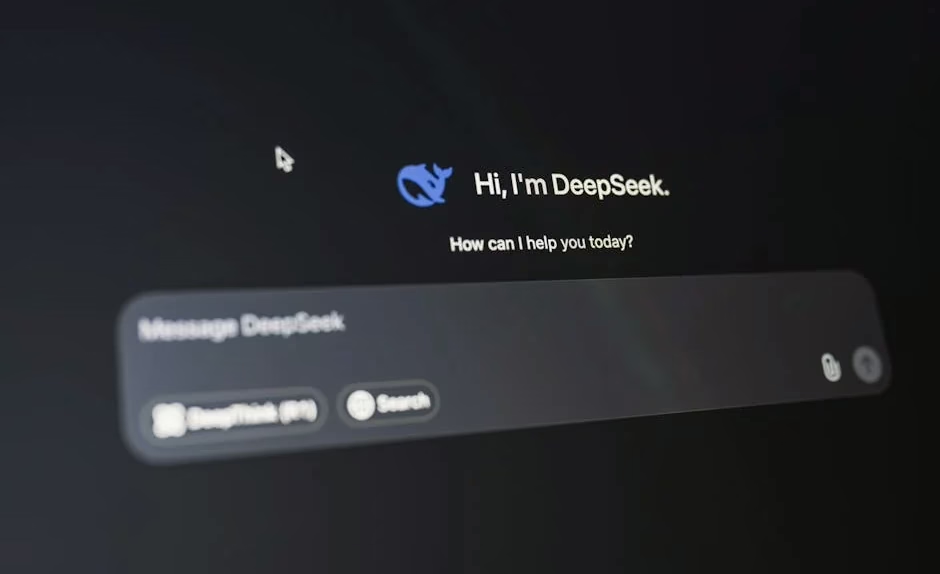

DeepSeek on Friday released its V4 model, a 1.6-trillion-parameter system that matches or exceeds the performance of OpenAI’s GPT-5.5 and Anthropic’s Claude Mythos Preview while costing approximately one-sixth the price through API access. According to VentureBeat, the Chinese AI startup’s latest model achieves near state-of-the-art results across multiple benchmarks and is available under the commercially-friendly MIT License.
DeepSeek AI researcher Deli Chen described the release on X as a “labor of love” developed over 484 days since the V3 launch. The model is now available on Hugging Face and through DeepSeek’s API.
OpenAI Responds with GPT-5.5 Launch
OpenAI countered DeepSeek’s momentum by unveiling GPT-5.5, formerly codenamed “Spud,” which the company positioned as a fundamental redesign of AI-computer interaction. According to VentureBeat, GPT-5.5 narrowly beats Anthropic’s Claude Mythos Preview on Terminal-Bench 2.0, though the margin represents essentially a statistical tie.
“It’s definitely our strongest model yet on coding, both measured by benchmarks and based on the feedback that we’ve gotten from trusted partners,” explained Amelia Glaese, VP of Research at OpenAI, in a video call with journalists. OpenAI co-founder Greg Brockman emphasized the model’s intuitive problem-solving capabilities, noting it “can look at an unclear problem and figure out what needs to happen next.”
GPT-5.5 excels particularly in coding tasks, computer use applications, and scientific research workflows. The model remains available alongside GPT-5.4, which OpenAI continues offering at half the API cost of its successor.
Benchmark Performance Comparison
DeepSeek-V4’s benchmark results demonstrate competitive performance across key AI evaluation metrics. The model’s Mixture-of-Experts (MoE) architecture enables it to match frontier-class capabilities while maintaining significantly lower operational costs. CNBC reported that the release intensifies pressure on global AI spending strategies as Chinese competition drives down costs.
The performance gains represent a continuation of DeepSeek’s disruptive trajectory that began with its R1 model in January 2025. That earlier release became a near-overnight global sensation by matching proprietary U.S. systems while remaining open source.
Industry analysts note that V4’s combination of performance and cost efficiency creates new competitive dynamics in enterprise AI adoption. The model’s 1-million token context length capability further enhances its utility for complex reasoning tasks.
Open Source Strategy Disrupts Pricing Models
DeepSeek’s MIT License approach continues challenging the closed-source model strategies of major AI companies. The startup, an offshoot of High-Flyer Capital Management, has consistently released models that achieve comparable performance to proprietary systems at fraction of the cost.
Community reactions on Hugging Face welcomed what observers call the “second DeepSeek moment,” with experts noting the arrival of cost-effective AI at scale. The release provides enterprises with viable alternatives to expensive proprietary APIs while maintaining commercial licensing flexibility.
The timing coincides with increased scrutiny of AI development costs and accessibility. DeepSeek’s approach demonstrates that frontier-class AI capabilities need not require prohibitive pricing structures, potentially accelerating enterprise adoption across price-sensitive markets.
Technical Architecture and Implementation
V4 employs a 1.6-trillion-parameter MoE design optimized for efficiency and performance. The architecture enables selective activation of model components based on task requirements, reducing computational overhead while maintaining output quality. DeepSeek developed the model using Huawei Ascend NPUs, highlighting alternative hardware ecosystems for AI training.
The software stack accompanying the model weights provides infrastructure for deployment across various environments. This comprehensive approach addresses enterprise concerns about vendor lock-in while offering flexibility in implementation choices.
DeepSeek’s technical documentation emphasizes the model’s reasoning capabilities and multi-modal processing features. The 484-day development cycle incorporated extensive testing and refinement based on community feedback from previous releases.
Market Impact and Competitive Response
The simultaneous releases from DeepSeek and OpenAI illustrate the intensifying competition in frontier AI development. CNBC analysis suggests these developments pressure existing pricing models across the industry.
Enterprise customers now face expanded options spanning cost-optimized open source solutions to premium proprietary services. This dynamic creates opportunities for businesses to match AI capabilities with budget constraints while maintaining competitive technical performance.
The releases also highlight geographical diversification in AI development leadership. DeepSeek’s consistent performance achievements demonstrate that innovation leadership extends beyond traditional Silicon Valley companies.
What This Means
DeepSeek-V4’s benchmark performance at dramatically reduced costs signals a fundamental shift in AI economics. The model proves that frontier-class capabilities need not require premium pricing, potentially accelerating enterprise adoption and democratizing access to advanced AI systems.
For businesses, V4 offers compelling alternatives to expensive proprietary APIs while maintaining commercial licensing flexibility. The open source approach reduces vendor dependency risks while providing transparency into model capabilities and limitations.
The competitive dynamic between DeepSeek and established players like OpenAI benefits end users through improved performance and pricing options. This competition drives innovation while expanding access to cutting-edge AI capabilities across diverse market segments.
FAQ
How does DeepSeek-V4 compare to GPT-5.5 in performance?
DeepSeek-V4 achieves near state-of-the-art results that match or exceed GPT-5.5 on multiple benchmarks while costing approximately one-sixth the price through API access. Both models represent current frontier-class capabilities.
What licensing terms apply to DeepSeek-V4?
DeepSeek-V4 is released under the MIT License, allowing commercial use, modification, and distribution. This provides enterprises with flexibility to integrate the model into products and services without restrictive licensing constraints.
When will these models be available for general use?
DeepSeek-V4 is immediately available through Hugging Face and DeepSeek’s API. OpenAI’s GPT-5.5 is also available now, with GPT-5.4 remaining accessible at half the API cost for budget-conscious users.
Related news
- CodePath and Anthropic team up to open source what they are learning about AI’s real impact on students – EdTech Innovation Hub – Google News – Tech Innovation
Sources
- OpenAI’s GPT-5.5 is here, and it’s no potato: narrowly beats Anthropic’s Claude Mythos Preview on Terminal-Bench 2.0 – VentureBeat
- DeepSeek-V4 arrives with near state-of-the-art intelligence at 1/6th the cost of Opus 4.7, GPT-5.5 – VentureBeat
- China’s DeepSeek releases preview of long-awaited V4 model as AI race intensifies – CNBC Tech