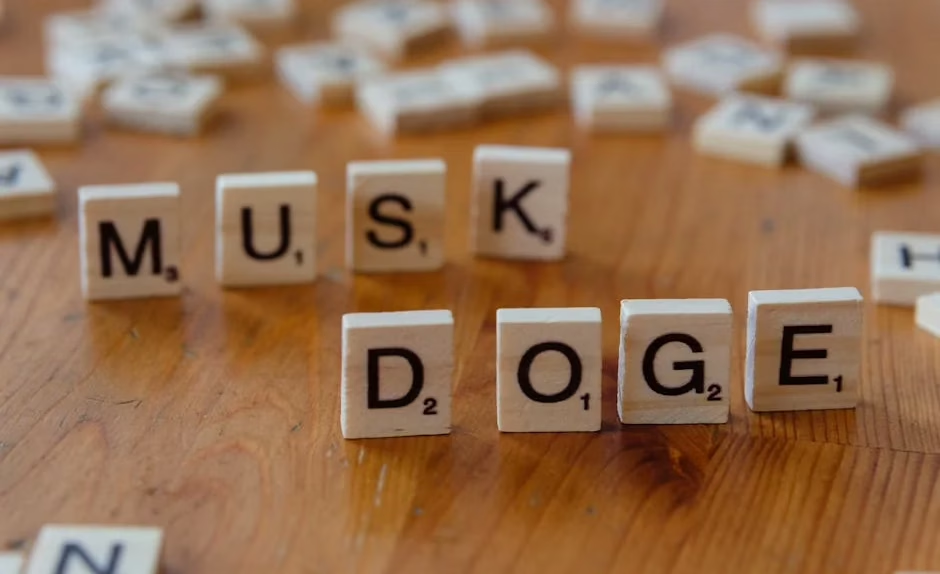

Elon Musk testified Tuesday as the first witness in his high-stakes lawsuit against OpenAI CEO Sam Altman, seeking up to $134 billion in damages and demanding the removal of OpenAI’s current leadership. According to The Verge, Musk portrayed his interest in founding OpenAI as an effort to help save humanity during his testimony.
The trial began with jury selection on April 27th in Northern California federal court. MIT Technology Review reported that nine jurors will deliver an advisory verdict to guide the judge in deciding Musk’s claims against Altman, Brockman, and Microsoft.
Musk cofounded OpenAI with Altman and others in 2015 but left in 2018 after what sources describe as a bitter power struggle. The Tesla CEO now operates xAI, which launched the Grok chatbot as a direct competitor to ChatGPT.
Core Legal Claims and Damages Sought
Musk alleges that Altman and OpenAI president Greg Brockman deceived him into bankrolling the company by promising to maintain it as a nonprofit dedicated to developing AI that benefits humanity. According to court documents, Musk is seeking $134 billion in damages from OpenAI and Microsoft.
The lawsuit specifically targets OpenAI’s 2023 restructuring to operate a for-profit subsidiary, which Musk claims violated the company’s founding mission. MIT Technology Review noted that Musk is asking the court to remove Altman and Brockman from their roles and restore OpenAI as a nonprofit.
Musk has requested that any damages be awarded to OpenAI’s nonprofit arm rather than to him personally, according to legal filings.
OpenAI’s Defense Strategy
OpenAI has dismissed the lawsuit as a competitive attack designed to benefit Musk’s AI ventures. In a statement on X, the company said “This lawsuit has always been a baseless and jealous bid to derail a competitor” aimed at boosting Musk’s SpaceX, xAI, and X companies.
The company argues that Musk’s departure in 2018 stemmed from his inability to gain control over OpenAI’s direction, not philosophical disagreements about its mission. OpenAI maintains that its for-profit structure enables the massive capital investments required to develop artificial general intelligence safely.
Key witnesses expected to testify include former OpenAI chief scientist Ilya Sutskever, former CTO Mira Murati, and Microsoft CEO Satya Nadella, according to MIT Technology Review.
Musk Amplifies Critical Coverage
As the trial began, Musk used X’s boost feature to amplify a New Yorker investigation critical of Altman’s business practices. Wired confirmed that Musk boosted journalist Ronan Farrow’s post promoting the investigation, with the boosted content appearing in users’ feeds without an “ad” label.
Musk also reposted the story directly, writing “Calling him ‘Scam’ Altman is accurate” in reference to his nickname for the OpenAI CEO. The timing coincided with the trial’s opening day, raising questions about potential jury influence.
X’s boost feature requires users to pay additional fees to amplify posts, and according to the platform’s FAQ, boosted content must self-identify as advertising and comply with ad policies.
Broader Implications for AI Industry
The trial outcome could reshape OpenAI’s corporate structure ahead of its highly anticipated IPO. MIT Technology Review noted that the court could rule on whether the company is allowed to continue operating as a for-profit enterprise.
A ruling in Musk’s favor could force OpenAI to restructure as a nonprofit, potentially limiting its ability to raise capital for expensive AI development. Microsoft has invested billions in OpenAI through its for-profit subsidiary, making the software giant a key stakeholder in the trial’s outcome.
The case also highlights tensions over AI safety and commercialization as the industry races toward artificial general intelligence. Both Musk and Altman have positioned themselves as advocates for responsible AI development, despite their business rivalry.
What This Means
This trial represents more than a personal dispute between two tech titans—it could fundamentally alter how AI companies balance profit motives with safety commitments. If Musk succeeds in forcing OpenAI back to nonprofit status, it would create a precedent that could affect other AI startups considering similar corporate structures.
The $134 billion damages claim reflects OpenAI’s massive valuation growth since its 2015 founding. A significant award could impact the company’s IPO plans and Microsoft’s AI strategy, potentially reshaping competitive dynamics in the AI market.
The trial also tests whether early founding agreements can bind companies as they evolve. OpenAI’s transformation from research lab to commercial powerhouse mirrors similar journeys by other tech companies, making the legal precedent particularly significant for Silicon Valley.
FAQ
When will the Musk vs OpenAI trial conclude?
The trial timeline hasn’t been specified, but with multiple high-profile witnesses including Musk, Altman, and Microsoft CEO Satya Nadella expected to testify, proceedings could extend several weeks.
What happens to ChatGPT if Musk wins the lawsuit?
If the court orders OpenAI to return to nonprofit status, ChatGPT would likely continue operating but under different ownership and funding structures, potentially limiting future development resources.
Could this trial delay OpenAI’s IPO plans?
Yes, a ruling that forces corporate restructuring or leadership changes could significantly delay OpenAI’s public offering, as investors would need clarity on the company’s legal status and governance structure.
Related news
Sources
- Live updates from Elon Musk and Sam Altman’s court battle over the future of OpenAI – The Verge
- Elon Musk and Sam Altman’s court battle over the future of OpenAI – The Verge
- Elon Musk Boosts New Yorker’s Sam Altman Exposé on X as Trial Begins – Wired
- Elon Musk and Sam Altman are going to court over OpenAI’s future – MIT Technology Review
- Tesla CEO Elon Musk takes stand in trial vs. OpenAI CEO Sam Altman that could reshape AI’s future – ABC7 Los Angeles – Google News – AGI