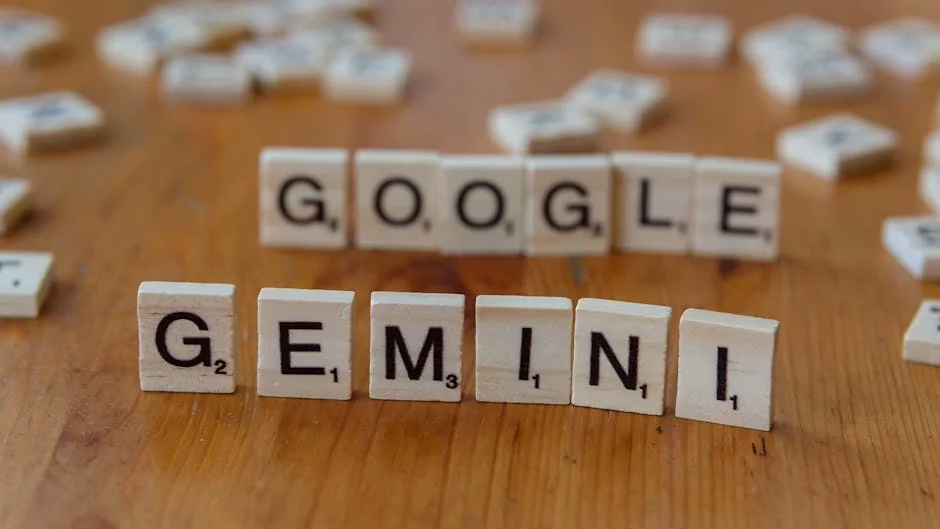

Google launched personalized image generation capabilities for Gemini subscribers this week, marking a significant escalation in the competitive AI image generation market valued at over $12 billion. The tech giant’s “Nano Banana-powered” feature leverages user data from Gmail and Google Photos to create contextually relevant images without explicit prompts, positioning Google to challenge market leaders DALL-E, Midjourney, and Stable Diffusion.
The move signals intensifying competition in generative AI, where image creation tools have emerged as a primary revenue driver for AI companies seeking sustainable business models beyond chatbots.
Market Leaders Face New Competition
The AI image generation sector has experienced explosive growth, with Midjourney reportedly generating over $200 million in annual revenue despite operating with fewer than 50 employees. OpenAI’s DALL-E integration with ChatGPT Plus has driven subscription growth, while Stability AI’s open-source Stable Diffusion model has captured developer mindshare despite ongoing funding challenges.
Google’s entry leverages its massive user data advantage. Unlike competitors requiring detailed prompts, Gemini’s personalized generation understands user preferences through existing Google services. Users can now request “Design my dream home” instead of specifying interests like tennis and music, as the system already knows these preferences.
Key competitive advantages:
- Access to user data across Google ecosystem
- Integration with existing productivity tools
- Subscription model already established with Gemini Plus/Pro/Ultra
- Enterprise distribution through Workspace
The feature launches initially for U.S. subscribers, with plans for Chrome desktop integration and international expansion.
Revenue Models Driving Industry Growth
AI image generators have pioneered diverse monetization strategies that other AI companies are now emulating. Midjourney’s subscription-only model generates approximately $200 million annually, proving consumer willingness to pay for creative AI tools.
OpenAI integrates DALL-E into ChatGPT Plus subscriptions, creating a comprehensive AI toolkit that justifies the $20 monthly fee. This bundling strategy has proven effective, with ChatGPT Plus reportedly reaching over 10 million subscribers.
Emerging revenue streams include:
- Enterprise licensing: Companies paying for custom image generation
- API access: Developers integrating image generation into applications
- Commercial usage rights: Premium tiers for business use
- Custom model training: Specialized models for specific industries
Stability AI’s open-source approach initially struggled with monetization but has pivoted toward enterprise services and cloud hosting, seeking to balance accessibility with revenue generation.
Investment Activity Reflects Market Confidence
Venture capital investment in generative AI reached $25.2 billion in 2023, with image generation companies capturing significant portions. Stability AI raised $101 million in 2022, though recent reports suggest financial challenges and potential acquisition discussions.
Midjourney’s bootstrapped success has attracted acquisition interest from major tech companies, though founder David Holz has indicated preference for independence. The company’s lean operation and high profitability make it an attractive target for companies seeking immediate revenue from AI investments.
Investment trends show:
- Preference for companies with proven revenue models
- Focus on enterprise applications over consumer tools
- Interest in specialized vertical applications
- Emphasis on responsible AI development and safety measures
Google’s internal development represents a different investment approach, leveraging existing infrastructure and user base rather than acquiring external capabilities.
Technical Innovation Drives Competitive Differentiation
While Google emphasizes personalization, competitors focus on different technical advantages. Midjourney leads in artistic quality and style consistency, making it preferred among creative professionals. DALL-E excels in prompt understanding and safety measures, crucial for enterprise adoption.
Stable Diffusion’s open-source nature enables customization and fine-tuning, attracting developers and researchers. This technical flexibility has spawned an ecosystem of derivative tools and services, creating network effects that strengthen its market position.
Key technical differentiators:
- Image quality and resolution capabilities
- Processing speed and generation time
- Style consistency and artistic control
- Safety measures and content filtering
- Integration capabilities with existing workflows
Google’s approach integrates with existing productivity tools like Google Vids, potentially creating workflow advantages for business users already embedded in the Google ecosystem.
Enterprise Adoption Accelerates Market Growth
Business adoption of AI image generation has exceeded initial projections, with companies using these tools for marketing, product design, and content creation. Enterprise spending on generative AI tools is projected to reach $143 billion by 2027, with image generation representing a significant portion.
Major brands including Coca-Cola, Nestlé, and Heinz have publicly embraced AI-generated imagery for advertising campaigns, validating the technology’s commercial viability. This enterprise adoption provides stable revenue streams less dependent on individual consumer subscriptions.
Enterprise use cases driving growth:
- Marketing and advertising creative development
- Product visualization and prototyping
- E-commerce product imagery
- Social media content creation
- Training and educational materials
Google’s enterprise focus through Workspace integration positions it well for this growing market segment.
What This Means
Google’s entry into personalized AI image generation represents a strategic shift toward data-driven competitive advantages in generative AI. While Midjourney and DALL-E built their success on superior image quality and user experience, Google’s approach leverages its unmatched user data access to create contextually relevant content.
This development signals maturation in the AI image generation market, where differentiation increasingly depends on integration capabilities and data advantages rather than pure technical performance. Companies with comprehensive user ecosystems gain significant competitive moats.
For investors, Google’s move validates the commercial viability of AI image generation while potentially pressuring standalone companies to justify premium valuations. The market appears large enough to support multiple successful players, but competition will intensify around enterprise customers and platform integration.
The introduction of SynthID watermarking across Google’s tools also indicates increasing focus on AI safety and authenticity, potentially becoming a regulatory requirement that favors established technology companies with resources to implement comprehensive safety measures.
FAQ
Q: How large is the AI image generation market?
A: The AI image generation market is valued at over $12 billion and growing rapidly, with projections suggesting it could reach $143 billion by 2027 as part of the broader generative AI market.
Q: Which AI image generator is most profitable?
A: Midjourney appears most profitable, generating approximately $200 million annually with fewer than 50 employees, demonstrating the highest revenue-per-employee ratio in the sector.
Q: How does Google’s approach differ from competitors?
A: Google leverages existing user data from Gmail and Google Photos to provide personalized image generation without detailed prompts, while competitors like DALL-E and Midjourney focus primarily on prompt-based generation and artistic quality.