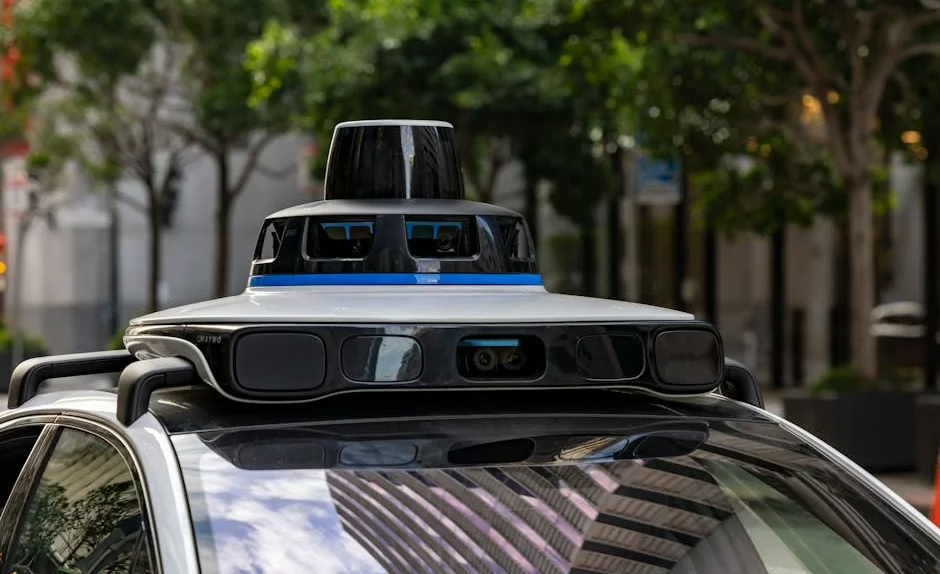

Tesla disclosed details of 17 robotaxi crashes — including two caused by remote human operators — while General Motors eliminated roughly 600 IT positions to hire AI-focused engineers, signaling how deeply AI is reshaping automotive operations in 2025 and 2026.
Tesla’s Robotaxi Crash Data Reveals a Teleoperator Problem
For more than a year, Tesla withheld narrative descriptions of its robotaxi incidents from public filings, citing confidential business information. That changed this week when the National Highway Traffic Safety Administration (NHTSA) published newly unredacted data covering 17 crashes between July 2025 and March 2026, as TechCrunch reported.
Two of those crashes share a common thread: a remote human operator — not the autonomous driving system — was at the wheel when the vehicle hit something. Both incidents occurred in Austin, Texas, at speeds under 10 mph, with safety monitors seated in the passenger seat and no paying customers on board.
In the first crash, dated July 2025, Tesla’s automated driving system (ADS) stalled on a street and couldn’t move forward. The safety monitor called for remote assistance. A teleoperator took control, turned the vehicle left, drove it up a curb, and struck a metal fence at 8 mph. The safety monitor sustained minor injuries but was not hospitalized, according to Tesla’s NHTSA filing.
The second incident, in January 2026, followed a similar sequence. The ADS was driving straight when the safety monitor again requested navigation help. The remote driver took over and drove the car directly into a temporary construction barricade at 9 mph, scraping the front left fender and tire. Tesla reported no injuries in that case.
Remote Driving Is More Common at Tesla Than at Competitors
The crashes draw attention to a part of autonomous vehicle operations that rarely gets public scrutiny: the remote teams that monitor robot cars and intervene when the software gets stuck. According to Wired, all U.S. self-driving operators maintain these remote support teams, based on letters submitted to a U.S. senator earlier this year.
But Tesla appears to stand apart in one key way. While most autonomous vehicle operators use remote teams primarily for monitoring and communication, Tesla more frequently allows remote workers to directly pilot the vehicles — a capability it defended in a letter to lawmakers.
“This capability enables Tesla to promptly move a vehicle that may be in a compromising position, thereby mitigating the need to wait for a first responder or Tesla field representative to manually recover the vehicle,” the company said, as quoted by TechCrunch.
That rationale is operationally sensible, but the crash data shows the approach carries its own risks. Remote driving at even low speeds introduces latency, limited spatial awareness, and human error — the same categories of failure the autonomous system is supposed to eliminate. Tesla, which disbanded its public relations team, did not respond to Wired’s request for comment.
GM Cuts 600 IT Workers, Targets AI-Native Hires
While Tesla manages its robotaxi growing pains, General Motors is executing a deliberate workforce restructuring built around AI skills. The company laid off more than 10% of its IT department — approximately 600 salaried employees — to make room for engineers with AI-focused backgrounds, according to TechCrunch Mobility.
GM has said it is actively hiring to backfill those roles, but the exchange is not one-to-one. The net result is likely a reduction in total headcount even as the skills profile of the department shifts.
The capabilities GM is prioritizing include:
- AI-native development — building systems from the ground up with AI at the core
- Data engineering and analytics
- Cloud-based engineering
- Agent and model development
- Prompt engineering
- New AI workflows
The distinction GM is drawing is meaningful: it wants people who design AI systems and train models, not people who use AI as a productivity add-on to existing workflows. That framing reflects a broader industry recognition that bolting AI onto legacy processes produces limited returns.
Automotive Job Losses Reach 20,000 Across Ford, GM, and Stellantis
GM’s cuts are part of a larger pattern. According to a calculation by CNBC cited in TechCrunch Mobility, Ford, GM, and Stellantis combined have eliminated more than 20,000 U.S. salaried jobs — roughly 19% of their combined peak workforces — this decade.
The reasons vary by company and by quarter: EV investment costs, slowing demand, supply chain restructuring. But AI-driven automation and the desire to rebuild IT organizations around newer skill sets are consistent factors across all three.
Not every company cutting jobs has a coherent AI strategy to show for it. TechCrunch noted that anecdotes from engineers and founders suggest some automotive firms are investing in AI without a clear sense of how to generate returns from it. The contrast with companies like Samsara — which spent a decade collecting in-cab camera data from millions of trucks and used that dataset to train a proprietary model capable of detecting road hazards like potholes — illustrates the gap between structured AI deployment and reactive hiring.
What This Means
The Tesla crash disclosures and GM’s workforce restructuring, taken together, reveal two distinct pressure points in automotive AI.
On the autonomous vehicle side, Tesla’s NHTSA filings show that human fallbacks in self-driving systems are not passive safety nets — they are active participants who can introduce new failure modes. The fact that two of Tesla’s 17 reported crashes were caused by remote operators, not the ADS itself, complicates the narrative that human oversight is straightforwardly safer than full autonomy. It also raises questions about whether regulators have adequate visibility into how frequently teleoperators take direct control of autonomous vehicles across the industry.
On the workforce side, GM’s restructuring is a signal that the automotive sector is past the point of treating AI as an optional capability. The company is paying a real cost — in severance, in institutional knowledge loss, in transition risk — to reorient its technical staff. Whether that investment produces measurable returns in vehicle development timelines or autonomous driving performance remains to be seen, but the direction of travel is clear.
For the broader industry, the question is no longer whether AI will reshape automotive engineering and operations. It already is. The more pressing question is which companies have the data, the talent pipelines, and the operational discipline to make that investment pay off — and which are simply running a skills-swap that looks decisive on an earnings call.
FAQ
What caused the Tesla robotaxi crashes disclosed to NHTSA?
Two of the 17 crashes Tesla reported to the NHTSA between July 2025 and March 2026 were caused by remote teleoperators who took direct control of the vehicles and drove them into a metal fence and a construction barricade, respectively. Both incidents occurred in Austin, Texas, at speeds under 10 mph, with no passengers on board.
Why is GM laying off IT workers if it plans to hire for AI roles?
GM eliminated roughly 600 salaried IT employees — more than 10% of its IT department — specifically to reallocate budget toward engineers with AI-native skills such as model development, data engineering, and agent design. The company has said it is hiring, but the swap is not one-to-one, meaning total IT headcount will likely decline even as the skill mix shifts.
How do Tesla’s teleoperator practices differ from other autonomous vehicle companies?
According to Wired, all U.S. self-driving operators maintain remote monitoring teams, but Tesla is unusual in that it more frequently allows remote workers to directly pilot vehicles rather than limiting them to observation and communication. Tesla has defended this as a way to recover stuck vehicles without waiting for on-site staff.
Sources
- TechCrunch Mobility: The AI skills arms race is coming for automotive – TechCrunch
- Tesla Reveals New Details About Robotaxi Crashes—and the Humans Involved – Wired
- Tesla reveals two Robotaxi crashes involving teleoperators – TechCrunch
- GM deploys AI tools to speed vehicle design and autonomous vehicle development – Automotive News – Google News – AI Tools
- 20 Leaders Who Built the CISO Era: 2 Decades of Change – Dark Reading