
Tesla disclosed details on 17 robotaxi crashes — including two caused by remote human operators — just as the 2026 Beijing Auto Show demonstrated how aggressively Chinese automakers are embedding AI and advanced driver-assistance systems across price points. The disclosures and the show together mark a pivotal week for automotive AI, exposing both the operational risks of early autonomous deployment and the competitive pressure building outside the United States.
Tesla’s Teleoperator Crashes: What the NHTSA Data Shows
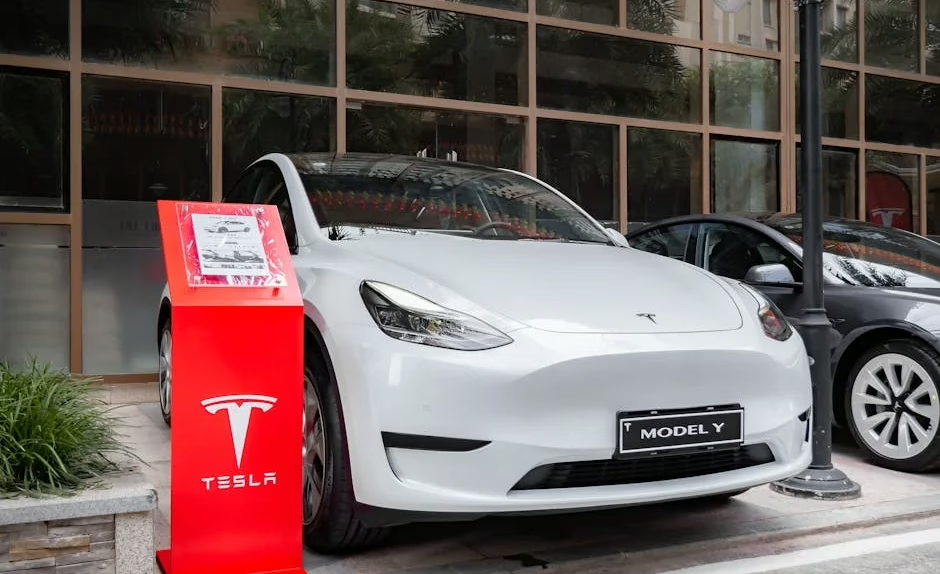
Tesla submitted unredacted crash narratives to the National Highway Traffic Safety Administration (NHTSA) this week, covering 17 incidents recorded by its Austin-based robotaxi network between July 2025 and March 2026. According to TechCrunch, two of those crashes occurred while remote teleoperators — not the autonomous driving system — were in control of the vehicles.
In the first incident, in July 2025, Tesla’s automated driving system stalled on a street in Austin. A safety monitor in the passenger seat requested remote assistance. The teleoperator took over, gradually increased speed, turned the vehicle toward the left side of the road, drove up a curb, and struck a metal fence at 8 mph. The safety monitor reported minor injuries but was not hospitalized.
The second crash, in January 2026, followed a similar pattern. The autonomous system was navigating normally when the safety monitor requested navigation help. The remote driver took control and steered the car directly into a temporary construction barricade at 9 mph, scraping the front left fender and tire. No injuries were reported.
Both crashes occurred at speeds below the 10 mph ceiling Tesla told lawmakers it imposes on teleoperator control. In a letter to a U.S. senator cited by Wired, Tesla described the teleoperator capability as a way to “promptly move a vehicle that may be in a compromising position, thereby mitigating the need to wait for a first responder or Tesla field representative to manually recover the vehicle.”
Why Tesla’s Redaction Reversal Matters
For more than a year, Tesla had marked all crash narrative descriptions as confidential business information when submitting to the NHTSA — a practice that set it apart from every other autonomous vehicle operator required to file similar reports. Wired reported that Tesla reversed course this week without explanation, and the latest NHTSA data release now includes full narrative descriptions for all 17 logged crashes.
The reversal is significant for two reasons. First, it gives regulators, researchers, and the public their first detailed look at how Tesla’s nascent robotaxi network has actually performed in the field. Second, the crash narratives highlight a safety-critical operational layer — remote human oversight — that is rarely discussed in public discourse about autonomous vehicles.
All U.S. self-driving operators maintain remote monitoring teams, according to letters submitted to a U.S. senator and cited by Wired. But Tesla appears to be an outlier in the degree to which it allows those remote workers to directly pilot vehicles, rather than limiting them to monitoring and flagging roles. That distinction becomes consequential when the teleoperator is the proximate cause of a collision.
Tesla, which has no public relations team, did not respond to Wired’s request for comment.
Beijing Auto Show 2026: AI and ADAS Go Mass-Market
While Tesla’s robotaxi program navigates early-stage operational friction, the 2026 Beijing International Automotive Exhibition — held this week — offered a different view of automotive AI’s trajectory. According to Wired’s show coverage, the event featured 1,451 vehicles, including 181 world premieres, making it the largest auto show in history by both exhibition space and vehicle count.
The show’s most consequential trend was the democratization of advanced driver-assistance technology. Lidar sensors — previously confined to premium and luxury segments — are now appearing in Chinese EVs priced below 100,000 yuan (approximately $14,500). Drive-by-wire systems, which replace mechanical steering columns and hydraulic brake lines with electronic signals, featured prominently across multiple manufacturers’ lineups.
Chinese automakers are also moving into smart cockpit software and in-car silicon, areas where they previously depended on foreign suppliers. Even Toyota’s locally produced models in China are now using Huawei’s powertrains and smart cockpit operating system, according to Wired — a detail that signals how thoroughly the competitive calculus has shifted.
Chinese Automakers Close the Premium Gap
The Beijing show reinforced a structural shift that has been building for several years: Chinese manufacturers are no longer competing solely on price. High-end EVs and large SUVs from domestic brands now carry AI-driven features that rival — and in some specifications exceed — what European and American automakers offer at comparable price points.
Key technology areas where Chinese manufacturers are asserting leadership, per Wired’s show analysis:
- Lidar-equipped ADAS at sub-$15,000 price points
- Drive-by-wire steering and braking systems in volume production
- Proprietary in-car chips and AI inference hardware
- Smart cockpit operating systems with deep AI integration
- High-capacity battery systems supporting performance-oriented EVs
The XPeng GX was among the models Wired highlighted as exemplifying this shift, though the full list spans 19 vehicles across multiple manufacturers and segments. The common thread is that features previously associated with $80,000-plus European vehicles are now appearing in Chinese models at a fraction of that cost — and spreading downward into entry-level segments faster than most Western analysts projected.
GM’s AI Push in Vehicle Design and AV Development
General Motors is separately deploying AI tools to accelerate both vehicle design workflows and autonomous vehicle development, according to a report in Automotive News. The specifics of GM’s tooling were not fully available from the source data, but the initiative reflects a broader industry pattern: traditional automakers integrating generative AI and machine learning into engineering pipelines, not just into the vehicles themselves.
GM’s move comes as the company continues rebuilding its autonomous vehicle strategy following the restructuring of its Cruise robotaxi subsidiary. Applying AI to internal design and development processes represents a parallel track — using the technology to reduce time-to-market and engineering costs even as the end-product AV systems remain works in progress.
What This Means
The Tesla NHTSA disclosures and the Beijing Auto Show are, on the surface, unrelated events. But together they define the current state of automotive AI with unusual clarity.
Tesla’s crash data reveals that even the most publicized autonomous vehicle program in the United States is still in an operationally fragile phase — one where human remote operators are a necessary backstop and, occasionally, a liability. The company’s year-long redaction of crash narratives obscured this reality from public scrutiny. Now that the data is visible, it shows a program that is functional but far from the fully autonomous, driverless future Tesla has marketed to consumers and investors.
Meanwhile, the Beijing show demonstrates that the competitive window for U.S. and European automakers to establish AI leadership in vehicles is narrowing. Chinese manufacturers have moved from cost competition to technology competition faster than the industry expected. Lidar at $14,500, drive-by-wire in volume production, and Huawei-powered Toyotas are not future projections — they are products on a show floor today.
For regulators, the Tesla disclosures argue for standardized, non-redactable crash reporting across all AV operators. For automakers outside China, the Beijing show argues for urgency. The two stories share a common thread: automotive AI is no longer a research project. It is a deployed, competitive, and consequential technology — with all the risks and pressures that implies.
FAQ
What caused the Tesla robotaxi crashes reported to the NHTSA?
Both crashes were caused by remote teleoperators — human workers who took control of the autonomous vehicles after safety monitors requested assistance. In each case, the teleoperator drove the car into a fixed object (a metal fence and a construction barricade) at speeds below 10 mph. The autonomous driving system itself was not in control at the moment of impact.
How does Tesla’s crash reporting differ from other autonomous vehicle companies?
Tesla had previously redacted all narrative descriptions in its NHTSA crash filings, citing confidential business information — a practice no other major AV operator followed. The company reversed that position this week, releasing full descriptions for all 17 crashes logged since its Austin robotaxi network launched in mid-2025. The reason for the reversal has not been disclosed.
Why are Chinese automakers significant in the ADAS and automotive AI market?
Chinese manufacturers have moved from competing primarily on low vehicle prices to competing on technology, deploying lidar sensors, drive-by-wire systems, and AI-integrated cockpits at price points well below what Western automakers offer with comparable features. The 2026 Beijing Auto Show, the largest in history with 1,451 vehicles and 181 world premieres, illustrated how rapidly these technologies are spreading from premium to entry-level segments in the Chinese market.
Sources
- The 19 Most Exciting Cars at the Beijing Auto Show 2026 – Wired
- Tesla Reveals New Details About Robotaxi Crashes—and the Humans Involved – Wired
- Tesla reveals two Robotaxi crashes involving teleoperators – TechCrunch
- GM deploys AI tools to speed vehicle design and autonomous vehicle development – Automotive News – Google News – AI Tools
- Joanna Stern is not a robot, but she lived with them – The Verge