
Artificial intelligence is transforming how we drive, with Tesla’s Autopilot and Waymo’s autonomous technology leading the charge in different directions. While Tesla focuses on camera-based systems for consumer EVs, Waymo pursues full autonomy through LiDAR and extensive mapping. Understanding these approaches helps consumers navigate the evolving landscape of AI-powered driving assistance.
The automotive AI market is projected to reach $74.5 billion by 2030, driven by advances in ADAS (Advanced Driver Assistance Systems) and autonomous vehicle development. For everyday drivers, this means smarter safety features, improved convenience, and gradually increasing automation in our daily commutes.
Tesla’s Vision-First Approach
Tesla has built its reputation on a vision-only approach to autonomous driving, relying primarily on cameras and neural networks rather than expensive LiDAR sensors. This strategy makes Tesla’s ADAS features more accessible to mainstream consumers.
Current Tesla Autopilot Features
Tesla’s Full Self-Driving (FSD) Beta offers several practical features for daily driving:
- Traffic Light Recognition: Automatically stops at red lights and proceeds on green
- Navigate on Autopilot: Handles highway interchanges and lane changes
- Smart Summon: Moves your car through parking lots to pick you up
- Auto Lane Change: Suggests and executes lane changes when safe
The user interface is surprisingly intuitive. Tesla’s touchscreen displays exactly what the car “sees” – other vehicles, pedestrians, and road markings appear as colorful representations. This transparency helps drivers understand when to trust the system and when to take control.
Real-World Performance
In practice, Tesla’s Autopilot excels on highways but struggles in complex urban environments. The system handles long-distance highway driving impressively, maintaining proper following distances and executing smooth lane changes. However, construction zones and unusual road configurations can confuse the vision-based system.
Tesla owners report that Autopilot reduces driving fatigue on long trips, though constant supervision remains necessary. The system requires drivers to apply pressure to the steering wheel every 15-30 seconds, ensuring attention stays on the road.
Waymo’s Comprehensive Autonomy Strategy
Waymo takes a fundamentally different approach, combining multiple sensor types including LiDAR, radar, and cameras to create detailed 3D maps of the environment. This redundancy aims for true Level 4 autonomy – no human driver required.
Advanced Sensor Integration
Waymo’s vehicles feature:
- 360-degree LiDAR: Creates precise distance measurements up to 300 meters
- High-resolution cameras: Capture fine details like traffic light colors
- Radar sensors: Detect objects through weather conditions
- Audio detection: Identifies emergency vehicle sirens
This sensor fusion approach costs significantly more than Tesla’s camera-only system but provides superior object detection and classification accuracy.
Geographic Limitations and Expansion
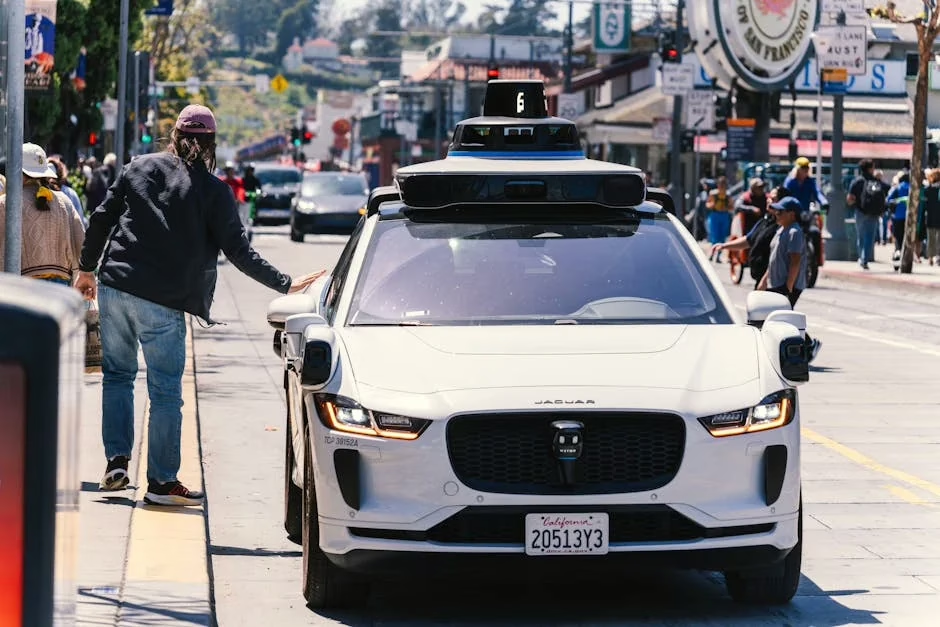
Currently, Waymo operates commercial robotaxi services in Phoenix, San Francisco, and Los Angeles. The company pre-maps these areas extensively, creating detailed 3D representations of every street, traffic light, and road sign.
This mapping requirement limits Waymo’s scalability compared to Tesla’s approach, which works anywhere without prior mapping. However, within mapped areas, Waymo’s performance surpasses human drivers in many scenarios.
ADAS Features Across the Industry
Beyond Tesla and Waymo, traditional automakers are integrating AI-powered ADAS features into mainstream vehicles. These systems focus on immediate safety benefits rather than full autonomy.
Standard ADAS Technologies
Modern vehicles increasingly include:
- Automatic Emergency Braking: Prevents rear-end collisions
- Blind Spot Monitoring: Alerts drivers to vehicles in adjacent lanes
- Lane Departure Warning: Guides vehicles back into proper lanes
- Adaptive Cruise Control: Maintains safe following distances automatically
These features work reliably across different weather conditions and road types, making them more universally applicable than advanced autonomous systems.
User Experience Considerations
The best ADAS systems balance automation with driver engagement. Overly intrusive warnings can frustrate drivers, while insufficient feedback creates dangerous overconfidence in the technology.
Successful implementations use subtle visual and audio cues that inform without overwhelming. For example, gentle steering wheel vibrations for lane departure warnings feel more natural than loud beeping sounds.
EV Integration and AI Synergy
Electric vehicles provide ideal platforms for advanced AI systems due to their sophisticated electrical architectures and over-the-air update capabilities. Tesla pioneered this integration, but other EV manufacturers are rapidly catching up.
Computational Requirements
AI-powered driving systems require significant processing power:
- Tesla’s FSD Computer: Processes 2,300 frames per second from eight cameras
- Waymo’s Custom Chips: Handle real-time sensor fusion from dozens of inputs
- Traditional Automakers: Partner with NVIDIA and Qualcomm for AI processing
EVs’ large battery packs easily support these power-hungry computers, while internal combustion vehicles face greater integration challenges.
Software Update Advantages
Unlike traditional vehicles, modern EVs receive regular software updates that improve driving capabilities over time. Tesla owners have experienced dramatic improvements in Autopilot performance through these updates, effectively upgrading their vehicles’ capabilities without visiting a service center.
This software-first approach means purchasing an EV with basic ADAS features today could result in significantly enhanced capabilities within months or years.
What This Means
The automotive AI landscape presents consumers with increasingly sophisticated options, each with distinct advantages and limitations. Tesla’s vision-based approach offers accessible automation for highway driving and simple urban scenarios, while Waymo’s comprehensive sensor suite enables true autonomy within mapped areas.
For most consumers, current ADAS features provide the greatest immediate value. Technologies like automatic emergency braking and adaptive cruise control work reliably across diverse conditions, reducing accident risk and driving stress without requiring perfect conditions or specific geographic areas.
The competition between different AI approaches benefits consumers through rapid innovation and falling costs. As these technologies mature, we can expect broader availability of advanced features and improved reliability across various driving scenarios.
Choosing between these systems depends on individual priorities: Tesla appeals to tech enthusiasts wanting cutting-edge features and regular updates, while traditional ADAS systems suit drivers preferring proven reliability over experimental capabilities.
FAQ
Q: Is Tesla’s Full Self-Driving actually fully autonomous?
A: No, Tesla’s FSD requires constant driver supervision and intervention. It’s classified as Level 2 automation, meaning the human driver remains responsible for vehicle operation at all times.
Q: Can I use Waymo’s robotaxi service anywhere?
A: Waymo currently operates only in Phoenix, San Francisco, and Los Angeles. The service requires extensive pre-mapping and testing before expanding to new cities.
Q: Are ADAS features worth the extra cost?
A: Basic ADAS features like automatic emergency braking and blind spot monitoring provide proven safety benefits and are increasingly standard equipment. Advanced features like Tesla’s FSD carry higher costs with less certain value propositions.
For the broader 2026 landscape across research, industry, and policy, see our State of AI 2026 reference.