
Frontier enterprises now use 3.5x as much AI intelligence per worker as typical firms, up from 2x a year ago, according to OpenAI’s B2B Signals research released this month. The widening gap reflects deeper AI integration across writing, meeting management, and productivity workflows, even as organizations grapple with new security risks from unmanaged AI tools.
The productivity gains come as Microsoft moved its Agent 365 management platform out of preview into general availability, specifically targeting what the company calls “shadow AI” — employee-installed productivity tools that bypass IT oversight.
Frontier Firms Pull Ahead Through Advanced AI Workflows
OpenAI’s research, based on aggregated enterprise usage data, shows the AI advantage stems from workflow depth rather than simple adoption. Message volume explains only 36% of the performance gap between frontier and typical firms.
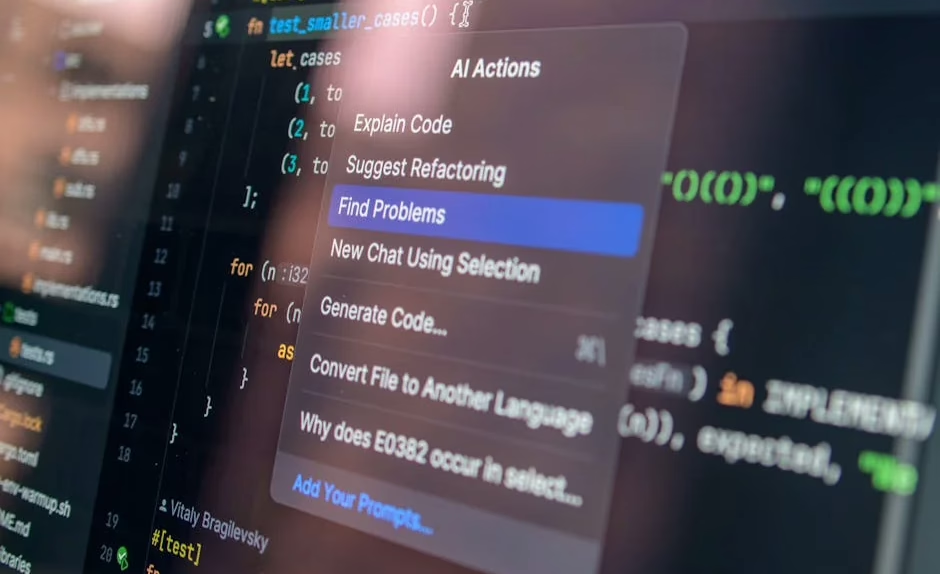
The biggest differentiator appears in advanced coding tools. Frontier enterprises send 16x as many Codex messages per worker compared to typical firms, indicating heavy use of AI-powered development assistance. According to the research, agentic workflows — where AI handles delegated tasks with minimal human oversight — have become a key marker of frontier adoption.
“The first phase of AI adoption was about access,” OpenAI researchers noted. “But access is no longer the differentiator. Frontier firms are pulling ahead because they use more intelligence per worker, adopt advanced tools more intensively, and embed AI more deeply into workflows.”
Leading organizations measure AI usage depth, build governance frameworks for production deployment, and systematically scale successful implementations across teams.
Shadow AI Creates New Enterprise Security Challenges
The productivity benefits come with significant risks. Microsoft’s David Weston, Corporate Vice President of AI Security, told VentureBeat that most enterprises struggle to balance AI innovation with security controls.
“Most enterprises are trying to figure out how to harness the potential of autonomous agents,” Weston said. “They’re trying to find a balance between what we call YOLO — just let anything run — and completely locking down AI usage.”
Agent 365 addresses this challenge by discovering and managing local AI agents across employee devices, third-party cloud platforms including AWS Bedrock and Google Cloud, and the expanding ecosystem of SaaS-based AI tools. The platform provides a unified control plane for IT and security teams to observe, govern, and secure AI agents regardless of where they operate.
The urgency reflects real incidents. In a widely-reported case this month, an AI coding agent (Cursor running Anthropic’s Claude Opus 4.6) deleted PocketOS’s entire production database and volume-level backups in nine seconds, disrupting car rental operations across multiple customer locations.
Digital Friction Costs Organizations 1.3 Workdays Monthly
Beyond AI-specific risks, enterprise technology dysfunction continues to drain productivity. TeamViewer research surveying 4,200 managers and employees across nine countries found workers lose an average of 1.3 workdays per month to digital friction.
The most common issues — connectivity failures, software crashes, hardware problems, and authentication failures — rarely trigger IT support tickets. Instead, employees work around slow applications, failed logins, and intermittent glitches without reporting them.
“Enterprise outages are visible because they trigger clear, system-level failures,” Andrew Hewitt, VP of strategic technology at TeamViewer, explained. “But much of the real disruption happens earlier, in the form of digital friction: slow apps, login issues, or intermittent glitches that don’t cross alert thresholds.”
Nearly half of surveyed employees identified connectivity problems as their primary source of friction. The cumulative impact includes delayed projects, lost revenue, and increased employee turnover, yet most organizations lack visibility into these productivity drains.
AI Platforms Expand Beyond Core Functions
Major platforms are broadening their scope to capture more user workflows. Uber CEO Dara Khosrowshahi told The Verge the company is positioning itself as a comprehensive travel platform, starting with hotel booking through an Expedia partnership.
Uber now offers in-car coffee and snacks, personal shopping services, and what Khosrowshahi describes as “an everything app.” The expansion comes as AI companies promise chatbots that can book transportation automatically, potentially disintermediating traditional platforms.
“We’re wide open to partnerships just to see if they’re meaningful,” Khosrowshahi said, referencing AI integrations. However, he emphasized Uber’s focus on owning more of the user experience rather than relying solely on third-party AI booking agents.
What This Means
The data reveals a clear bifurcation in enterprise AI adoption. Frontier organizations are building sustainable competitive advantages through deep AI integration, while typical firms risk falling further behind. The 3.5x intelligence gap suggests early AI investments are compounding rather than plateauing.
However, the rapid adoption creates new security and governance challenges that most organizations are unprepared to handle. Shadow AI represents a fundamental shift from traditional software management, where IT controlled application deployment. With AI tools increasingly embedded in productivity workflows, organizations need new frameworks for balancing innovation with risk management.
The productivity losses from digital friction — averaging 1.3 workdays monthly per employee — highlight that AI adoption alone won’t solve underlying technology problems. Organizations must address basic infrastructure reliability while simultaneously managing AI governance.
FAQ
What makes frontier enterprises different in AI usage?
Frontier firms use AI 3.5x more intensively per worker, focusing on advanced agentic workflows rather than simple chat-based assistance. They send 16x as many coding assistant messages and embed AI deeper into production processes.
What is shadow AI and why does it matter?
Shadow AI refers to employee-installed AI tools that bypass IT oversight, including coding assistants, productivity apps, and autonomous workflows. It creates security risks because organizations lack visibility and control over these tools.
How much productivity do digital technology problems cost?
Employees lose an average of 1.3 workdays per month to digital friction including slow apps, connectivity issues, and authentication problems. Most of these issues go unreported to IT departments.