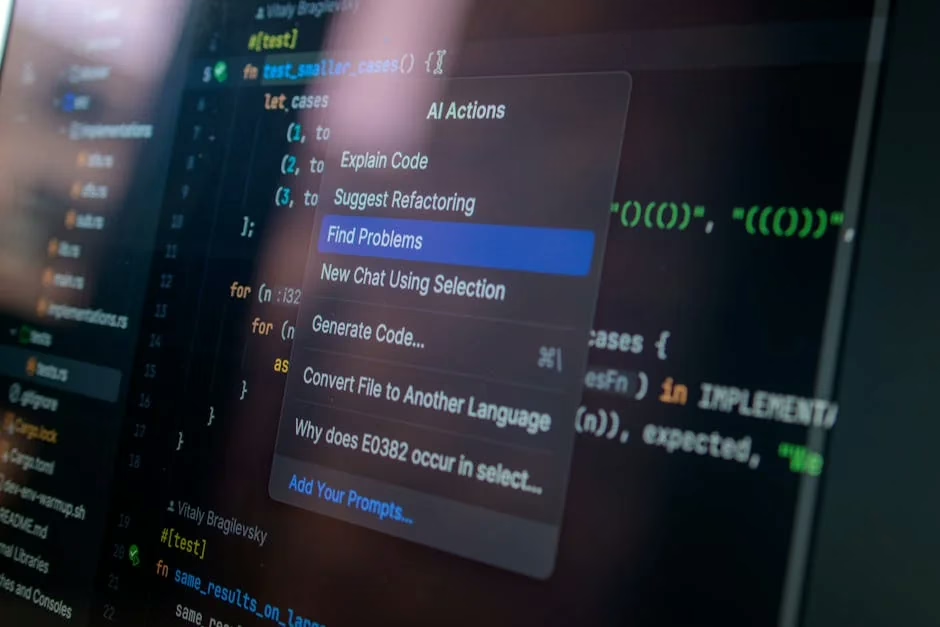

Salesforce on Wednesday unveiled Headless 360, its most ambitious architectural transformation in 27 years, exposing every platform capability as APIs, MCP tools, and CLI commands for AI agent operation. The announcement at the company’s TDX developer conference in San Francisco ships more than 100 new tools immediately available to developers.
The initiative marks Salesforce’s decisive response to whether enterprise software needs graphical interfaces in an AI-driven world. According to Salesforce’s announcement, the company decided two and a half years ago to “rebuild Salesforce for agents” rather than bury capabilities behind traditional UIs.
Enterprise Software Faces AI Disruption
The timing reflects broader turbulence in enterprise software, with the iShares Expanded Tech-Software Sector ETF down roughly 28% from its September peak. Industry fears center on AI potentially rendering traditional SaaS business models obsolete.
Jayesh Govindarjan, EVP at Salesforce and key architect behind Headless 360, described the announcement as rooted in fundamental platform reimagining rather than incremental feature additions. The platform transformation enables AI agents to reason, plan, and execute across Salesforce’s entire ecosystem without browser interfaces.
Anthropic Expands Into Design Tools
Anthropic today launched Claude Design from its Anthropic Labs division, enabling users to create visual work through conversational prompts. The product, available immediately to all paid Claude subscribers, challenges established players like Figma, Adobe, and Canva.
Claude Design is powered by Claude Opus 4.7, Anthropic’s most capable vision model also released today. The company is rolling access gradually to Claude Pro, Max, Team, and Enterprise subscribers throughout the day.
The simultaneous launches mark Anthropic’s expansion from foundation model provider to full-stack product company. According to Bloomberg, Anthropic hit roughly $20 billion in annualized revenue in early March 2026, surpassing $30 billion by early April. The company is in early talks with Goldman Sachs, JPMorgan, and Morgan Stanley about a potential IPO as early as October 2026.
Security Tools Face New AI Attack Vectors
Adversaries injected malicious prompts into legitimate AI tools at more than 90 organizations in 2025, according to CrowdStrike’s Global Threat Report. While compromised tools could only read data, the next generation of autonomous SOC agents shipping now possess write access to critical infrastructure.
Cisco announced AgenticOps for Security in February, featuring autonomous firewall remediation and PCI-DSS compliance capabilities. Ivanti launched Continuous Compliance and Neurons AI last week with built-in policy enforcement and approval gates.
The escalation from read-only compromised tools to autonomous agents with infrastructure write access creates new attack vectors. A compromised SOC agent can rewrite firewall rules, modify IAM policies, and quarantine endpoints through approved API calls that EDR systems classify as authorized activity.
Microsoft Partners Drive AI Production Deployment
Microsoft outlined its Frontier Transformation framework as AI moves from experimentation to production deployment. The approach focuses on two essential elements: intelligence grounded in unique work contexts and trust through observable, managed AI artifacts.
According to Microsoft’s blog, partners differentiate by turning ideas into deployable solutions, prioritizing high-value use cases, and establishing governance for reliable production AI operation. The framework emphasizes moving from targeted pilots to operating AI at scale with unified governance.
Customers increasingly demand measurable business outcomes with security, governance, and responsible AI built from day one. Microsoft partners address these requirements by building proper data and security foundations while establishing adoption and measurement capabilities.
Google Documents 1,302 Enterprise AI Use Cases
Google expanded its real-world generative AI use case documentation to 1,302 examples from leading organizations, up from 101 cases published two years ago. The Google Cloud blog describes this as evidence of the “agentic enterprise” era, with production AI deployed meaningfully across thousands of organizations.
The majority showcase agentic AI applications built with Gemini Enterprise, Gemini CLI, Security Command Center, and AI Hypercomputer infrastructure. Google enlisted Gemini Enterprise running the latest Gemini Pro models to analyze the complete dataset and surface notable trends.
The rapid expansion from 101 to 1,302 documented use cases demonstrates what Google calls “the fastest technological transformation we’ve seen,” driven by customer enthusiasm rather than vendor push.
What This Means
These launches signal a fundamental shift in enterprise software architecture, with major vendors racing to rebuild platforms for AI-first operation. Salesforce’s Headless 360 represents the most radical transformation, essentially admitting that traditional UIs may become obsolete in agent-driven workflows.
The security implications are significant. While current AI tool compromises only enabled data theft, the new generation of autonomous agents with write access to critical infrastructure creates unprecedented attack surfaces. Organizations deploying these tools must implement robust governance frameworks before adversaries exploit the expanded capabilities.
Anthropic’s move into design tools demonstrates how AI companies are expanding beyond foundation models into application layers, directly challenging established software categories. This vertical integration strategy may become necessary as AI capabilities commoditize and differentiation moves to the application layer.
FAQ
What is Salesforce Headless 360?
Headless 360 is Salesforce’s architectural transformation that exposes every platform capability as APIs, MCP tools, and CLI commands, enabling AI agents to operate the entire system without graphical interfaces. It ships with more than 100 new developer tools immediately available.
How do autonomous SOC agents create new security risks?
Unlike previous AI tools that could only read data, autonomous SOC agents have write access to critical infrastructure like firewalls and IAM policies. If compromised, they can modify security configurations through legitimate API calls that appear as authorized activity to monitoring systems.
What makes Claude Design different from existing design tools?
Claude Design allows users to create visual work through conversational prompts rather than traditional design interfaces. Powered by Claude Opus 4.7, it can generate designs, interactive prototypes, and marketing materials directly from text descriptions, challenging established players like Figma and Adobe.
Related news
- Discord Sleuths Gained Unauthorized Access to Anthropic’s Mythos – Wired
- AI-Driven Cybersecurity: Transforming Enterprise Security with Intelligent Automation – Security Boulevard – Google News – AI Security
- Google to invest up to $40 billion in Anthropic as search giant spreads its AI bets – CNBC Tech