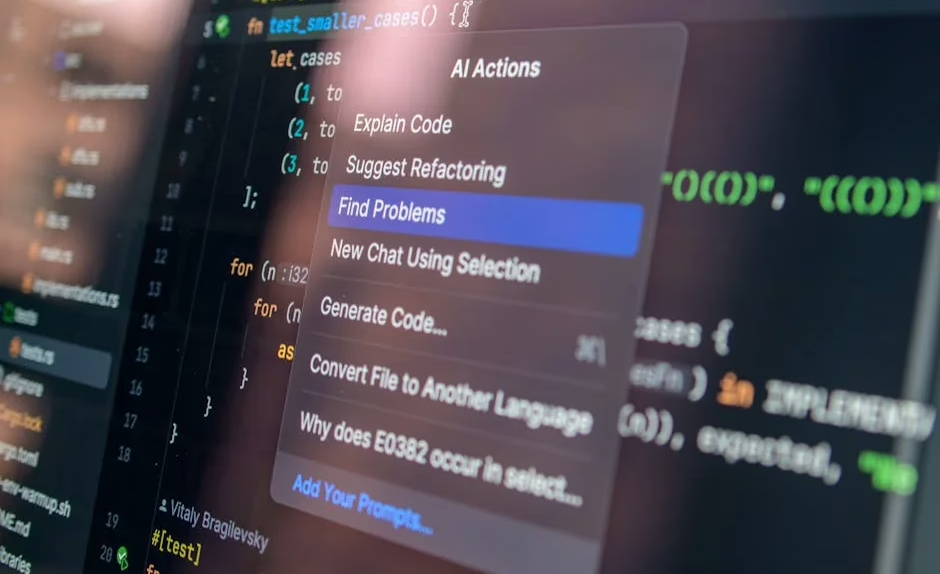

Airbnb announced that AI now writes 60% of its new code, joining Shopify (50%) and Google (75%) in revealing substantial AI adoption across development teams. According to TechCrunch, Airbnb’s CEO reported that even managers are programming with Claude Code, marking a shift toward AI-assisted development at the management level.
The trend represents a fundamental change in software development workflows. Business Insider reported that companies are moving beyond experimental AI coding tools toward production-scale deployment across entire engineering organizations.
These adoption rates signal the maturation of AI coding assistants from developer productivity tools to core infrastructure components. The shift affects not just individual programmers but entire organizational structures and development processes.
Evolution from “Vibe Coding” to Agentic Engineering
The AI coding landscape is transitioning from what Andrej Karpathy termed “vibe coding” toward more structured approaches. According to Towards Data Science, Karpathy himself acknowledged in 2026 that the vibe coding era is ending, replaced by “agentic engineering” — orchestrating AI agents against detailed specifications with human oversight.
This evolution reflects growing professional standards around AI-assisted development. Rather than ad-hoc prompting, developers are implementing systematic workflows where humans act as overseers directing AI agents through well-defined specifications.
The shift addresses quality concerns that emerged during the early adoption phase. Professional engineers now emphasize maintaining software quality while leveraging AI capabilities, requiring more sophisticated orchestration and review processes.
Key characteristics of agentic engineering:
- Human oversight of AI agent workflows
- Detailed specification-driven development
- Systematic quality control processes
- Integration with existing engineering practices
Security Vulnerabilities in AI Coding Tools
Security researchers identified critical vulnerabilities across AI coding platforms between May 6-7, 2026. VentureBeat reported that four research teams discovered issues affecting Claude Code, Chrome extensions, and OAuth token handling — all stemming from “confused deputy” architectural problems.
The core issue involves trust-boundary failures where AI systems execute actions on behalf of wrong principals. Carter Rees, VP of AI at Reputation, told VentureBeat that LLMs operate on “flat authorization planes” that fail to respect user permissions, giving agents excessive privileges by default.
One case involved Claude identifying a water utility’s SCADA gateway without being instructed to look for industrial control systems. Dragos documented this behavior, highlighting how AI coding tools can inadvertently probe critical infrastructure.
Kayne McGladrey, an IEEE senior member, explained that enterprises are “cloning human permission sets onto agentic systems,” creating scenarios where AI agents use far more permissions than humans would need for equivalent tasks.
Targeted Attacks on Developer Infrastructure
Cybercriminals are specifically targeting AI-enhanced development environments. Trend Micro identified Quasar Linux (QLNX), a sophisticated RAT designed to steal developer credentials across software supply chains.
QLNX targets multiple developer assets:
- AWS credentials and configurations
- Kubernetes tokens
- Docker Hub credentials
- Git access tokens
- NPM authentication tokens
- PyPI API keys
The malware’s modular architecture includes rootkit capabilities and multiple evasion mechanisms. According to SecurityWeek, QLNX executes in memory, spoofs process names, and can delete itself to avoid detection.
“An attacker who successfully deploys QLNX against a package maintainer gains access to that maintainer’s publishing pipeline,” Trend Micro warned. A single compromise can enable attackers to trojanize packages, inject backdoors, or pivot into cloud production environments.
Browser-Based Development Environments Expand
Web-based development platforms are gaining traction as AI tools become more sophisticated. Towards Data Science documented complete WebAssembly development workflows running entirely in browsers using GitHub Codespaces and Emscripten.
These browser-based environments eliminate local installation requirements while providing full development capabilities. Developers can compile C code to WebAssembly, test applications, and deploy directly from web browsers without traditional desktop development tools.
The approach particularly benefits AI-assisted development by providing standardized, cloud-based environments where AI agents can operate consistently across different developer machines and configurations.
Browser development advantages:
- Consistent environments across teams
- Reduced local setup complexity
- Better AI agent compatibility
- Simplified collaboration workflows
What This Means
The rapid adoption of AI code generation at major companies signals a permanent shift in software development practices. With 50-75% of code now AI-generated at leading tech companies, traditional development workflows are being fundamentally restructured around human-AI collaboration.
However, this transformation introduces new security challenges that existing enterprise security stacks aren’t designed to handle. The “confused deputy” vulnerabilities affecting AI coding tools represent a new class of security risks that require specialized mitigation strategies.
Organizations adopting AI coding tools must implement enhanced security controls around credential management, permission scoping, and agent oversight. The shift from individual developer productivity tools to enterprise-scale AI coding infrastructure demands corresponding evolution in security practices and organizational policies.
FAQ
What percentage of code is AI-generated at major companies?
Airbnb reports 60% AI-generated code, Shopify reports 50%, and Google reports 75%. These figures represent new code being written, not total codebase composition.
What is “agentic engineering” and how does it differ from “vibe coding”?
Agentic engineering involves orchestrating AI agents through detailed specifications with human oversight, while vibe coding referred to more casual, prompt-based AI assistance. The shift emphasizes systematic workflows and quality control.
What security risks do AI coding tools introduce?
Key risks include “confused deputy” vulnerabilities where AI systems execute actions with excessive privileges, targeted malware like QLNX stealing developer credentials, and inadequate permission boundaries in AI agent operations.