
The Rise of AI Innovation: From Google’s Gemini to Microsoft’s o3-mini-high
In a rapidly evolving AI landscape, tech giants and startups alike are pushing the boundaries of what artificial intelligence can accomplish. Recent developments from Google, Microsoft, and other players highlight the accelerating pace of innovation in this field.
Google’s State-of-the-Art Text Embedding
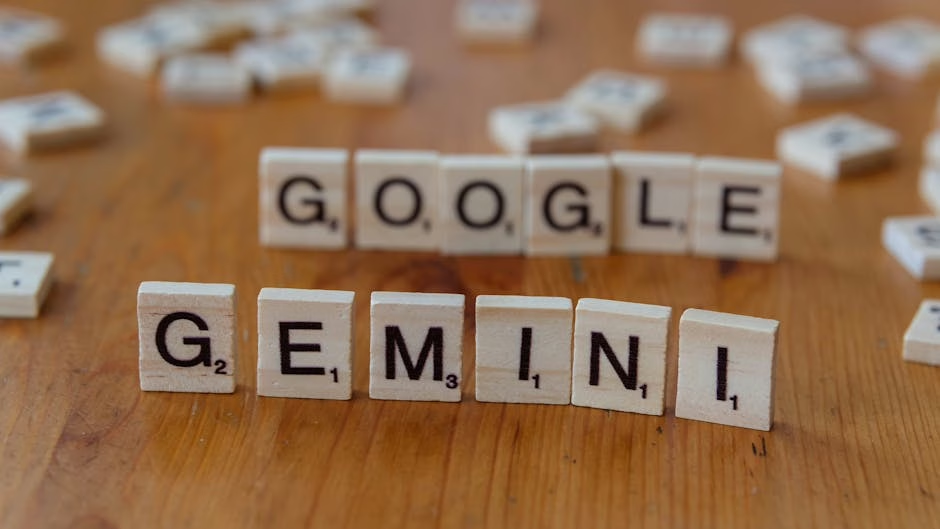
Google has recently released state-of-the-art text embedding capabilities via the Gemini API, marking a significant advancement in how AI systems can understand and process textual information. This development builds upon Google’s broader AI strategy, which includes Gemini 2.0’s enhanced code execution capabilities.
A Google Developers Blog post detailed how the new embedding model enables more sophisticated text analysis and understanding, potentially improving various applications from search to content recommendation. The Gemini embedding text model represents a leap forward in how machines can interpret human language and context.
Meanwhile, Google’s Imagen 3 model has been generating buzz for its impressive visual capabilities. Users on social media platforms have been showcasing the model’s ability to create remarkably detailed and realistic images, with some describing it as “insane” in terms of quality and coherence. The model appears particularly adept at generating complex scenes, including cyberpunk environments when paired with other tools like Kling 1.6.
Microsoft’s Strategic AI Moves
Not to be outdone, Microsoft has made significant announcements regarding its AI offerings. Microsoft Copilot users now have free, unlimited access to the o3-mini-high model, a move that substantially enhances the capabilities available to users without additional cost.
According to reports, the “Think Deeper” feature in Copilot has been upgraded and is now powered by the o3-mini-high model. This enhancement allows users to engage in more sophisticated reasoning and problem-solving with the AI assistant, potentially closing the gap with competitors like Claude and GPT models.
AI in Government and Security
Beyond consumer applications, AI is increasingly finding its way into government operations. The U.S. State Department has announced plans to use AI to check tens of thousands of social media accounts belonging to foreign students, raising questions about privacy, accuracy, and the expanding role of artificial intelligence in security and immigration matters.
This development comes amid growing concerns about AI systems being potentially influenced by biased information. Reports indicate that a Moscow-based global news network has allegedly “infected” Western artificial intelligence tools with Russian propaganda, highlighting the vulnerability of AI training data to manipulation.
Benchmark Wars and Model Comparisons
As new models emerge, the AI community has been actively benchmarking their performance. Claude 3.7 Sonnet with its “Thinking” capability has shown impressive results across multiple benchmarks, often outperforming other models including GPT-4.5 Preview.
One analysis averaged the performance of Claude 3.7 and GPT-4.5 across 11 different benchmarks, with Claude-3.7-Sonnet-Thinking scoring 69.41%, followed by GPT-4.5-Preview at 66.26%, and Claude-3.7-Sonnet at 61.63%. These benchmarks test various capabilities including math, reasoning, coding, language skills, and resistance to hallucination.
However, some users have raised concerns about benchmarking methodologies, noting that models like QwQ utilize 2-3 times more tokens to solve tasks compared to models like R1. This token usage has significant implications for pricing and latency when deploying these models in real-world applications.
Innovative AI Applications
Beyond the core models, novel applications of AI continue to emerge. Researchers have created what’s being called the world’s first “Synthetic Biological Intelligence” that runs on living human cells, potentially opening new frontiers in computing that blend biology and technology.
In the entertainment sphere, AI-generated content is making strides with projects like “ANTIVILLAIN,” billed as the first AI-generated musical. This demonstrates how creative fields previously thought to be uniquely human domains are increasingly being influenced by artificial intelligence.
The Sesame voice model has also garnered attention for its ability to cross “the uncanny valley of voice,” with some users reporting that it provides the first genuinely real-feeling conversational experience they’ve had with an AI.
Looking Ahead: Cooperation or Competition?
As AI capabilities continue to advance, questions about international cooperation versus competition are coming to the fore. China’s ambassador has warned that the U.S. and China need to cooperate on AI or risk “opening Pandora’s box,” suggesting that unregulated competition in AI development could lead to unforeseen and potentially dangerous consequences.
Meanwhile, speculation about future models like GPT-5 continues, with users eager for information about release dates and potential capabilities. The rapid pace of advancement has some analysts predicting that the differences between consecutive years (like 2030 and 2031) will eventually be greater than those between decades (like 2000 and 2020) once technological singularity is approached.
As these developments unfold, the AI landscape continues to evolve at a breathtaking pace, promising both exciting opportunities and significant challenges for society, industry, and individuals alike.
Sources
- State-of-the-art text embedding via the Gemini API – Reddit Singularity
- The State Department will use AI to check tens of thousands of social media accounts from foreign students — the new use of AI? – Reddit Singularity
- Laser light made into a supersolid for the first time – Reddit Singularity
- Google’s Imagen 3 Model is Insane – Reddit Singularity
- Google finally adding AI search. – Reddit Singularity
- Real-time control of Newtonian fluids using the Navier-Stokes equations – Google Scholar – Hinton
- ANTIVILLAIN (The First AI Generated Musical) – Reddit Singularity
- Microsoft Copilot users get free, unlimited access to o3-mini-high model – Reddit Singularity
- Beautiful Cyberpunk Scene using Imagen 3 + Kling 1.6 – Reddit Singularity
- A well-funded Moscow-based global ‘news’ network has infected Western artificial intelligence tools worldwide with Russian propaganda – Reddit Singularity
- GPT-4.5 seems the first model to kinda “play” Minecraft purely from screenshots (details and prompt in comments) – Reddit Singularity
- News 📰 Trump, Chip Maker TSMC Expected to Announce $100 Billion Investment in the US, per WSJ. – Reddit Singularity
- Elon Musk’s AI chatbot says a ‘Russian asset’ delivered the State of the Union – Reddit Singularity
- GPT-4.5 Preview takes first place in the Elimination Game Benchmark, which tests social reasoning (forming alliances, deception, appearing non-threatening, and persuading the jury). – Reddit Singularity
- qwq LiveBench – LCB generation beats the state-of-the-art. – Reddit Singularity
- Think Deeper just got smarter. Now powered by o3-mini-high free in Copilot. – Reddit Singularity
- News article: World’s largest call center using AI to ‘neutralize’ Indian employees’ accents – Reddit Singularity
- GPT 5 release date and capabilities? – Reddit Singularity
- Any word on the timeline for Meta’s next release? – Reddit Singularity
- Scientists discover a protein that reverses cellular aging. “The results were very intriguing,” said Shinji Deguchi, senior author of the study. “Suppressing AP2A1 in older cells reversed senescence and promoted cellular rejuvenation, while ΑΡ2Α1 oνerexpression in young cells advanced senescence. – Reddit Singularity
- Stanford NLP Group Founder and early Transformer LLM researcher Professor Christopher Manning: “Large Language Models in 2025 – How Much Understanding and Intelligence?” (40 minutes) – Reddit Singularity
- LADDER: Self-Improving LLMs Through Recursive Problem Decomposition – Reddit Singularity
- Gemini 2.0 Deep Dive: Code Execution – Reddit Singularity
- Israeli Supreme Court is Fed Up with lawyers using AI “Hallucinations”: For the Second Time This Week, Petitioners Relied on AI Fabricated Rulings (Translation in comments) – Reddit Singularity
- Scientists identify ‘inflammation’ gene that hastens aging – Reddit Singularity
- Good exemples of mind blowing project currently ongoing? – Reddit Singularity
- World’s first “Synthetic Biological Intelligence” runs on living human cells. – Reddit Singularity
- Factory begins trial for humanoid robots that can build more of themselves – Reddit Singularity
- The Sesame voice model has been THE moment for me – Reddit Singularity
- China and US need to cooperate on AI or risk ‘opening Pandora’s box’, ambassador warns – Reddit Singularity
- Convince me that the majority of the population won’t become the movie “Her” – Reddit Singularity
- Chain of Draft: Thinking Faster by Writing Less. “CoD matches or surpasses CoT in accuracy while using as little as only 7.6% of the tokens, significantly reducing cost and latency across various reasoning tasks” – Reddit Singularity
- Is ChatGPT Pro ($200/month) Still Worth It? – Reddit Singularity
- Huge issue with reasoning model benchmarks – Reddit Singularity
- Deepseek shadowbanned in X? – Reddit Singularity
- Is there a realistic scenario where AGI and ASI doesn’t just benefit the wealthy, and makes life worse for the rest of us? – Reddit Singularity
- I averaged the performance of Claude 3.7 and GPT-4.5 across 11 different benchmarks and here are the results – Reddit Singularity
- Failed prediction of the week from Joe Russo: “AI will be able to to create a full movie within two years” (made on April 2023) – Reddit Singularity
- Believing AGI/ASI will only benefit the rich is a foolish assumption. – Reddit Singularity
- GPT-4.5 hallucination rate, in practice, is too high for reasonable use – Reddit Singularity
- Could it be possible to dynamically change reasoning effort of CoT models with just 1 single special token in the system message? – Reddit Singularity
- What are all other free AI chat applications are out now? This post has information about ChatGPT, Claude, Le Chat, DeepSeek, Gemini studio, Poe. – Reddit Singularity
- GPT4.5 Review from a physician. This is on a whole other level for non reasoning tasks. – Reddit Singularity
- I genuinely don’t understand people convincing themselves we’ve plateaued… – Reddit Singularity
- Empirical evidence that GPT-4.5 is actually beating scaling expectations. – Reddit Singularity
- How I see radical longevity will happen after singularity – Reddit Singularity
- Software Developers – Stop worrying and start preparing! – Reddit Singularity
- Well, gpt-4.5 just crushed my personal benchmark everything else fails miserably – Reddit Singularity