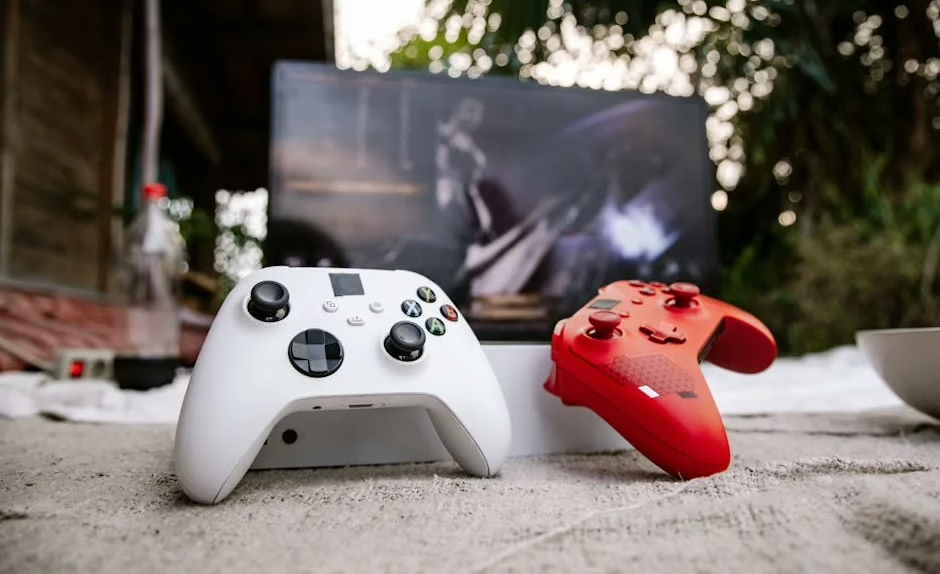

Microsoft discontinued its Xbox Copilot AI project on Tuesday while simultaneously launching Agent 365 out of preview, marking a strategic pivot toward enterprise AI governance as the company addresses what executives call “shadow AI” threats in corporate environments.
Xbox CEO Asha Sharma announced the company is “winding down Copilot on mobile” and “will stop development of Copilot on console,” according to The Verge. The decision follows Sharma’s reorganization of the Xbox platform team, which added executives from Microsoft’s CoreAI division to Xbox operations.
Agent 365 Addresses Shadow AI Concerns
Microsoft took Agent 365 into general availability last week, positioning the platform as a unified control system for enterprise AI governance. The product lets IT and security teams monitor AI agents across Microsoft’s ecosystem, third-party platforms including AWS Bedrock and Google Cloud, and employee endpoints.
“Most enterprises are trying to figure out how to harness the potential of autonomous agents,” David Weston, Corporate Vice President of AI Security at Microsoft, told VentureBeat. “They’re trying to find a balance between what we call YOLO — just let anything run.”
The platform specifically targets “shadow AI” — coding assistants, productivity tools, and autonomous workflows that employees install without IT approval. Microsoft identifies this as an emerging enterprise security risk that most organizations are beginning to address.
OpenAI Partnership History Revealed in Court
Court documents from the ongoing Musk v. Altman trial revealed Microsoft executives’ early reservations about OpenAI funding dating back to 2017. According to The Verge, internal emails showed Microsoft worried OpenAI could “storm off to Amazon” and “shit-talk” Azure if the partnership failed.
The emails, presented as evidence Thursday, show CEO Satya Nadella and other Microsoft executives expressing doubts about OpenAI’s potential for artificial general intelligence breakthroughs. Several executives reported that visits to OpenAI’s offices in 2017-2018 did not indicate imminent AGI developments, according to Wired.
Microsoft initially provided $60 million in discounted cloud computing services to OpenAI in 2016. OpenAI consumed those resources twice as fast as expected, prompting requests for five times more computing power to continue video game AI projects.
$1 Billion Investment Decision
Despite early reservations, Microsoft announced a $1 billion OpenAI investment roughly 18 months after the internal emails, following OpenAI’s creation of a for-profit arm. The partnership provided Microsoft potential returns of $20 billion, transforming what executives initially viewed as a risky bet into one of tech’s most successful corporate partnerships.
Microsoft worried that refusing additional support could push OpenAI toward Amazon, the dominant cloud provider at the time. This strategic concern ultimately influenced the decision to deepen the partnership despite internal skepticism about OpenAI’s near-term prospects.
Stock Performance Amid AI Competition
Microsoft shares have become a “source of funds” for investors rotating into newer AI stocks, according to CNBC’s Jim Cramer. CNBC reported that Cramer maintains his Microsoft position in the Charitable Trust portfolio, stating “I just don’t think that they’re going to sit there and let this happen.”
The stock rotation reflects investor appetite for flashier AI investments over established players like Microsoft. However, Cramer suggests this dynamic won’t persist indefinitely as Microsoft continues developing AI capabilities across its product portfolio.
Enterprise AI Strategy Focus
Microsoft’s decision to end Xbox Copilot while launching Agent 365 signals a strategic focus on enterprise AI governance over consumer gaming applications. The company positions Agent 365 as addressing urgent operational challenges rather than theoretical future concerns.
The platform’s general availability timing coincides with increasing enterprise adoption of autonomous AI agents across various business functions. Microsoft’s approach emphasizes control and visibility over AI deployments, contrasting with more permissive “YOLO” strategies some organizations have adopted.
https://x.com/asha_shar/status/2051746410660593933
What This Means
Microsoft’s simultaneous discontinuation of Xbox Copilot and launch of Agent 365 reflects a maturing AI strategy focused on enterprise governance over consumer experimentation. The company recognizes that shadow AI represents an immediate security challenge requiring dedicated management tools.
The OpenAI partnership revelation demonstrates how strategic concerns about cloud competition can override technical skepticism in corporate decision-making. Microsoft’s early doubts about OpenAI’s AGI timeline proved less important than preventing Amazon from capturing a promising AI partner.
For enterprises, Agent 365’s general availability suggests Microsoft believes AI governance has moved from planning phase to operational necessity. Organizations must now actively manage AI agent proliferation rather than simply monitoring it.
FAQ
Why did Microsoft end Xbox Copilot AI?
New Xbox CEO Asha Sharma discontinued the project as part of a platform reorganization aimed at helping Xbox “move faster” and “address friction for both players and developers.” The decision reflects strategic priorities rather than technical limitations.
What is shadow AI that Agent 365 addresses?
Shadow AI refers to AI tools and agents that employees install on their devices without IT approval — including coding assistants, productivity tools, and autonomous workflows. Microsoft identifies this as a new category of enterprise security risk.
How did Microsoft’s early OpenAI skepticism affect the partnership?
Despite internal doubts about OpenAI’s AGI prospects in 2017-2018, Microsoft ultimately invested $1 billion to prevent OpenAI from partnering with Amazon. Strategic competition concerns outweighed technical reservations about immediate breakthroughs.
Related news
- Chris Hohn’s hedge fund slashes $8bn Microsoft stake in warning over AI disruption – Financial Times Tech
- After Earnings, Is Microsoft Stock a Buy, a Sell, or Fairly Valued? – Morningstar Canada – Google News – Microsoft
- Chris Hohn’s hedge fund slashes $8bn Microsoft stake in warning over AI disruption – Financial Times – Google News – Microsoft
Sources
- Cramer: Investors’ selling Microsoft stock to fund flashier AI picks won’t last forever – CNBC Tech
- Musk v. Altman Evidence Shows What Microsoft Executives Thought of OpenAI – Wired
- Microsoft was worried OpenAI would run off to Amazon and ‘shit-talk’ Azure – The Verge
- Microsoft gives up on Xbox Copilot AI – The Verge
- Microsoft takes Agent 365 out of preview as shadow AI becomes an enterprise threat – VentureBeat