
DeepSeek-V4 Challenges Closed-Source AI Giants
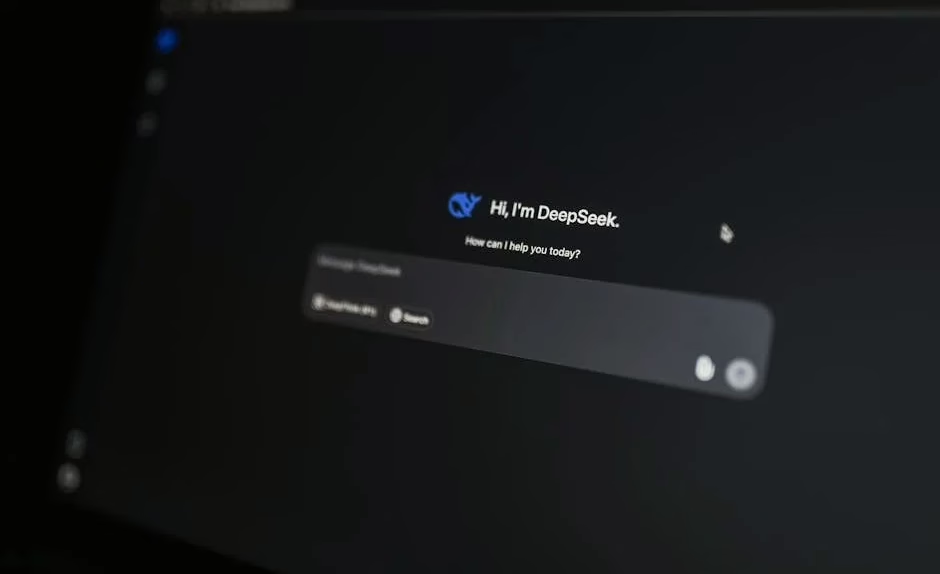
DeepSeek released its V4 model on Monday, delivering near state-of-the-art performance at approximately one-sixth the cost of premium models like Claude Opus 4.7 and GPT-5.5. The 1.6-trillion-parameter Mixture-of-Experts model is available under the MIT License through Hugging Face and DeepSeek’s API.
DeepSeek AI researcher Deli Chen described the release as a “labor of love” 484 days after V3’s launch, stating “AGI belongs to everyone.” The model matches or exceeds closed-source systems on several benchmarks while maintaining commercial-friendly licensing.
https://x.com/deepseek_ai/status/2047516922263285776
Breakthrough in AI Reasoning Architectures
Recent research reveals fundamental shifts in how large language models perform reasoning tasks. According to arXiv research, LLM reasoning operates through latent-state trajectories rather than explicit chain-of-thought processes, challenging conventional understanding of AI cognition.
The study separates three competing hypotheses: reasoning mediated by latent states (H1), explicit surface chain-of-thought (H2), or generic serial compute gains (H0). Current evidence most strongly supports H1, suggesting that visible reasoning traces may not reflect the model’s actual computational processes.
This finding has implications for interpretability research and reasoning benchmark design. The researchers recommend treating latent-state dynamics as the primary object of study for LLM reasoning, rather than focusing solely on observable chain-of-thought outputs.
Structured Reasoning Frameworks Emerge
Researchers have developed new approaches to address systematic limitations in LLM logical reasoning. A new framework implements Peirce’s tripartite inference—abduction, deduction, and induction—as an explicit protocol for AI-assisted reasoning.
The system enforces logical consistency through five algebraic invariants called the Gamma Quintet. The strongest invariant, the Weakest Link bound, ensures no conclusion exceeds the reliability of its least-supported premise. This prevents logical inconsistencies from accumulating across multi-step inference chains.
The framework underwent verification through property-based testing of 100 properties and 16 fuzz tests over 100,000+ generated cases. This provides a verified reference implementation suitable as a foundation for future reasoning benchmarks.
Novel Prompting Techniques Address Randomness
Prompt engineering advances tackle LLMs’ difficulty with probabilistic tasks through new techniques like String Seed-of-Thought (SSoT). According to Forbes research, SSoT enables proper probabilistic instruction following (PIF) for tasks requiring randomness.
Traditional LLMs struggle with truly random outputs—asking an AI to simulate coin flips rarely produces the expected 50/50 distribution. SSoT addresses this limitation by providing structured prompt templates that guide models toward more realistic probabilistic behavior.
The technique has applications in gaming simulations, human behavior modeling, and any scenario requiring random number generation. This represents a significant advance in making AI systems more suitable for probabilistic reasoning tasks.
Enterprise AI Adoption Accelerates
Real-world deployment data shows explosive growth in AI reasoning applications across enterprises. Google Cloud reports documenting 1,302 production use cases from leading organizations, marking what they call “the era of the agentic enterprise.”
The majority of implementations showcase agentic AI applications built with tools like Gemini Enterprise and Security Command Center. This represents the fastest technological transformation in recent history, driven primarily by customer demand rather than vendor push.
Production AI and agentic systems are now deployed meaningfully across virtually every organization attending major industry conferences. The scale suggests reasoning-capable AI has moved from experimental to mission-critical status across industries.
What This Means
DeepSeek-V4’s release fundamentally alters the AI landscape by proving that frontier-class reasoning capabilities can be delivered at dramatically lower costs through open-source models. This creates immediate pressure on closed-source providers to justify premium pricing while accelerating global AI democratization.
The convergence of breakthrough reasoning frameworks, novel prompting techniques, and massive enterprise adoption signals a maturation phase for AI reasoning capabilities. Organizations can now access sophisticated logical reasoning, probabilistic modeling, and structured inference at previously impossible price points.
These developments suggest we’re entering a new phase where reasoning quality becomes commoditized while implementation expertise and domain-specific applications become the primary differentiators. The combination of cost reduction and capability enhancement will likely accelerate AI adoption across sectors previously constrained by economic barriers.
FAQ
How does DeepSeek-V4 compare to GPT-5 and Claude Opus?
DeepSeek-V4 delivers near state-of-the-art performance comparable to GPT-5.5 and Claude Opus 4.7 while costing approximately one-sixth the price through API access. It matches or exceeds these models on several benchmarks while maintaining commercial-friendly open-source licensing.
What is the difference between chain-of-thought and latent reasoning?
Chain-of-thought refers to visible reasoning steps that models output, while latent reasoning occurs in the model’s internal computational states. Recent research suggests that actual reasoning happens primarily through latent-state trajectories rather than the explicit reasoning chains we can observe.
Can current AI models handle truly random tasks?
Traditional LLMs struggle with probabilistic tasks like coin flipping, often producing biased rather than truly random outputs. New techniques like String Seed-of-Thought (SSoT) prompting aim to solve this by providing structured templates that guide models toward more realistic probabilistic behavior.