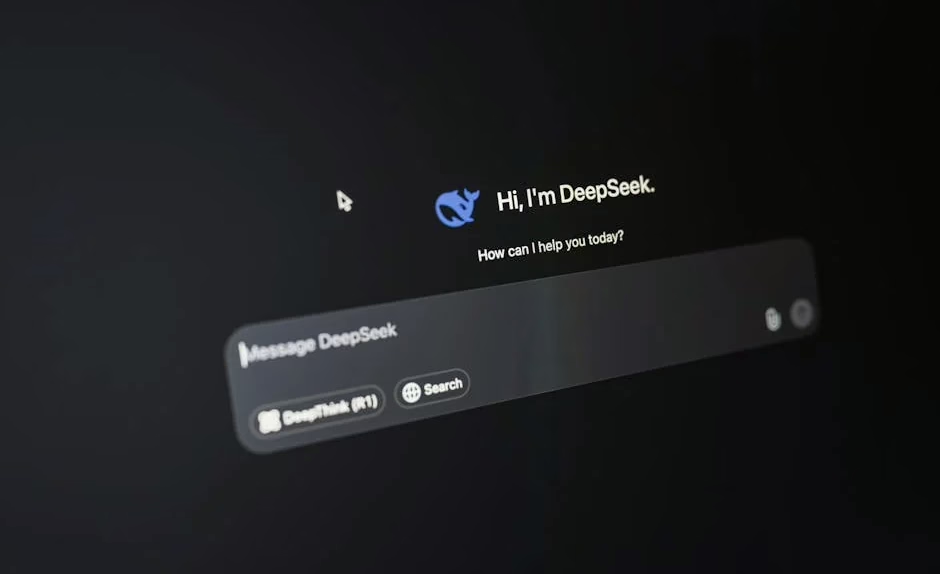

DeepSeek released its V4 model on Monday, a 1.6-trillion-parameter Mixture-of-Experts system that matches frontier AI performance at approximately one-sixth the API cost of Claude Opus 4.7 and GPT-5.5. According to VentureBeat, the model is available under the commercially-friendly MIT License on Hugging Face and through DeepSeek’s API.
https://x.com/deepseek_ai/status/2047516922263285776
DeepSeek AI researcher Deli Chen described the release as a “labor of love” 484 days after the V3 launch, stating “AGI belongs to everyone.” Industry observers are calling this the “second DeepSeek moment,” referencing the company’s January 2025 breakthrough with the R1 model that initially disrupted the AI landscape.
Performance Benchmarks and Technical Architecture
DeepSeek-V4 achieves near state-of-the-art performance across multiple evaluation metrics while maintaining significantly lower operational costs. The model utilizes a Mixture-of-Experts architecture with 1.6 trillion parameters, allowing it to activate only relevant portions during inference to optimize computational efficiency.
The Chinese AI startup, an offshoot of High-Flyer Capital Management, has consistently focused on cost-effective AI solutions. Their previous R1 model became a global sensation by matching proprietary U.S. models while remaining open source, forcing the industry to reconsider pricing strategies for frontier AI capabilities.
Benchmark results show V4 matching or exceeding performance of closed-source systems on reasoning, coding, and mathematical tasks. The model’s 1-million token context length provides substantial capability for complex document processing and extended conversations at the reduced API pricing.
OpenAI Counters with Privacy Filter Open Source Release
OpenAI launched Privacy Filter this week, a 1.5-billion-parameter open source model designed to detect and redact personally identifiable information before data reaches cloud servers. According to VentureBeat, the tool is available on Hugging Face under Apache 2.0 license and can run on standard laptops or directly in web browsers.
The Privacy Filter represents OpenAI’s continued investment in open source development, following their gpt-oss family release and recent open sourcing of agentic orchestration tools. The model functions as a “privacy-by-design” toolkit, using bidirectional token classification to read text from both directions for comprehensive PII detection.
This release addresses enterprise concerns about sensitive data exposure during AI training and inference. By providing on-device processing capabilities, organizations can sanitize datasets locally before cloud deployment, reducing privacy risks while maintaining AI functionality.
Open Source Model Adoption Accelerates Across Enterprise
Enterprise adoption of open source AI models continues expanding as organizations seek cost-effective alternatives to premium API pricing. Towards Data Science reported that developers are increasingly turning to Chinese open source alternatives like Kimi-K2.5 and GLM-5.1 for AI assistant applications, driven by Claude Opus 4.6’s $5 input and $25 output pricing per million tokens.
The shift toward open source models reflects broader industry pressure on closed-source providers to justify premium pricing. With DeepSeek-V4 offering comparable performance at substantially lower costs, enterprises are reassessing their AI infrastructure investments and exploring locally-deployable alternatives.
Google’s recent compilation of 1,302 real-world generative AI use cases demonstrates widespread enterprise AI adoption, with many organizations now deploying agentic systems across their operations. This scale of deployment makes cost considerations increasingly critical for sustainable AI strategies.
Fine-Tuning and Customization Ecosystem Growth
The open source AI ecosystem continues expanding with improved fine-tuning tools and frameworks. Hugging Face’s latest guide on fine-tuning large language models with PyTorch demonstrates the growing accessibility of model customization for specific enterprise use cases.
Fine-tuning capabilities allow organizations to adapt open source models for domain-specific applications while maintaining cost advantages over proprietary alternatives. This flexibility proves particularly valuable for specialized industries requiring custom AI behavior without the ongoing API costs of closed-source solutions.
The combination of powerful base models like DeepSeek-V4 and accessible fine-tuning tools creates opportunities for organizations to develop highly customized AI systems. This trend toward specialized, locally-controlled AI deployment represents a significant shift from the early ChatGPT era’s reliance on general-purpose cloud APIs.
What This Means
DeepSeek-V4’s release fundamentally challenges the pricing model of frontier AI, demonstrating that state-of-the-art performance doesn’t require premium API costs. The 1/6th pricing advantage over Claude Opus 4.7 and GPT-5.5, combined with MIT License availability, enables widespread enterprise adoption without vendor lock-in concerns.
This “second DeepSeek moment” forces closed-source providers to justify their pricing premiums while accelerating open source AI development globally. Organizations now have viable alternatives to expensive proprietary models, potentially reshaping enterprise AI procurement strategies and reducing barriers to AI adoption across industries.
The simultaneous release of OpenAI’s Privacy Filter indicates that even closed-source leaders recognize the strategic importance of open source contributions. This dual approach—proprietary flagship models alongside open source tools—may become the standard industry pattern as competition intensifies.
FAQ
How does DeepSeek-V4 pricing compare to other frontier models?
DeepSeek-V4 costs approximately 1/6th the price of Claude Opus 4.7 ($5 input/$25 output per million tokens) and GPT-5.5 through API access, while delivering comparable performance across benchmarks.
What license does DeepSeek-V4 use for commercial deployment?
DeepSeek-V4 is released under the MIT License, allowing commercial use, modification, and distribution without restrictive copyleft requirements that might limit enterprise adoption.
Can Privacy Filter run without internet connectivity?
Yes, OpenAI’s Privacy Filter is designed for on-device processing and can run locally on standard laptops or in web browsers, enabling data sanitization without cloud connectivity or data transmission.
Related news
- Three reasons why DeepSeek’s new model matters – MIT Technology Review