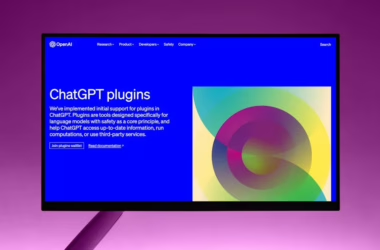

OpenAI on April 23, 2026 released GPT-5.5, marking what the company calls “a new class of intelligence for real work” with significant advances in multi-step reasoning and autonomous task completion. According to OpenAI’s announcement, GPT-5.5 matches GPT-5.4 per-token latency while delivering substantially higher intelligence and using fewer tokens for complex coding tasks.
The release represents a convergence of several AGI research milestones across the industry, as multiple labs demonstrate breakthroughs in reasoning capabilities, agentic workflows, and compositional generalization — core components needed for artificial general intelligence.
Enhanced Reasoning and Planning Capabilities
GPT-5.5’s core advancement lies in its ability to “plan, use tools, check its work, navigate through ambiguity, and keep going” across multi-part tasks without requiring step-by-step human guidance. OpenAI reported the model excels at writing and debugging code, researching online, analyzing data, and operating software autonomously.
This capability mirrors recent research breakthroughs in reasoning architectures. Researchers at JD.com and academic institutions introduced Reinforcement Learning with Verifiable Rewards with Self-Distillation (RLSD), which combines reinforcement learning’s performance tracking with granular feedback mechanisms. The technique addresses what co-author Chenxu Yang described as the “signal density problem” where “a multi-thousand-token reasoning trace gets a single binary reward.”
Meanwhile, arXiv research on neuro-symbolic systems challenged the assumption that compositional reasoning emerges automatically from symbol grounding, demonstrating that reasoning requires explicit training objectives rather than emerging as a byproduct.
Competitive Landscape in Agentic AI
The GPT-5.5 launch intensifies competition in agentic AI capabilities, particularly following recent releases from Anthropic’s Claude Opus 4.7 and open-source alternatives. VentureBeat reported that Anthropic’s model previously held the lead for most powerful generally available LLM.
Poolside, a San Francisco-based startup founded in 2023, launched its Laguna XS.2 models as free, high-performing open alternatives optimized for agentic coding workflows. The company released both models alongside a coding agent harness called “pool” and a web-based development environment called “shimmer.”
https://x.com/eisokant/status/2049142230397370537
Chinese companies including DeepSeek and Xiaomi have pursued strategies of “nearing the frontier” with open licensing and significantly lower costs, according to VentureBeat’s analysis.
Infrastructure and Enterprise Deployment
NVIDIA and Google Cloud announced expanded collaboration to support agentic and physical AI deployment at enterprise scale. NVIDIA’s blog detailed new offerings including NVIDIA Vera Rubin-powered A5X bare-metal instances and preview access to Google Gemini running on NVIDIA Blackwell and Blackwell Ultra GPUs.
The partnership targets moving “agents that manage complex workflows to robots and digital twins on the factory floor” from laboratory settings into production environments. Google Cloud’s AI Hypercomputer platform will integrate NVIDIA Nemotron open models and the NVIDIA NeMo framework for enterprise agentic applications.
Enterprise deployment represents a critical milestone, as research indicates that custom reasoning models can now be built “with a fraction of the compute” using new training paradigms like RLSD, lowering technical and financial barriers for businesses.
Technical Architecture Advances
GPT-5.5’s efficiency gains stem from architectural improvements that enable higher intelligence without increased latency. OpenAI reported the model uses “significantly fewer tokens to complete the same Codex tasks, making it more efficient as well as more capable.”
This efficiency aligns with broader industry research into compositional generalization. The Iterative Logic Tensor Network (iLTN) architecture demonstrated that models trained solely on grounding objectives fail to generalize, while joint training on “perceptual grounding and multi-step reasoning” achieved high zero-shot accuracy across novel tasks.
The research provides “conclusive evidence that symbol grounding, while necessary, is insufficient for generalization,” establishing reasoning as a distinct capability requiring explicit learning objectives rather than an emergent property.
Safety and Preparedness Framework
OpenAI implemented what it describes as its “strongest set of safeguards to date” for GPT-5.5, including evaluation across safety and preparedness frameworks, internal and external red-teaming, and targeted testing for advanced cybersecurity and biology capabilities. The company collected feedback from nearly 200 trusted early-access partners before public release.
API deployments require additional safeguards, with OpenAI working “closely with partners and customers on the safety and security considerations” for enterprise integration. The graduated rollout reflects industry recognition that more capable agentic systems require proportionally robust safety measures.
What This Means
The convergence of reasoning breakthroughs, agentic capabilities, and enterprise infrastructure represents a significant step toward AGI. Multiple research threads — from compositional generalization to efficient training paradigms — are maturing simultaneously, enabling practical deployment of autonomous AI systems.
GPT-5.5’s ability to maintain human-level latency while delivering substantially higher intelligence suggests the industry has overcome key technical bottlenecks that previously limited agentic AI adoption. The emphasis on enterprise deployment and safety frameworks indicates these capabilities are transitioning from research demonstrations to production-ready systems.
The competitive dynamics between proprietary models (OpenAI, Anthropic) and open alternatives (Poolside, DeepSeek, Xiaomi) will likely accelerate development while democratizing access to advanced reasoning capabilities across different market segments.
FAQ
What makes GPT-5.5 different from previous models?
GPT-5.5 can autonomously plan and execute multi-step tasks without requiring human guidance at each step, while maintaining the same response speed as GPT-5.4. It uses fewer computational tokens to complete complex coding tasks, making it both more capable and more efficient.
How does this relate to artificial general intelligence (AGI)?
GPT-5.5 demonstrates key AGI components including multi-step reasoning, autonomous planning, and tool use across different domains. Combined with recent research showing that reasoning capabilities require explicit training rather than emerging automatically, these advances represent significant progress toward general intelligence.
What are the implications for enterprise AI adoption?
New training techniques like RLSD enable companies to build custom reasoning models with significantly reduced computational requirements. The NVIDIA-Google Cloud partnership provides enterprise-grade infrastructure for deploying agentic AI systems, moving these capabilities from research labs into production environments.
Related news
Sources
- How to build custom reasoning agents with a fraction of the compute – VentureBeat
- Grounding vs. Compositionality: On the Non-Complementarity of Reasoning in Neuro-Symbolic Systems – arXiv AI
- NVIDIA and Google Cloud Collaborate to Advance Agentic and Physical AI – NVIDIA AI Blog
- Introducing GPT-5.5 | OpenAI – openai.com