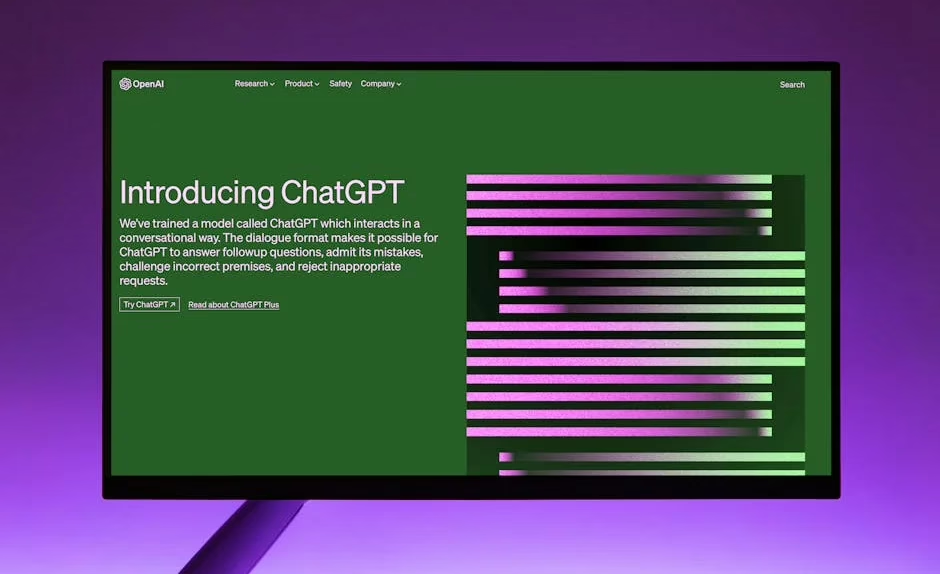

OpenAI and Microsoft announced Monday the termination of their exclusive partnership and revenue-sharing arrangement, marking a significant shift in the AI industry’s most consequential corporate alliance since 2019. Under the new agreement, OpenAI can now license its models to any cloud provider, including Microsoft competitors Google and Amazon, while Microsoft will stop sharing AI revenue with OpenAI.
The restructured deal caps OpenAI’s payments to Microsoft at a fixed ceiling rather than continuing indefinitely, according to Forbes. Microsoft retains approximately 27% ownership in OpenAI, valued at around $225 billion following OpenAI’s October restructuring that removed profit caps from its for-profit arm.
Partnership Evolution and Growing Tensions
The Microsoft-OpenAI relationship began in 2019 with Microsoft’s $1 billion investment in what was then a small nonprofit research lab. The original deal made Microsoft the exclusive seller of OpenAI’s technology to businesses and restricted OpenAI to running exclusively on Microsoft’s Azure cloud platform.
Tensions escalated as OpenAI’s computing demands outgrew Microsoft’s capacity to supply adequate infrastructure. The strain became particularly evident when OpenAI pursued the $500 billion Stargate data center project with Oracle and SoftBank, directly competing with Microsoft’s cloud services. CNBC reported that nearly a year of contentious negotiations preceded Monday’s announcement.
Microsoft shares dropped approximately 1% in early trading following the announcement, reflecting investor uncertainty about the partnership’s future dynamics.
Industry-Wide Partnership Realignments
The OpenAI-Microsoft restructuring reflects broader shifts in AI industry partnerships as companies seek greater flexibility and reduced dependencies. Amazon CEO Andy Jassy indicated on X that AWS would pursue fuller engagement with OpenAI following the partnership changes, signaling intensified competition among cloud providers for AI workloads.
Microsoft’s blog post emphasized “Frontier Transformation” strategies, focusing on embedding AI capabilities into business processes through partner networks. The company outlined frameworks for “enriching employee experiences” and “reinventing customer engagement” through agentic AI solutions.
Google simultaneously showcased momentum with its announcement of 1,302 real-world generative AI use cases across leading organizations, demonstrating enterprise adoption of Gemini Enterprise and related tools.
Startup Funding Activity Continues
Despite partnership reshuffling among tech giants, AI startup funding remains robust. Indian instant house-help startup Snabbit is raising approximately $50-55 million at a $400 million valuation, led by Susquehanna Venture Capital, according to TechCrunch.
The round represents a 122% valuation increase from Snabbit’s $180 million valuation in October 2025, when it raised $30 million. Founded in 2024, Snabbit connects households with on-demand domestic services through a managed worker network, completing over one million jobs in March 2026 alone.
Mirae Asset, FJ Labs, Lightspeed Venture Partners, and Bertelsmann India Investments are expected to participate in the funding round, which could be announced next week.
Market Implications and Competitive Dynamics
The partnership restructuring enables OpenAI to diversify its cloud infrastructure dependencies while maintaining access to Microsoft’s enterprise customer base. For Microsoft, the arrangement reduces ongoing revenue-sharing obligations while preserving significant equity upside through its 27% ownership stake.
Cloud providers Amazon Web Services and Google Cloud Platform stand to benefit from OpenAI’s newfound flexibility, potentially hosting ChatGPT and GPT-4 workloads previously restricted to Azure infrastructure. This shift could accelerate pricing competition and service innovation across cloud AI platforms.
The Stargate project, involving Oracle and SoftBank’s $500 billion commitment to data center infrastructure, exemplifies OpenAI’s strategy to secure computing resources beyond Microsoft’s ecosystem. Such massive infrastructure investments signal the scale required to train and deploy next-generation AI models.
Enterprise AI Adoption Acceleration
Google’s compilation of 1,302 enterprise AI use cases demonstrates rapid production deployment across industries, moving beyond experimental pilots to scaled implementations. The cases showcase applications of “agentic AI” systems that can autonomously execute complex workflows within business processes.
Microsoft’s partner-focused approach emphasizes governance, security, and change management capabilities essential for enterprise AI adoption. The company’s framework prioritizes “intelligence and trust” as foundational elements for sustainable AI transformation initiatives.
Enterprise customers increasingly demand measurable business outcomes from AI investments, driving vendors to provide comprehensive implementation support rather than standalone technology products.
What This Means
The OpenAI-Microsoft partnership restructuring signals maturation in AI industry relationships, moving from exclusive dependencies toward flexible, multi-vendor strategies. OpenAI’s ability to work with competing cloud providers should accelerate innovation and reduce costs through increased competition.
For enterprises, this shift provides more deployment options and potentially better pricing as cloud providers compete for AI workloads. However, organizations must now navigate more complex vendor relationships and integration challenges across multiple platforms.
The continued startup funding activity, exemplified by Snabbit’s significant valuation increase, demonstrates investor confidence in AI applications beyond large language models, particularly in service automation and workflow optimization sectors.
FAQ
What changes in the OpenAI-Microsoft partnership?
OpenAI can now license its technology to any cloud provider, not just Microsoft, while Microsoft stops sharing AI revenue with OpenAI. Microsoft retains 27% ownership worth approximately $225 billion.
Why did the exclusive partnership end?
OpenAI’s computing demands exceeded Microsoft’s capacity, leading to tensions when OpenAI pursued infrastructure partnerships with Microsoft competitors like Oracle and SoftBank for the $500 billion Stargate project.
How does this affect enterprise AI users?
Businesses gain more deployment options across multiple cloud providers, potentially benefiting from increased competition and pricing flexibility, though they may face more complex vendor management requirements.
Related news
- The next phase of the Microsoft OpenAI partnership – OpenAI – Google News – Microsoft
- Microsoft and OpenAI gut their exclusive deal, freeing OpenAI to sell on AWS and Google Cloud – VentureBeat
- OpenAI ends Microsoft legal peril over its $50B Amazon deal – TechCrunch