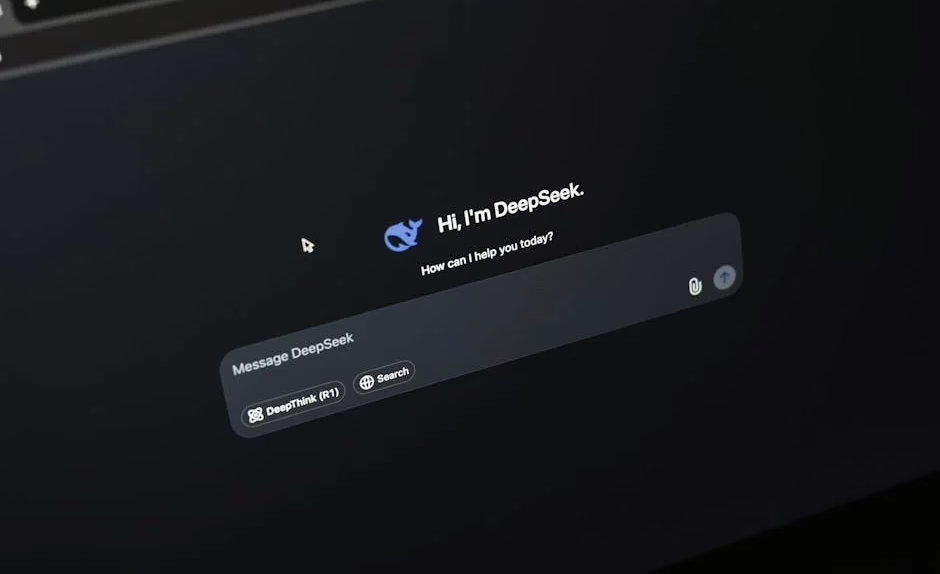

Chinese AI firm DeepSeek and OpenAI both released flagship models this week, with DeepSeek’s open-source V4 supporting longer prompts and OpenAI’s GPT-5.5 advancing toward a unified “super app” platform. The releases highlight intensifying competition between Chinese and US AI developers, with Chinese firms increasingly focusing on open-source alternatives to proprietary Western models.
DeepSeek V4 Returns with Enhanced Context Processing
DeepSeek on Friday released a preview of V4, its first major model since the breakthrough R1 reasoning model launched in January 2025. According to MIT Technology Review, V4 can process significantly longer prompts than previous generations through a new design that handles large text volumes more efficiently.
The model maintains DeepSeek’s open-source approach, allowing free download, use, and modification. This marks the company’s return to frontier model development after months of scrutiny including personnel departures, launch delays, and government oversight from both US and Chinese authorities.
DeepSeek had teased V4’s release earlier this month by adding “expert” and “flash” modes to its online platform, prompting speculation about an upcoming major announcement. The company’s R1 model previously stunned the industry with strong performance despite training on limited computing resources.
OpenAI Advances Toward Unified Platform with GPT-5.5
OpenAI on Thursday launched GPT-5.5, which the company describes as its “smartest and most intuitive to use model” yet. According to TechCrunch, co-founder Greg Brockman positioned the release as advancing toward “more agentic and intuitive computing” and bringing OpenAI closer to creating a comprehensive “super app.”
Brockman explained that GPT-5.5 offers “faster, sharper thinking for fewer tokens” compared to version 5.4, making frontier AI more accessible to businesses and consumers. The model represents another step toward combining ChatGPT, Codex, and AI browser capabilities into one unified enterprise service.
Chief scientist Jakub Pachocki indicated OpenAI expects continued rapid model releases, stating the company sees “pretty significant improvements in the short term, extremely significant improvements in the medium term.” OpenAI has maintained a monthly release cadence with previous launches in March, December, and November.
Chinese Competition Intensifies Open-Source Push
Chinese AI companies are increasingly embracing open-source development as an alternative to competing directly with well-funded US firms. SenseTime this week released SenseNova U1, an image processing model that can interpret visuals without converting to text first, reducing computational requirements.
US startup Poolside also entered the competition, launching two Laguna models optimized for coding workflows. The San Francisco-based company’s approach targets agentic AI applications that can write code, use tools, and take autonomous actions.
Hardware Independence Drives Chinese Strategy
Chinese firms are prioritizing compatibility with domestic chip manufacturers amid US export restrictions on advanced AI hardware. SenseTime’s U1 model launched with support from 10 Chinese chip designers including Cambricon and Biren Technology, according to Wired.
DeepSeek similarly designed V4 to run on Chinese-made chips, reducing dependence on restricted Western hardware. SenseTime co-founder Dahua Lin acknowledged the company “may still need to use the best chips to ensure the speed of our iteration,” but emphasized continued optimization for domestic alternatives.
The hardware independence strategy reflects broader Chinese efforts to develop AI capabilities despite trade restrictions. US export controls particularly limit access to training chips, which remain dominated by companies like NVIDIA.
Open Source Becomes Competitive Advantage
The wave of open-source releases from Chinese companies contrasts with the proprietary approach favored by leading US firms. DeepSeek’s V4 joins models from companies like Xiaomi in offering near-frontier performance at significantly lower costs than proprietary alternatives.
This strategy allows Chinese firms to build developer ecosystems and gain adoption despite lacking the computational resources of well-funded Western competitors. Open licensing also enables rapid iteration and community contributions that can accelerate development cycles.
Poolside’s entry into open-source development suggests some US startups are adopting similar strategies to compete with larger rivals. The company’s focus on coding applications targets a specific niche where open models can provide practical advantages over general-purpose proprietary systems.
What This Means
The simultaneous releases highlight how AI development has become a rapid-fire competition between Chinese and US companies pursuing different strategies. Chinese firms are leveraging open-source development and hardware independence to compete despite resource constraints, while US companies focus on proprietary platforms and comprehensive service integration.
This divergence creates distinct ecosystems that may reshape global AI adoption patterns. Open-source Chinese models appeal to cost-conscious developers and organizations seeking customizable solutions, while proprietary US platforms target enterprises requiring integrated services and support.
The accelerating release pace suggests both sides view 2026 as a critical year for establishing market position. Companies that successfully balance performance, cost, and accessibility may gain lasting advantages as AI becomes mainstream across industries.
FAQ
How does DeepSeek V4 compare to previous versions?
V4 can process much longer prompts than earlier generations through improved text handling efficiency. It maintains DeepSeek’s open-source licensing while representing the company’s return to frontier model development after the successful R1 reasoning model.
What is OpenAI’s “super app” concept?
OpenAI envisions combining ChatGPT, Codex, and AI browser capabilities into one unified platform for enterprise customers. GPT-5.5 advances this goal by improving model efficiency and expanding agentic computing capabilities beyond simple chat interactions.
Why are Chinese AI companies focusing on open-source models?
Open-source development allows Chinese firms to compete despite limited access to advanced Western hardware and smaller computational budgets. It also builds developer ecosystems and enables rapid community-driven improvements to accelerate development cycles.
Related news
Sources
- China’s DeepSeek releases preview of long-awaited V4 model as AI race intensifies – CNBC Tech
- Sanctioned Chinese AI Firm SenseTime Releases Image Model Built for Speed – Wired
- OpenAI releases GPT-5.5, bringing company one step closer to an AI ‘super app’ – TechCrunch
- American AI startup Poolside launches free, high-performing open model Laguna XS.2 for local agentic coding – VentureBeat