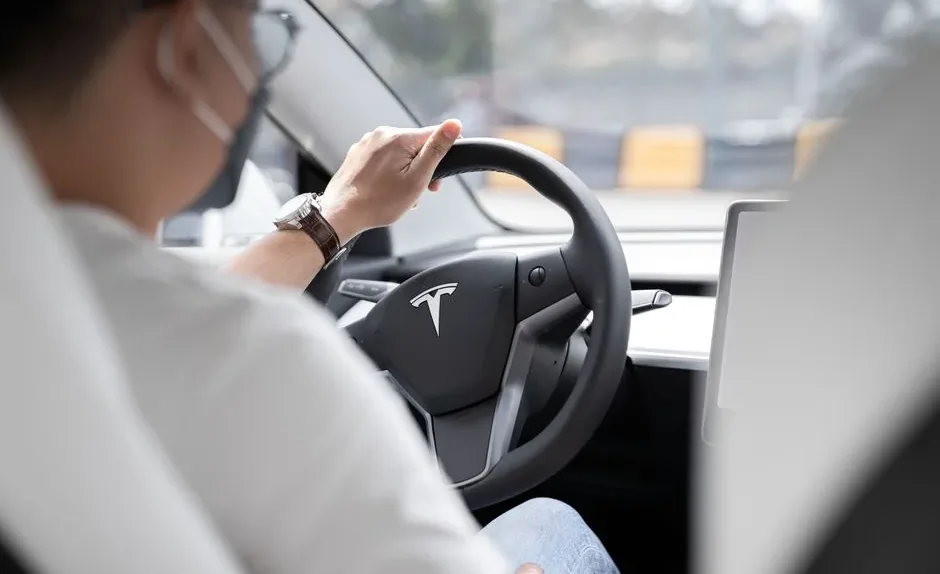

Tesla captured 54% of U.S. EV sales in June 2026 even as the broader market contracted sharply, while NVIDIA’s automotive division continues pushing a full-stack autonomous driving platform into production vehicles — a pairing that illustrates both the promise and friction of AI-driven mobility in mid-2026.
U.S. EV Sales Fell 27.8% Year-Over-Year in June 2026
The U.S. EV market recorded an estimated 74,967 units sold in June 2026, down 15.2% from May and 27.8% from a year earlier, according to Cox Automotive’s June 2026 figures reported by Forbes. EVs represented just 5.4% of total new-vehicle sales, a decline from the prior month. Cox described the market as “softer than last year.”
Tesla remained the volume leader with 40,460 units sold, followed by Rivian, Toyota, Cadillac, and Hyundai. Despite the overall decline, Tesla’s share rose because its sales drop was less severe than competitors’. Cox noted: “Tesla’s share of total EV sales increased to roughly 54%, as its sales decline was less severe than the broader market.”
Rivian was the only higher-volume EV brand to post a month-over-month gain, rising 8.3% from May to claim the No. 2 sales position.
Q2 2026 Marked a Third Consecutive Quarter of Year-Over-Year Declines
Zooming out to the full second quarter, EV volume fell 20.5% year-over-year — the third consecutive quarter of double-digit annual declines, according to Cox Automotive. Q1 2026 had been worse, with a 27.3% year-over-year drop, and Q4 2025 was steeper still. Cox framed the Q2 result as incremental improvement: “The Q2 sales decline was an improvement over Q1, when sales fell 27.3%, and far better than Q4 2025.”
A majority of automakers reported lower EV sales for the quarter. The persistent softness reflects a combination of inflation pressure on consumers, higher vehicle prices, and an EV adoption cycle that The Verge has described as fully off track in the United States.
NVIDIA’s Automotive Head Competes Internally for GPU Compute
NVIDIA is a central supplier to the auto industry’s AI ambitions, but even internally the resource constraints are real. In a Decoder interview with The Verge, Xinzhou Wu — NVIDIA’s head of automotive — described a dynamic where the automotive division competes with the rest of NVIDIA’s business for GPU compute, the same chips that the broader AI industry is consuming at record rates.
Wu has been instrumental in building NVIDIA’s full-stack autonomous driving platform, which automakers can adopt as a turnkey system. The platform is already deployed in newer Mercedes-Benz EVs, a concrete production milestone that distinguishes NVIDIA’s automotive business from purely conceptual roadmaps.
The challenge Wu’s team navigates is structural: NVIDIA’s GPUs are the most sought-after compute in the world right now, and automotive — while a growing vertical — must make its case alongside hyperscalers, AI labs, and enterprise customers all competing for the same silicon.
Autonomous Driving Remains Stuck on the Final 20 Percent
Self-driving technology continues to face what practitioners describe as the “last 20 percent” problem — the long tail of edge cases that resist automation even as highway and structured-road performance improves. The Verge’s interview with Wu surfaced this tension directly: every automaker and supplier describes full autonomy as inevitable, yet the timeline keeps extending.
NVIDIA’s approach is to offer a complete software and hardware stack rather than discrete components, lowering the integration burden for automakers. A demo video released at GTC Taiwan showed NVIDIA’s in-vehicle AI model running continuously — narrating and processing the driving environment in real time at highway speeds, a glimpse of how onboard language models are being woven into ADAS pipelines.
Waymo, operating under Alphabet, continues to expand its commercial robotaxi service in U.S. cities but has not announced a timeline for broad consumer availability. The gap between controlled robotaxi deployments and mass-market consumer autonomy remains wide.
NVIDIA Expands Full-Stack AI Across Japan’s Auto and Robotics Sectors
Beyond the U.S. market, NVIDIA is deepening its automotive and robotics presence in Japan. According to the NVIDIA AI Blog, CEO Jensen Huang traveled to Tokyo this week to meet with AI and manufacturing partners, with a focus on physical AI — robots and autonomous systems that interact with the real world.
Huang’s visit included an unannounced appearance at NVIDIA’s Build-a-Claw developer event, where Japanese engineers demonstrated robots using NVIDIA’s open models to perform physical manipulation tasks. Japan’s manufacturing base makes it a strategic market for automotive AI: the country is home to Toyota, Honda, and a dense supplier ecosystem that is actively integrating AI into production lines and vehicle platforms.
NVIDIA’s full-stack pitch — covering chips, software frameworks, simulation tools, and pre-trained models — is designed to let automakers and robotics firms build on a common foundation rather than assembling components from multiple vendors.
What This Means
The June 2026 EV data and NVIDIA’s internal compute competition tell a consistent story: the automotive AI transition is real but slower and harder than the industry projected. Tesla’s ability to hold 54% market share in a contracting market reflects brand loyalty and infrastructure advantages, not a healthy overall EV environment. Three consecutive quarters of year-over-year sales declines suggest the demand curve has not yet found a floor.
For NVIDIA, the automotive vertical is strategically important but operationally constrained. When even the head of automotive at the world’s dominant GPU maker has to fight for compute allocation, it signals how intense the internal competition for resources is — and how difficult it is for any single vertical to claim priority. Automakers building on NVIDIA’s platform inherit both the capability and the supply-chain uncertainty.
The self-driving timeline question remains unresolved. Production deployments in Mercedes vehicles and Waymo’s expanding robotaxi footprint are meaningful data points, but neither represents the mass-market consumer autonomy that industry roadmaps have been promising for a decade.
FAQ
What share of U.S. EV sales did Tesla hold in June 2026?
According to Cox Automotive, Tesla held approximately 54% of U.S. EV sales in June 2026, selling 40,460 units. Its share rose despite an overall market decline because its sales fell less sharply than other brands.
Which NVIDIA automotive products are already in production vehicles?
NVIDIA’s full-stack autonomous driving platform is deployed in newer Mercedes-Benz EVs, according to The Verge’s interview with Xinzhou Wu, NVIDIA’s head of automotive. The platform combines NVIDIA hardware and software into a system automakers can integrate directly.
Why are U.S. EV sales declining in 2026?
Cox Automotive attributed the decline to softer consumer demand, with EVs representing just 5.4% of new-vehicle sales in June 2026. Broader pressures include inflation, rising vehicle prices, and an EV adoption cycle that analysts and industry observers describe as running behind earlier projections.
Sources
- Even Nvidia’s head of automotive fights with Nvidia for compute – The Verge
- NVIDIA and Japan Bring Full-Stack AI and Robotics to Every Industry – NVIDIA AI Blog
- Tesla Claims 54% Of Sagging U.S. EV Market In June, Rivian Sales Up—According To Cox – Forbes Tech
- Bridgestone on having a local and global supply chain presence – Automotive Logistics – Google News – Logistics
- Automakers warn USMCA annual review threatens investment in North American automotive supply chains – Automotive Logistics – Google News – Logistics