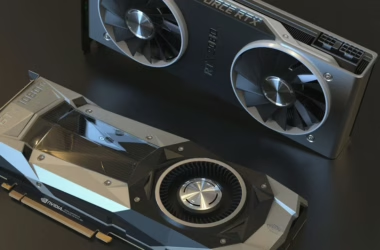

NVIDIA technologies now run more than 400 of the world’s 500 fastest supercomputers, according to rankings released this week at the ISC High Performance conference in Hamburg, Germany. The figure represents 81% of the TOP500 list — a gain of 17 systems from the previous ranking — with 90% of systems newly added to the list built on NVIDIA hardware.
NVIDIA Dominates June 2025 TOP500 Rankings
NVIDIA GPUs accelerate a record 238 systems on the current TOP500, while NVIDIA networking connects a record 376 systems — the majority running NVIDIA Quantum InfiniBand. According to the NVIDIA AI Blog, NVIDIA systems across the list now deliver more than 2x the AI training throughput and nearly 3x the AI inference throughput of every other platform combined.
The Grace CPU also expanded its footprint: 26 TOP500 systems now use the NVIDIA Grace CPU, up eight from the previous list. On the Green500 efficiency rankings, the top eight systems all run on NVIDIA GPUs, and nine of the top ten use NVIDIA technologies. The most energy-efficient single system, KAIROS, runs on a single NVIDIA Grace Hopper Superchip.
New Scientific Software Debuts at ISC Hamburg
Alongside the supercomputer rankings, NVIDIA used the ISC conference to introduce a set of GPU-accelerated software tools targeting scientific research. The new releases include the NVIDIA DAQIRI library, NVIDIA ALCHEMI NIM microservices, and the forthcoming NVIDIA cuPhoton reference code — all part of the NVIDIA CUDA-X collection.
According to the NVIDIA AI Blog, cuPhoton — running on NVIDIA GB200 NVL72 systems — accelerated loading and reading of FITS astronomical image data from the Rubin Observatory’s Legacy Survey of Space and Time (LSST) by 14,900x. Signal processing and analysis using 32 NVIDIA Grace Blackwell superchips ran up to 8,400x faster than CPU-based workflows. The LSST camera, described by Rubin Observatory as the largest digital camera ever built for astronomy, generates data volumes that previously created multi-day processing backlogs.
Rubin Generation Introduces 100% Liquid Cooling
NVIDIA’s next hardware generation, codenamed Rubin, is the first AI infrastructure platform designed for 100% liquid cooling — eliminating fans from every chip and networking component in the system. The design is documented in the NVIDIA DSX AI factory reference guide.
The Rubin cooling architecture operates at up to 45°C coolant temperature, higher than previous liquid-cooled systems, which improves energy efficiency by reducing the work required to reject heat. Ali Heydari, director of data center cooling and infrastructure at NVIDIA, said in the NVIDIA AI Blog: “The NVIDIA DSX reference design for AI factories has zero water consumption — we have eliminated massive amounts of power usage and pretty much all water usage. With dry-cooler-based designs, it’s a closed-loop system with no evaporative water cooling — outside of maybe 1% of the year when we might need chillers in some climates.”
Historically, cooling has accounted for up to 40% of total data center energy consumption, according to a McKinsey analysis cited in the NVIDIA post. The closed-loop dry-cooler design targets that overhead directly.
AI Agents Move Into Telecom Network Operations
NVIDIA is also expanding into telecommunications infrastructure management, demonstrating autonomous network operations tools at TM Forum’s DTW Ignite 2026 conference in Copenhagen this week. The platform combines synthetic data generation, telecom-domain AI models, secure agent runtimes, and network simulation.
According to the NVIDIA AI Blog, the goal is to move beyond task-based automation — where AI speeds up predetermined steps — toward agents that proactively detect network problems and coordinate changes across network, IT, and business systems without constant human direction. NVIDIA’s telecom autonomy platform overview describes agents designed to understand operator intent and maintain human control over policy decisions.
Telecom operators have already reported measurable returns from generative AI in network management and customer care, according to an NVIDIA-commissioned industry report, though specific ROI figures were not disclosed in the source material.
What This Means
The June 2025 TOP500 results confirm that NVIDIA’s position in high-performance computing is not static — it is compounding. Capturing 90% of new entrants to the list means competing platforms are not gaining ground on fresh deployments. The simultaneous rollout of domain-specific software (cuPhoton, DAQIRI, ALCHEMI) signals a strategy of deepening integration into scientific workflows, making the GPU infrastructure harder to displace once embedded in research pipelines.
The Rubin cooling architecture matters beyond efficiency metrics. Data center operators face increasing pressure on power purchase agreements and water usage permits. A closed-loop, zero-evaporation design removes two major regulatory and cost constraints simultaneously, which could accelerate deployment timelines for large-scale AI factories.
The telecom push is a longer-duration bet. Autonomous network operations require AI agents that can act reliably on live infrastructure — a higher trust bar than copilot-style tools. NVIDIA’s approach of combining simulation environments with domain-specific models is a credible path, but commercial deployments at scale remain ahead.
FAQ
How many of the TOP500 supercomputers use NVIDIA technology?
As of the June 2025 TOP500 rankings released at ISC Hamburg, NVIDIA technologies power more than 400 of the 500 systems — 81% of the list. NVIDIA GPUs accelerate 238 systems and NVIDIA networking connects 376 systems.
What is NVIDIA cuPhoton and what does it do?
NVIDIA cuPhoton is a GPU-accelerated reference code for processing astronomical image data in the FITS format. Running on GB200 NVL72 systems, it accelerated FITS image loading from the Rubin Observatory’s LSST survey by 14,900x compared to CPU-based processing.
What makes the Rubin generation’s cooling design different from earlier NVIDIA systems?
The Rubin generation is NVIDIA’s first AI infrastructure platform with 100% liquid cooling — no fans anywhere in the system. It operates at coolant temperatures up to 45°C and uses a closed-loop dry-cooler design that eliminates evaporative water consumption, according to the NVIDIA DSX reference design documentation.
Related news
- AMD And Nvidia Are Neck In HPC Supercomputing – The Next Platform – Google News – NVIDIA
- Nvidia Sued by Music Platform Jamendo Over AI Training on Songs: ‘A Blatant Violation’ – Billboard – Google News – NVIDIA
- Nvidia, Micron, AMD lead tech sell-off as AI trade cools – Yahoo Finance – Google News – NVIDIA
Sources
- From Materials Simulation to Experimental Astronomy, New NVIDIA AI Software Unlocks Scientific Discoveries – NVIDIA AI Blog
- NVIDIA Brings Trusted, 24/7 AI Agents to Telecom Operations – NVIDIA AI Blog
- NVIDIA Powers Over 400 of the World’s 500 Fastest Supercomputers – NVIDIA AI Blog
- Hotter Than a Hot Tub: The 45°C Breakthrough to Cool AI’s Biggest Machines – NVIDIA AI Blog
- Laptop prices suck these days, so here are some Prime Day deals that help a little – The Verge