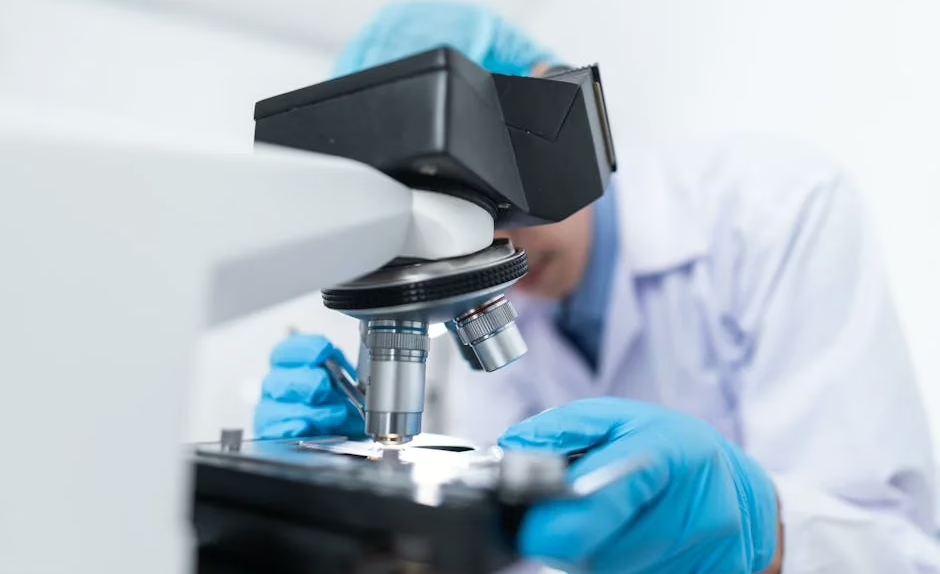

Isomorphic Labs on Tuesday closed a $2.1 billion funding round led by Thrive Capital, marking the second-largest biotech fundraise in history and signaling massive investor confidence in AI-powered drug development. The Alphabet subsidiary, founded in 2021, will use the capital to advance its AI-driven drug design platform built on Nobel Prize-winning protein structure prediction technology.
Record-Breaking Investment in AI Drug Development
The funding round represents a dramatic escalation in AI drug discovery investment, following Isomorphic’s initial $600 million raise last year. According to Endpoints News, only Altos Labs has raised more capital in a single biotech funding round. The investment comes at an undisclosed valuation, though the company’s rapid funding growth suggests significant investor appetite for AI-native drug development approaches.
Isomorphic President Max Jaderberg told Forbes that the funding represents “a lot of validation of what we’ve been building out the past four-and-a-half, almost five, years.” The London-based company has remained notably secretive about specific drug candidates in its pipeline, focusing instead on platform development and partnership strategies.
The biotech sector has seen increased AI investment as companies seek to address the industry’s core challenges: drug development typically costs over $1 billion per approved therapy and takes 10-15 years from discovery to market. AI proponents argue that computational approaches can dramatically reduce both timelines and failure rates by better predicting drug-target interactions and optimizing molecular design.
AlphaFold Foundation Powers Drug Design Platform
Isomorphic’s core technology stems from AlphaFold, the protein structure prediction AI that earned CEO Demis Hassabis the 2024 Nobel Prize in Chemistry. AlphaFold 3, released in May 2024, expanded beyond proteins to predict structures for small molecules, peptides, and antibodies — the fundamental building blocks of modern pharmaceuticals.
The company has built its Isomorphic Labs Drug Design Engine (IsoDDE) on this foundation. Jaderberg described IsoDDE as “like half a dozen AlphaFold breakthrough” technologies integrated into a unified platform for molecular design. The system aims to predict how potential drug molecules will interact with target proteins before expensive laboratory synthesis and testing.
This computational-first approach represents a shift from traditional drug discovery, where researchers typically synthesize thousands of compounds and test them experimentally. By predicting molecular behavior in silico, Isomorphic hopes to identify promising drug candidates with higher success rates and lower development costs.
Competitive Landscape in AI Drug Discovery
Isomorphic enters a crowded field of AI drug discovery companies, though few have achieved comparable funding levels. The sector has seen mixed results, with some high-profile failures alongside notable successes in specific therapeutic areas.
Recent developments suggest growing momentum for AI approaches. Spinogenix announced positive Phase 2 results for tazbentetol in schizophrenia treatment, demonstrating a 6.3-point reduction in PANSS scores in an add-on trial. The drug, designed to promote synaptic regeneration through fascin-1/F-actin modulation, maintained efficacy for days after discontinuation.
Tazbentetol represents a “first-in-class investigational synaptic regenerative therapy” that triggers neurons to produce new synapses. Spinogenix is also testing the compound for Alzheimer’s disease, ALS, glaucoma, and diabetic retinopathy, suggesting broad potential for neurodegenerative applications.
Research Infrastructure and Benchmarking Advances
The AI research community has developed new benchmarks to evaluate discovery capabilities in complex domains. Researchers recently introduced PolitNuggets, a multilingual benchmark for testing how well AI agents can discover and synthesize “long-tail” facts from dispersed sources.
The benchmark covers 400 global political figures and over 10,000 political facts, using an optimized multi-agent evaluation system. The researchers found that current AI systems often struggle with fine-grained details and show substantial efficiency variations, highlighting challenges that could apply to drug discovery applications requiring precise molecular-level reasoning.
These evaluation frameworks become critical as AI systems take on more complex discovery tasks. In drug development, the ability to synthesize information from diverse sources — patent databases, clinical trial results, molecular biology literature — could determine success in identifying novel therapeutic targets and designing effective compounds.
Hardware Infrastructure Supporting AI Drug Discovery
The computational demands of AI drug discovery have driven significant hardware investment. Cerebras Systems, which designs large-scale AI training chips, completed a successful IPO on Thursday, generating billions in value for the company and investors including Benchmark Capital.
Benchmark partner Eric Vishria, who led the firm’s $25 million Series A investment in Cerebras in 2016, initially resisted taking the meeting with the hardware startup. “Why did I take this meeting?” he recalled asking, given Benchmark’s decade-long absence from hardware investments. However, CEO Andrew Feldman’s presentation that “GPUs actually suck for deep learning” convinced Vishria of the market opportunity.
The Cerebras approach — building wafer-scale processors specifically for AI training — addresses the computational bottlenecks that limit current drug discovery AI systems. As molecular simulation and design models grow more sophisticated, specialized hardware may become essential for companies like Isomorphic to achieve their platform ambitions.
What This Means
Isomorphic’s $2.1 billion raise represents a pivotal moment for AI drug discovery, providing unprecedented capital to prove that computational approaches can deliver approved therapies at scale. The funding level suggests investors believe AI can address fundamental inefficiencies in pharmaceutical R&D, though the company’s secretive approach to pipeline disclosure makes it difficult to assess near-term clinical prospects.
The broader ecosystem shows signs of maturation, with specialized hardware, improved benchmarking methods, and early clinical successes like tazbentetol providing validation for AI-driven approaches. However, the ultimate test remains bringing AI-designed drugs through clinical trials to market approval — a challenge no company has yet fully demonstrated at scale.
Success could reshape pharmaceutical development by dramatically reducing costs and timelines, potentially enabling treatment development for rare diseases that currently lack economic incentives. Failure could trigger investor skepticism about AI’s near-term potential in complex scientific domains requiring regulatory approval.
FAQ
What makes Isomorphic Labs different from other AI drug discovery companies?
Isomorphic Labs builds on AlphaFold, the Nobel Prize-winning protein structure prediction technology, giving it a unique foundation in computational biology. The company operates as an Alphabet subsidiary with access to Google’s AI research and computational resources, potentially providing advantages in model development and scaling.
How does AI drug discovery compare to traditional pharmaceutical research?
Traditional drug discovery relies heavily on experimental synthesis and testing of thousands of compounds, costing over $1 billion per approved drug over 10-15 years. AI approaches aim to predict molecular behavior computationally before expensive laboratory work, potentially identifying better candidates with higher success rates and lower costs.
What are the main challenges facing AI drug discovery companies?
AI drug discovery companies must prove their computational predictions translate to real-world clinical efficacy, navigate complex regulatory approval processes, and demonstrate they can consistently identify successful drug candidates. The field also faces technical challenges in accurately modeling complex biological systems and drug-target interactions.
Sources
- The biggest AI breakthrough in medicine & drug discovery – Reddit Singularity
- (Breakthrough) Tazbentetol significantly improved symptoms in patients with schizophrenia in a Phase 2 add-on clinical trial, with efficacy sustained for many days after drug discontinuation. – Reddit Singularity
- PolitNuggets: Benchmarking Agentic Discovery of Long-Tail Political Facts – arXiv AI
- Cerebras IPO makes billions for Benchmark but VC Eric Vishria almost didn’t take the meeting – TechCrunch
- Isomorphic Labs’ $2.1 Billion Fundraise Is The Biggest Bet Yet On AI Drug Discovery – Forbes Tech