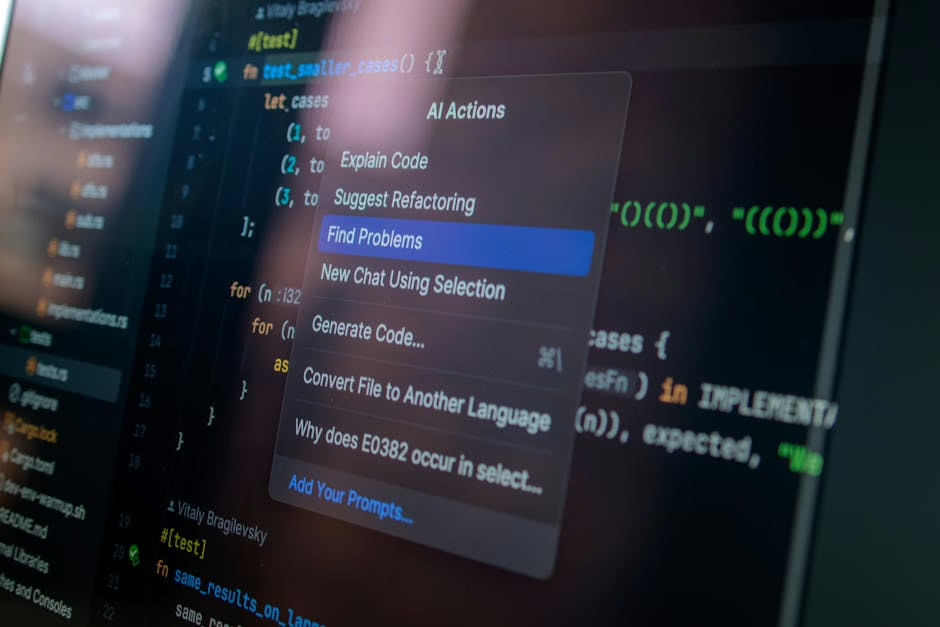

Enhanced Code Repository Analysis Capabilities
Recent user discoveries have highlighted ChatGPT’s robust capability to analyze entire codebases through compressed file uploads. This functionality represents a significant advancement in AI-assisted software development, allowing developers to upload zipped Git repositories for comprehensive code analysis and documentation assistance.
The technical implementation leverages ChatGPT’s multimodal processing architecture, which can parse and understand complex file structures, dependencies, and code relationships across multiple programming languages. This capability is particularly valuable for poorly documented Python modules and legacy codebases where traditional documentation may be insufficient.
Technical Architecture Benefits
The compressed repository analysis feature demonstrates several key technical advantages:
- Context Preservation: The model maintains awareness of inter-file dependencies and project structure
- Multi-file Analysis: Simultaneous processing of related code components enables more accurate recommendations
- Documentation Generation: Automatic extraction of functionality patterns from undocumented code
The Infrastructure Challenge for Agentic AI
As the industry prepares for what experts predict will be the “year of agentic AI” in 2026, a critical technical challenge has emerged that extends beyond model capabilities. While much attention focuses on benchmark comparisons between models like Llama 3 and GPT-4, or context window optimization, the real bottleneck lies in data infrastructure architecture.
Agent Fragility in Production Systems
Autonomous AI agents tasked with complex operations—from flight booking to cloud infrastructure management—face significant reliability challenges in production environments. These systems must handle:
- Real-time Decision Making: Processing streaming data for personalized media delivery during high-traffic events
- System Diagnostics: Autonomous troubleshooting of infrastructure outages
- Resource Management: Dynamic allocation of cloud computing resources
Data Constitution Framework
The solution requires moving beyond prompt engineering toward establishing robust data governance frameworks. This “data constitution” approach emphasizes:
Structured Data Pipelines: Implementing consistent data formatting and validation protocols that ensure agent reliability across diverse operational contexts.
Fault-Tolerant Architecture: Building redundancy and error recovery mechanisms into agent decision-making processes, particularly crucial for systems serving millions of concurrent users during major events.
Standardized Interfaces: Creating uniform API specifications that allow agents to interact reliably with various enterprise systems and databases.
Technical Implications for AI Development
These developments highlight a maturation in AI system design philosophy. The focus is shifting from raw model performance metrics toward comprehensive system reliability and practical deployment considerations.
The combination of enhanced code analysis capabilities and the push toward more robust agentic systems suggests that 2024-2026 will be defined by infrastructure innovation rather than purely algorithmic advancement. This represents a natural evolution as AI systems transition from research demonstrations to mission-critical enterprise applications.
For organizations planning AI implementations, the emphasis should be on building solid data foundations and fault-tolerant architectures that can support the autonomous agents of tomorrow, rather than solely optimizing for the latest model benchmarks.