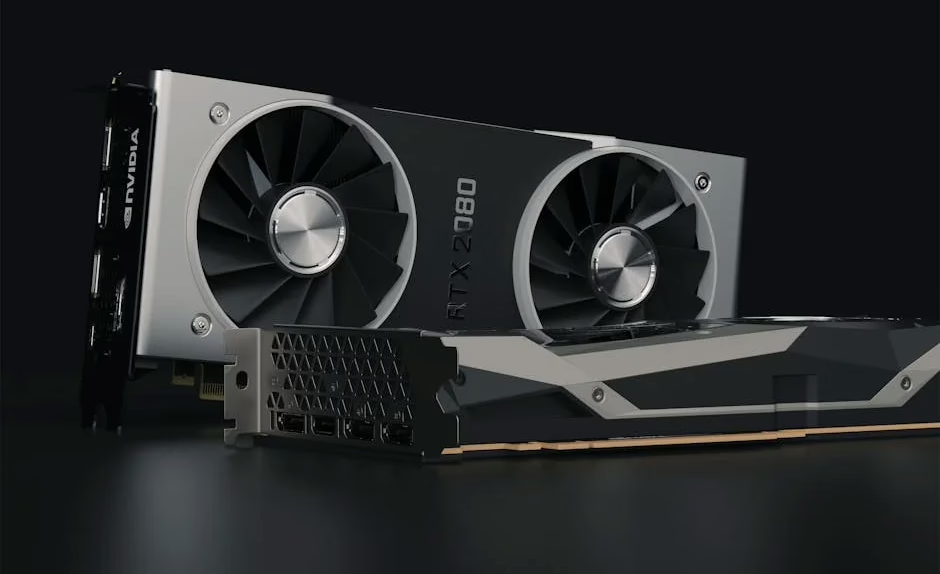

Enterprise GPU utilization averages just 5% despite $401 billion in AI infrastructure spending this year, according to Gartner and Cast AI research. Meanwhile, breakthrough training techniques demonstrated in OpenAI’s Parameter Golf challenge show how architectural innovations can deliver comparable model performance with 95% fewer resources.
The disconnect between massive AI infrastructure investments and actual utilization has created what industry analysts call the “$401 billion problem.” Companies locked into three-to-five-year GPU depreciation cycles during the 2024-2025 “GPU scramble” now face idle hardware that must generate measurable returns as those assets age.
Parameter Efficiency Breakthroughs
OpenAI’s Parameter Golf challenge revealed significant advances in model efficiency through architectural constraints. Over 2,000 submissions from 1,000+ participants competed to minimize loss on a fixed FineWeb dataset while staying within a 16 MB artifact limit and 10-minute training budget on 8×H100s.
According to OpenAI’s blog post, participants achieved surprising results through careful optimizer tuning, quantization work, and new modeling approaches. The challenge demonstrated that meaningful AI capabilities don’t require massive parameter counts when architectural choices are optimized correctly.
The competition also highlighted how AI coding agents accelerated experimentation. These tools lowered barriers to entry, enabling broader participation while changing the pace of technical innovation. “Agents helped lower the cost of experimentation, made it easier for more people to participate, and changed the pace of the competition,” OpenAI reported.
Core Architecture Components Driving Efficiency
Modern LLM architecture optimization starts with fundamental building blocks that engineers must understand to build efficient systems. The transformation from text to model input involves multiple stages, each presenting optimization opportunities.
Tokenization serves as the critical first step, converting text into numerical representations that models can process. According to Towards Data Science analysis, this process significantly impacts model efficiency and downstream performance. Engineers moving from computer vision to LLMs often underestimate tokenization’s role in system optimization.
Transformer architectures remain the dominant paradigm, but efficiency improvements focus on attention mechanisms and parameter utilization. Mixture of Experts (MoE) models exemplify this approach by activating only relevant parameters for each token rather than the entire model, dramatically reducing computational requirements.
Infrastructure Reality vs. Procurement Patterns
The enterprise GPU utilization crisis stems from procurement patterns established during the 2024 AI boom. VentureBeat reported that organizations locked in capacity under traditional depreciation cycles, creating a “self-reinforcing procurement loop” that makes idle GPUs nearly impossible to release.
Cerebras Systems’ recent IPO illustrates the infrastructure transformation underway. The company’s stock nearly doubled on its first trading day, reaching a $100 billion market cap based on its wafer-scale engine approach. Cerebras raised $5.55 billion in what Bloomberg called the largest U.S. tech IPO since Uber’s 2019 debut.
“With this new capital, we’re going to fill more data halls with Cerebras systems to power the world’s fastest inference,” Julie Choi, Cerebras’ Chief Marketing Officer, told VentureBeat. The company’s approach demonstrates how specialized architectures can deliver superior performance per dollar compared to traditional GPU clusters.
Training Technique Evolution
Advanced training methods now focus on maximizing output from constrained resources rather than scaling parameter counts indefinitely. The Parameter Golf results showed that careful optimizer tuning and quantization techniques can match larger models’ performance within strict resource limits.
Test-time training emerged as a particularly effective approach, allowing models to adapt during inference without permanent parameter updates. This technique enables smaller base models to achieve performance comparable to much larger systems for specific tasks.
Reinforcement Learning from Human Feedback (RLHF) continues evolving as a core training component. TechCrunch’s AI glossary explains how RLHF helps align model outputs with human preferences while maintaining efficiency. The technique constrains how far models can deviate from original policies in single steps, preventing instability while improving output quality.
What This Means
The AI architecture landscape is shifting from a “more parameters equals better performance” mindset to sophisticated efficiency optimization. Organizations sitting on underutilized GPU capacity now have proven techniques to maximize their existing investments rather than purchasing additional hardware.
The Parameter Golf results demonstrate that architectural innovation can deliver enterprise-grade AI capabilities within dramatically reduced resource constraints. This trend will likely accelerate as CFOs demand measurable returns from AI infrastructure investments and new efficiency techniques prove their commercial viability.
For enterprises, the immediate opportunity lies in auditing current GPU utilization and implementing proven efficiency techniques before considering additional capacity purchases. The $401 billion infrastructure problem has a solution — it just requires rethinking how AI systems are architected and deployed.
FAQ
What is Parameter Golf and why does it matter for AI efficiency?
Parameter Golf was OpenAI’s machine learning challenge where participants had to minimize model loss while staying within a 16 MB limit and 10-minute training budget. The challenge proved that careful architectural choices can achieve comparable performance to much larger models, directly addressing enterprise GPU waste problems.
How can enterprises improve their 5% GPU utilization rates?
Enterprises can implement mixture of experts architectures, optimize tokenization processes, and adopt test-time training techniques demonstrated in recent efficiency research. These approaches maximize output from existing hardware rather than requiring additional GPU purchases.
What makes Cerebras different from traditional GPU-based AI infrastructure?
Cerebras builds wafer-scale engines that process AI workloads on single chips rather than distributed GPU clusters. This architecture eliminates communication overhead between separate processors, delivering faster inference speeds and potentially better utilization rates than traditional setups.
Sources
- The Must-Know Topics for an LLM Engineer – Towards Data Science
- 5% GPU utilization: The $401 billion AI infrastructure problem enterprises can’t keep ignoring – VentureBeat
- What Parameter Golf taught us about AI-assisted research – OpenAI Blog
- Cerebras stock nearly doubles on day one as AI chipmaker hits $100 billion — what it means for AI infrastructure – VentureBeat
- So you’ve heard these AI terms and nodded along; let’s fix that – TechCrunch