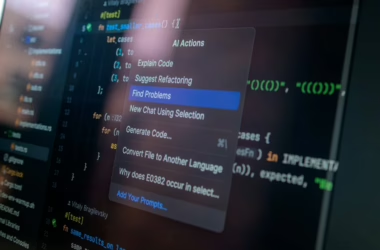

Google CEO Sundar Pichai revealed that artificial intelligence now generates 75% of the company’s code, marking a significant shift in how the tech giant develops software. The disclosure came during recent analyst discussions where Pichai highlighted Google’s enterprise AI solutions as the primary growth driver for Google Cloud for the first time.
According to The Washington Post, Google’s AI transformation extends beyond internal operations, with the company facing internal resistance over potential military applications of its AI technology.
Enterprise AI Drives Cloud Growth
Google’s enterprise AI solutions have become the company’s fastest-growing segment, with sales increasing eightfold year-over-year. Pichai told analysts that these AI products now represent the “primary growth driver for cloud for the first time,” signaling a fundamental shift in Google’s business model.
The company’s AI-first approach has permeated its development processes, with three-quarters of new code now generated by AI systems rather than human programmers. This represents one of the highest rates of AI code generation reported by any major technology company.
Google’s cloud division has struggled to compete with Amazon Web Services and Microsoft Azure, but the AI boom has provided new momentum. Enterprise customers are increasingly adopting Google’s AI tools for code generation, data analysis, and automation tasks.
Internal Opposition to Military AI Use
Over 600 Google employees signed an internal letter demanding that CEO Sundar Pichai block the Pentagon from using Google’s AI models for classified military purposes. The letter, reported by The Washington Post, includes signatures from more than 20 principals, directors, and vice presidents.
Many signers work in Google’s DeepMind AI laboratory, the company’s premier AI research division. The employees argue that “the only way to guarantee that Google does not become associated with such harms is to reject any classified workloads.”
The internal pushback reflects ongoing tensions within Google about the appropriate use of AI technology. Employees expressed concern that classified military applications could occur “without our knowledge or the power to stop them.”
Google previously faced employee protests over Project Maven, a Pentagon contract for AI-powered drone imagery analysis, which the company ultimately chose not to renew in 2018.
DeepMind Integration and AI Leadership
Google’s AI strategy centers on its DeepMind division, which has produced breakthrough technologies including AlphaGo and large language models. The integration of DeepMind’s research capabilities with Google’s massive computing infrastructure has accelerated the company’s AI development.
Pichai has positioned Google as a leader in the AI race, competing directly with OpenAI, Microsoft, and Anthropic. The company’s Gemini AI models power many of Google’s consumer and enterprise products, from search to cloud services.
Time Magazine recognized Google as one of its 2026 Most Influential Companies, crediting Pichai with pushing the company “to the front of the AI race.” The recognition reflects Google’s successful pivot from a search and advertising company to an AI-first technology leader.
The company’s AI models now handle everything from code generation to customer service, with internal adoption serving as a testing ground for enterprise products.
Competitive Positioning in AI Market
Google faces intense competition in the enterprise AI market from Microsoft’s partnership with OpenAI and Amazon’s AI services. The company’s eightfold growth in enterprise AI sales suggests strong market traction despite late entry into some AI segments.
The 75% AI-generated code statistic demonstrates Google’s commitment to eating its own dog food, using its AI tools internally before selling them to customers. This approach provides valuable real-world testing and helps identify potential issues before enterprise deployment.
Google’s AI strategy includes both proprietary models and open-source initiatives, balancing competitive advantage with broader ecosystem development. The company continues to invest heavily in AI research and development, with DeepMind leading fundamental research efforts.
What This Means
Google’s revelation that AI generates three-quarters of its code represents a watershed moment for software development. This level of AI integration suggests that major technology companies are moving faster than expected toward AI-assisted development workflows.
The internal employee resistance to military AI applications highlights the ongoing ethical debates within tech companies about AI use cases. Google’s handling of this internal dissent will likely influence how other companies navigate similar ethical questions.
The dramatic growth in enterprise AI sales validates Google’s strategic pivot toward AI-first products. Success in this market could help Google Cloud gain ground against Amazon and Microsoft, reshaping the competitive dynamics in cloud computing.
FAQ
How does Google’s 75% AI-generated code compare to other companies?
Google’s 75% figure appears to be among the highest reported by major technology companies. Most organizations are still in early stages of AI code adoption, making Google’s level of integration notably advanced.
What specific AI tools does Google use for code generation?
While Google hasn’t detailed specific internal tools, the company likely uses versions of its Gemini models and specialized coding assistants similar to its publicly available AI development tools.
Will Google’s employee opposition affect its military AI contracts?
Google’s response to the employee letter remains unclear. The company previously withdrew from Project Maven due to similar employee concerns, suggesting internal pressure can influence corporate decisions on military AI applications.
Related news
Sources
- Google employees ask Sundar Pichai to say no to classified military AI use – The Verge
- 75% Google code now AI-generated, says Sundar Pichai: How company is putting AI to work – The Indian Express – Google News – Google
- ‘Our enterprise AI solutions have become our primary growth driver for cloud for the first time,’ CEO Sundar Pichai tells analysts, noting that sales on those products grew eightfold from a year ago – facebook.com – Google News – AGI
- How Sundar Pichai Pushed Google To the Front of the AI Race: 2026 TIME100 Most Influential Companies – Time Magazine – Google News – Google
- Google CEO Sundar Pichai says 75% of the company’s code is AI-generated – Fast Company – Google News – Google