
AI productivity applications delivered measurable speed improvements to 81,000 users in 2026, with high-wage workers and entrepreneurs reporting the largest gains, according to Anthropic’s Economic Index study. However, those experiencing the biggest productivity boosts also expressed the highest concerns about job displacement, revealing a paradox at the heart of workplace AI adoption.
Google Cloud documented over 1,300 real-world AI use cases from leading organizations, marking what executives call “the fastest technological transformation we’ve seen.” The applications span from automated meeting notes and email drafting to complex enterprise workflows that handle everything from game testing at Capcom to financial advisory services at Citi Wealth.
Enterprise AI Agents Reshape Core Operations
Major corporations moved beyond experimental AI pilots to deploy autonomous agents that fundamentally re-engineer business operations. Canva announced AI tools that automatically generate presentations and documents by pulling data from Slack, email, and other workplace systems.
Home Depot implemented AI agents for customer service automation, while Mars deployed systems for accelerated product research. These implementations represent a shift from AI as a research curiosity to production-ready systems handling mission-critical tasks.
Key enterprise deployments include:
- Capcom: Automated game testing and quality assurance
- Citi Wealth: AI-powered financial advisory services
- Home Depot: Customer service and inventory management
- Mars: Product development and research acceleration
Google Cloud’s agentic AI platform, built on Gemini Enterprise and Security Command Center, powers many of these implementations. The company reports that “virtually every one of the thousands of organizations” at their 2026 conference deployed meaningful AI systems.
Productivity Gains Concentrated Among High Earners
Anthropic’s analysis of Claude usage patterns revealed significant productivity improvements, but benefits clustered around specific worker categories. High-wage professionals, particularly entrepreneurs and technologists, registered the most substantial gains from AI writing assistants and meeting tools.
Interestingly, workers with lower education levels also reported large productivity improvements, suggesting AI tools democratize certain capabilities across skill levels. “Most respondents reported that Claude enhanced their capabilities in the form of broadening the scope of their work or speeding it up,” Anthropic researchers noted.
The study found that AI tools offer “empowerment on a personal level,” with users more likely to discuss benefits flowing to themselves rather than employers or AI companies. This personal productivity focus explains why adoption rates remain high despite growing concerns about workplace disruption.
Productivity patterns by worker type:
- Entrepreneurs: Highest reported speed gains, expanded project scope
- Technical workers: Significant automation of routine coding and documentation
- Lower-wage workers: Substantial improvements in communication and task completion
- Early-career professionals: Strong gains but highest job displacement anxiety
Security Risks Emerge as AI Gets Infrastructure Access
While productivity tools demonstrate clear benefits, security researchers identified new vulnerabilities as AI systems gain deeper enterprise access. VentureBeat reported that adversaries successfully injected malicious prompts into legitimate AI tools at over 90 organizations in 2025, compromising credentials and cryptocurrency.
The next generation of autonomous security agents poses escalated risks. Unlike previous compromised tools that could only read data, new SOC agents can rewrite firewall rules, modify IAM policies, and quarantine endpoints using privileged credentials.
Cisco’s AgenticOps for Security, announced in February 2026, includes autonomous firewall remediation capabilities. Ivanti’s Neurons AI platform launched with policy enforcement and approval gates designed to address these security concerns.
“In the agentic era, defending against AI-accelerated adversaries and securing AI systems themselves require operating at machine speed,” CrowdStrike CEO George Kurtz stated.
Job Displacement Fears Peak Among Power Users
The Anthropic study revealed a striking correlation: workers experiencing the largest AI-driven speed improvements also expressed the highest anxiety about job displacement. About 20% of respondents worried about AI eliminating their roles, with concerns concentrated among early-career workers and those in AI-exposed industries.
“Users experiencing the largest speedups were also the most nervous about AI’s job impacts,” the researchers found. This paradox suggests that intimate familiarity with AI capabilities breeds both appreciation for productivity gains and realistic assessment of replacement risks.
Despite displacement fears, users simultaneously “feel more productive and empowered at work.” Some respondents reported that AI enabled them to start businesses or freed time for higher-value activities, indicating complex workforce dynamics beyond simple job elimination.
Fear patterns by demographic:
- Early-career workers: Highest displacement anxiety despite productivity gains
- AI-exposed roles: Strong correlation between tool usage and job concerns
- Technical professionals: Balanced view of augmentation vs. replacement
- Creative workers: Mixed responses depending on tool integration approach
AI Writing Tools Lead Adoption Categories
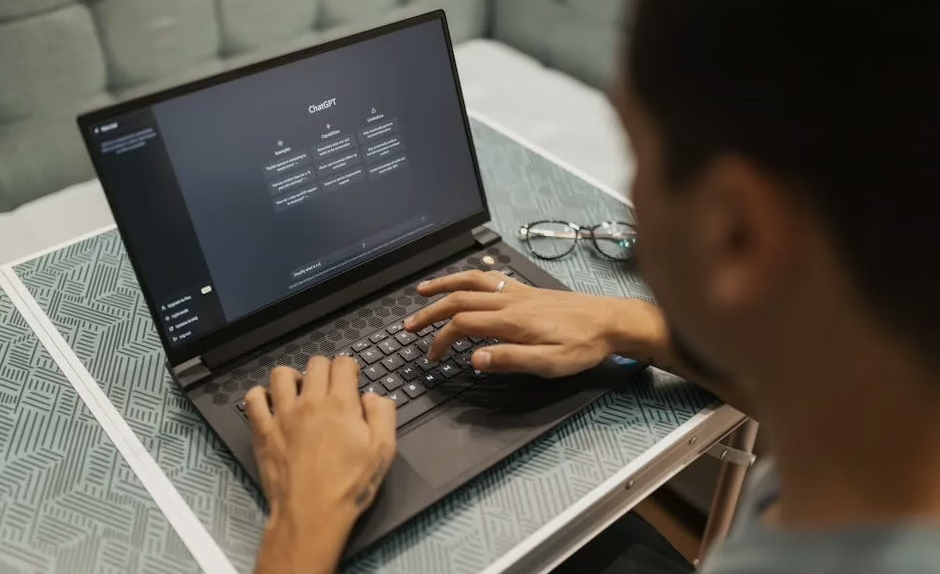
Writing assistance emerged as the dominant AI productivity application, with tools like Claude, ChatGPT, and specialized platforms handling everything from email drafting to complex document creation. These applications showed consistent adoption across industries and skill levels.
Meeting productivity tools ranked second, with AI-powered transcription, summarization, and action item generation becoming standard in enterprise environments. Calendar management and scheduling optimization tools rounded out the top adoption categories.
Canva’s evolution illustrates the trajectory from simple design tools to comprehensive AI-powered productivity platforms. The company’s latest update allows users to simply describe desired outputs, with AI systems automatically gathering relevant data from workplace sources to generate presentations and documents.
What This Means
The AI productivity revolution has moved decisively from experimental to operational, with measurable speed improvements driving widespread enterprise adoption. However, the correlation between productivity gains and job displacement fears signals that organizations must carefully manage workforce transitions alongside technology deployment.
Security considerations become critical as AI agents gain infrastructure access. The shift from read-only data tools to systems that can modify firewall rules and access controls creates new attack vectors that require proactive governance frameworks.
The concentration of benefits among high-wage workers suggests AI may initially increase rather than decrease workplace inequality, despite productivity gains across skill levels. Organizations implementing AI productivity tools should consider how to distribute benefits more equitably while addressing legitimate displacement concerns through retraining and role evolution programs.
FAQ
What AI productivity tools show the biggest impact?
Writing assistants like Claude and ChatGPT lead adoption, followed by meeting transcription and summarization tools. Enterprise platforms integrating multiple data sources, like Canva’s updated system, show particularly strong productivity gains.
Are AI productivity tools actually replacing jobs?
Current data shows productivity enhancement rather than widespread job elimination. However, workers experiencing the largest speed improvements also express the highest concerns about future displacement, suggesting the impact varies significantly by role and industry.
What security risks do AI productivity tools create?
Major risks include prompt injection attacks that compromise credentials and the new threat of autonomous agents with infrastructure access. Over 90 organizations experienced AI tool compromises in 2025, with next-generation agents capable of modifying firewall rules and security policies.