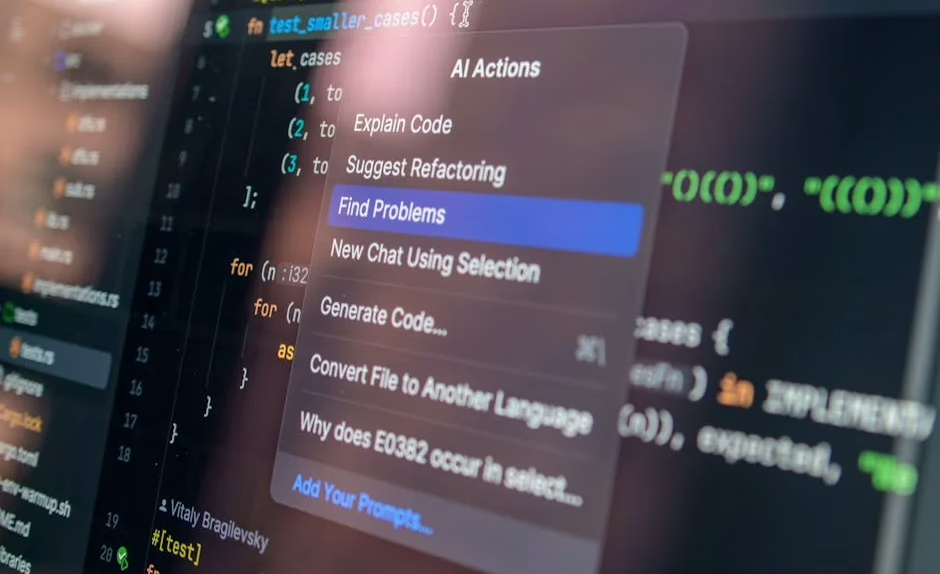

Major enterprises are rapidly deploying AI-powered productivity tools that fundamentally change how employees handle writing, meetings, email, and calendar management. According to Google Cloud’s latest research, over 1,302 organizations are now using agentic AI systems for productivity tasks, marking the fastest technological transformation in business history.
Companies like Home Depot, Capcom, and Mars are leveraging AI assistants to automate complex workflows, while Canva’s recent enterprise pivot demonstrates how design tools are evolving into comprehensive productivity platforms that pull data from Slack, email, and other sources to create presentations automatically.
Enterprise AI Agents Handle Real Business Tasks
The shift from experimental AI to production-ready productivity tools is accelerating across industries. Google’s enterprise case studies reveal that companies are deploying AI agents for high-stakes operations including:
- Financial services: Citi Wealth uses AI assistants to provide personalized investment advice and portfolio management
- Gaming: Capcom employs AI agents for automated game testing and quality assurance
- Retail: Home Depot’s AI systems handle customer service inquiries and inventory management
- Manufacturing: Mars integrates AI productivity tools across research and development workflows
These implementations go far beyond simple chatbots. Modern AI productivity apps can schedule meetings across time zones, draft emails in your writing style, take comprehensive meeting notes, and even manage complex project workflows.
Writing Assistants Evolve Beyond Simple Text Generation
AI writing assistants have matured significantly, moving from basic text completion to sophisticated content creation that understands context and business requirements. Canva’s latest update exemplifies this evolution, allowing users to simply describe what they need and have the AI pull relevant information from multiple sources.
Key improvements in AI writing tools include:
- Context awareness: Understanding your company’s tone, style, and terminology
- Multi-source integration: Pulling data from email, Slack, calendars, and documents
- Real-time collaboration: Multiple users can work with AI assistants simultaneously
- Industry-specific templates: Pre-built workflows for legal, marketing, and technical writing
However, productivity gains aren’t automatic. Recent research from Waydev shows that while developers initially accept 80-90% of AI-generated code, they often need to revise it significantly later, reducing real-world acceptance rates to 10-30%.
Meeting and Calendar AI Transforms Time Management
AI-powered meeting tools are revolutionizing how teams collaborate and manage their time. These systems can automatically:
- Schedule meetings: Find optimal times across multiple calendars and time zones
- Generate agendas: Create structured meeting outlines based on email threads and project status
- Take comprehensive notes: Transcribe, summarize, and extract action items in real-time
- Follow up automatically: Send summaries and track action item completion
The user experience has become remarkably intuitive. Instead of wrestling with scheduling conflicts, you can simply tell your AI assistant “Schedule a project review with the design team next week” and it handles the coordination.
Security and Approval Systems Address Enterprise Concerns
As AI productivity tools gain more capabilities, security becomes paramount. NanoClaw’s partnership with Vercel introduces infrastructure-level approval systems that ensure no sensitive action occurs without human consent.
This approach addresses the “keys to the kingdom” problem where organizations had to choose between keeping AI agents in useless sandboxes or granting them dangerous levels of access. The new system works through familiar messaging apps:
- DevOps teams: AI proposes infrastructure changes that require senior engineer approval in Slack
- Finance departments: AI prepares payments but requires human signature via WhatsApp
- HR workflows: AI drafts communications but needs manager approval before sending
This infrastructure-level security represents a fundamental shift from application-based permissions to system-wide governance.
User Experience Design Prioritizes Simplicity
The best AI productivity apps succeed because they integrate seamlessly into existing workflows rather than requiring users to learn new interfaces. Successful implementations share common design principles:
Natural language interaction: Users can communicate with AI tools using everyday language rather than complex commands or prompts.
Contextual awareness: The AI understands what you’re working on and provides relevant suggestions without being asked.
Progressive disclosure: Advanced features remain hidden until needed, keeping the interface clean for basic tasks.
Familiar integration points: AI capabilities appear within existing tools like email clients, calendar apps, and document editors.
Canva’s approach exemplifies this philosophy. Rather than creating a separate AI interface, they’ve integrated intelligence directly into their existing design workflow, making AI assistance feel natural and intuitive.
What This Means
The AI productivity revolution is moving beyond hype into practical business value. Organizations that embrace these tools thoughtfully—with proper security measures and realistic expectations—are seeing genuine improvements in efficiency and output quality.
The key is focusing on user experience rather than raw AI capabilities. The most successful implementations prioritize seamless integration, intuitive interfaces, and robust approval systems over flashy features.
For businesses considering AI productivity tools, the evidence suggests starting with specific, well-defined use cases rather than broad deployments. Focus on areas where AI can augment human decision-making rather than replace it entirely.
FAQ
Q: Are AI productivity apps secure enough for enterprise use?
A: Modern AI productivity platforms like NanoClaw 2.0 include infrastructure-level approval systems that require human consent for sensitive actions, addressing major security concerns while maintaining functionality.
Q: Do AI writing assistants actually improve productivity?
A: While initial acceptance rates are high (80-90%), real-world productivity depends on implementation quality. Organizations see the best results when AI tools integrate naturally into existing workflows rather than requiring new processes.
Q: What’s the difference between AI productivity apps and traditional automation?
A: AI productivity apps can understand context, handle ambiguous requests, and adapt to changing situations, while traditional automation follows rigid, pre-programmed rules. This flexibility makes them more useful for complex knowledge work.