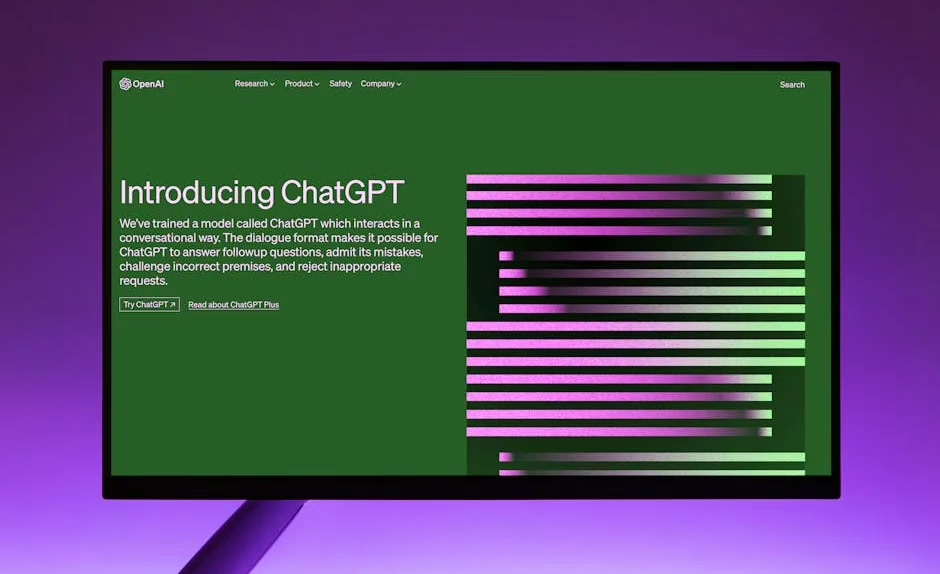

OpenAI has officially launched ChatGPT Images 2.0, a significant upgrade to its image generation capabilities that introduces sophisticated multilingual text rendering, comprehensive infographic creation, and enhanced visual content production. The new `gpt-image-2` model, which has been quietly tested on LM Arena AI under the codename “duct tape” for several weeks, represents a fundamental advancement in multimodal AI architecture.
According to VentureBeat, the update encompasses both the new API model and a suite of “Thinking” features for ChatGPT subscribers, marking what OpenAI describes as “a fundamental shift in how the company views visual media.” The release comes just months after the December 2025 launch of GPT-Image-1.5, demonstrating OpenAI’s accelerated development timeline for visual AI capabilities.
Technical Architecture Breakthrough
ChatGPT Images 2.0 introduces several technical innovations that address longstanding challenges in AI-generated visual content. The model demonstrates unprecedented capability in text-within-image generation, supporting multilingual text blocks and complex typographic layouts that previous models struggled to produce coherently.
Key technical improvements include:
- Enhanced instruction following for complex visual compositions
- Improved color accuracy and lighting models building on GPT-Image-1.5 foundations
- Advanced text rendering engine capable of handling multiple languages simultaneously
- Sophisticated layout understanding for infographics, slides, and user interface mockups
The model’s architecture appears to incorporate advanced attention mechanisms specifically designed for spatial reasoning and text-image coherence. Early testing reveals the system can generate realistic website screenshots, detailed floor plans, and character models from multiple angles with remarkable consistency.
Multimodal Content Generation Capabilities
The new model excels in creating complex visual content that combines textual and graphical elements seamlessly. According to VentureBeat, users have reported “insanely realistic generation of user interfaces and screenshots from popular websites and platforms” during the testing phase.
Notable capabilities include:
- Full infographic creation with data visualization components
- Presentation slide generation with professional layouts
- Interactive map creation with geographic accuracy
- Manga and comic-style artwork with consistent character representation
- Web research integration that incorporates real-time data into visual outputs
The system’s ability to handle user-uploaded imagery extends these capabilities to image editing and enhancement workflows. This represents a significant advancement in multimodal AI, where the model can understand, modify, and generate visual content based on both textual prompts and existing images.
World ID Integration Expands Human Verification
Parallel to OpenAI’s image generation advances, Sam Altman’s World project has announced significant expansion of its human verification technology. According to TechCrunch, Tools for Humanity revealed plans to integrate World ID verification into Tinder, Zoom, DocuSign, and other mainstream platforms.
The World project’s technical approach relies on zero-knowledge proof-based authentication using iris scanning technology. The spherical Orb devices convert iris patterns into unique cryptographic identifiers while maintaining user anonymity. This addresses growing concerns about AI agent proliferation in digital spaces.
Current adoption metrics:
- 18 million verified users (up from 12 million in 2024)
- Global Tinder integration following successful Japan pilot
- Enterprise partnerships with major videoconferencing and document platforms
As Altman noted at the San Francisco event, “We are heading to a world now where there’s going to be more stuff generated by AI than by humans,” highlighting the technical necessity for robust human verification systems.
Performance Metrics and User Experience
Early performance data from the LM Arena AI testing platform indicates ChatGPT Images 2.0 demonstrates substantial improvements across multiple evaluation criteria. The model’s text generation accuracy within images shows marked improvement over previous iterations, particularly in handling complex multilingual content.
User feedback during the testing phase highlighted several breakthrough capabilities:
- Reproduction of real-life figures including Sam Altman with high fidelity
- Web research integration that automatically incorporates current information
- Grid-based image generation for creating multiple related visuals simultaneously
- Character consistency across multiple viewing angles and poses
The integration of “Thinking” features suggests OpenAI has implemented chain-of-thought reasoning specifically for visual content generation, allowing the model to plan and execute complex visual compositions more effectively.
What This Means
ChatGPT Images 2.0 represents a significant technical milestone in multimodal AI development, particularly in addressing the challenge of coherent text-image integration. The model’s advanced capabilities in generating complex visual content with embedded textual elements could accelerate adoption in enterprise design workflows, educational content creation, and marketing automation.
The simultaneous expansion of World ID verification technology addresses a critical infrastructure need as AI-generated content becomes increasingly sophisticated. The combination of advanced content generation capabilities with robust human verification systems suggests the AI industry is proactively addressing authenticity concerns.
For technical practitioners, these developments indicate that multimodal AI architectures are approaching production-ready sophistication for complex creative tasks. The rapid iteration cycle from GPT-Image-1.5 to Images 2.0 demonstrates OpenAI’s commitment to maintaining technical leadership in visual AI capabilities.
FAQ
What makes ChatGPT Images 2.0 different from previous image generation models?
ChatGPT Images 2.0 introduces advanced text-within-image capabilities, supporting multilingual content, complex layouts, and realistic interface mockups. The model can generate comprehensive infographics, presentation slides, and detailed visual content that previous versions couldn’t produce coherently.
How does World ID verification work technically?
World ID uses iris scanning technology through spherical Orb devices to create unique cryptographic identifiers. The system employs zero-knowledge proof-based authentication to verify human identity while maintaining anonymity, converting iris patterns into encrypted digital signatures.
When will ChatGPT Images 2.0 be available to all users?
According to OpenAI’s announcement, ChatGPT Images 2.0 is rolling out to ChatGPT users across all subscription tiers. The `gpt-image-2` model is also available through OpenAI’s API for developers building applications with advanced image generation capabilities.
Related news
- ChatGPT Images 2.0 launches with text, slides and multilingual output | ETIH EdTech News – EdTech Innovation Hub – Google News – Tech Innovation
- OpenAI teams up with Infosys to bring AI tools to more businesses – TechCrunch
- Retail traders can now get long OpenAI as Robinhood’s venture fund takes a stake – CNBC Tech