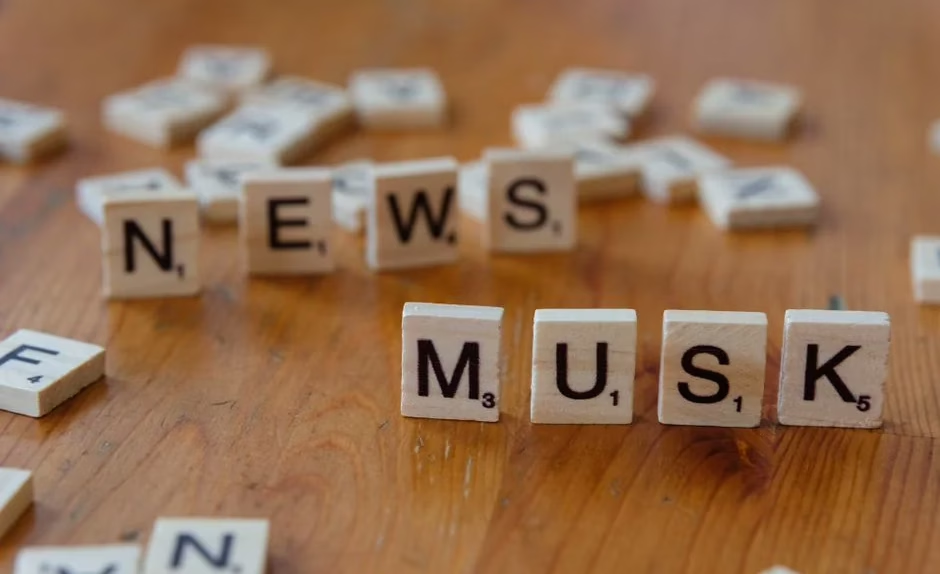

A jury in Oakland, California dismissed all of Elon Musk’s claims against OpenAI, Sam Altman, and Greg Brockman in late May 2026, ending a nearly month-long trial that exposed the inner workings of one of AI’s most consequential founding relationships. The dismissal came on statute-of-limitations grounds after just a few hours of deliberation.
How the Trial Unfolded
The Musk v. Altman trial featured testimony from Elon Musk, Sam Altman, Microsoft CEO Satya Nadella, OpenAI cofounder Greg Brockman, and former OpenAI board member Shivon Zilis, among others. Musk’s legal team argued that Altman and Brockman broke a founding promise to keep OpenAI a nonprofit dedicated to developing AI for humanity’s benefit — and enriched themselves by converting its for-profit subsidiary into a public benefit corporation in 2025.
Musk’s attorney Steven Molo told the court that Altman and Brockman “broke their promise to use money Musk donated to maintain OpenAI as a nonprofit,” according to MIT Technology Review. OpenAI’s attorney Sarah Eddy countered that no such promise was ever made, and that OpenAI remains a nonprofit committed to safe AI development despite the restructuring.
Eddy also argued that Musk filed his lawsuit too late — and that his real motivation was to undermine a competitor to his own AI company, xAI, which he launched in 2023.
The Verdict and Its Immediate Fallout
The jury dismissed all charges against OpenAI and its leadership, citing the statute of limitations. According to The Verge, deliberations lasted only a couple of hours before the verdict was returned.
Musk did not accept the outcome quietly. In a post he later deleted, he called Judge Yvonne Gonzalez Rogers a “terrible activist Oakland judge” and announced plans to appeal. He wrote, as TechCrunch reported, “There is no question to anyone following the case in detail that Altman & Brockman did in fact enrich themselves by stealing a charity.”
TechCrunch’s analysis noted that OpenAI’s attorneys “detailed point by point how the law was on their client’s side,” while Musk’s team focused primarily on attacking Altman’s credibility — a strategy that failed to move the jury.
What the Trial Revealed About Both Sides
The proceedings surfaced details that complicated Musk’s portrayal of himself as a wronged philanthropist. Greg Brockman testified that in 2017, Musk asked him to bring a team of OpenAI researchers — including Andrej Karpathy, Ilya Sutskever, and Scott Gray — to Tesla’s headquarters to assist its “demoralized” autopilot team for several weeks.
“It was pretty clear that was not something we could say no to,” Brockman said, according to TechCrunch. Sutskever reportedly advised Tesla engineers that finding 10,000 images of a specific tricky corner case would allow them to fix their self-driving software — a direct transfer of nonprofit-funded expertise to Musk’s commercial vehicle business.
On the other side, Altman was cross-examined over his alleged history of self-dealing involving companies that do business with OpenAI, according to MIT Technology Review. Altman responded by characterizing Musk as a power-seeker who wanted personal control over the development of artificial general intelligence.
OpenAI also introduced a physical exhibit: a golden trophy of a donkey’s rear end that had been gifted to an employee who was called a “jackass” by Musk for pushing back on his plans to accelerate toward AGI — framing it as evidence of the company’s commitment to AI safety over speed.
From Co-Founders to Courtroom
Musk and Altman co-founded OpenAI together in 2015 as a nonprofit AI research lab, according to CNBC. For several years, Altman publicly praised Musk; in 2019 he wrote that “betting against Elon is historically a mistake.”
The relationship deteriorated over the following decade, culminating in Musk’s 2024 lawsuit accusing OpenAI of abandoning its founding mission in favor of profit. The trial, reported by The Verge, put ChatGPT’s future structure directly at stake — Musk sought to unwind OpenAI’s 2025 restructuring and remove Altman and Brockman from leadership.
OpenAI Moves Forward: $2M Token Deal for YC Startups
While the trial dominated headlines, OpenAI separately announced an investment initiative targeting early-stage startups. At a Y Combinator event on Tuesday, May 20, Altman offered $2 million worth of OpenAI tokens to every startup in YC’s current cohort — approximately 169 companies — in exchange for equity, according to TechCrunch.
The deal is structured as an uncapped SAFE, meaning it converts at the startup’s first priced round — typically a Series A — with no valuation ceiling. YC managing director Jared Friedman told TechCrunch: “It will convert in the next priced round, which is typically the Series A.”
An uncapped structure benefits founders because a higher valuation at conversion means a smaller equity slice for OpenAI. Discussion on X suggested OpenAI could hold roughly 2% equity if a startup reaches a $100 million valuation, though TechCrunch noted that figure could not be verified without seeing the actual terms.
For OpenAI, the arrangement serves two purposes: equity upside if these startups succeed, and a strong incentive for early-stage companies to build on OpenAI’s infrastructure from day one.
What This Means
The jury’s swift dismissal on statute-of-limitations grounds means the core legal question — whether Altman and Brockman actually broke a contractual promise to Musk — was never decided on its merits. Musk’s announced appeal could keep the dispute alive, but the procedural loss significantly weakens his position.
More broadly, the trial produced a public record that cuts both ways. OpenAI’s for-profit restructuring stands intact, and Altman remains in charge of a company that is now aggressively expanding its startup ecosystem footprint through the YC token deal. Musk, meanwhile, faces the reputational cost of testimony showing that he, too, directed nonprofit-funded researchers toward his own commercial interests.
OpenAI’s next legal and regulatory exposure is likely to shift toward its IPO trajectory and the scrutiny of its nonprofit governance — issues that the trial raised but the verdict did not resolve.
FAQ
Why did the jury dismiss Musk’s lawsuit against OpenAI?
The jury dismissed all charges on statute-of-limitations grounds, meaning Musk waited too long to file his claims regardless of their underlying merit. Deliberations lasted only a few hours before the verdict was returned in late May 2026.
What was Musk asking for in the OpenAI trial?
Musk sought to reverse OpenAI’s 2025 restructuring — which converted its for-profit subsidiary into a public benefit corporation — and to remove Sam Altman and Greg Brockman from their leadership roles at the company.
What is the OpenAI token deal with Y Combinator startups?
OpenAI offered $2 million in AI tokens to each of the approximately 169 startups in Y Combinator’s current cohort, structured as an uncapped SAFE that converts to equity at the startup’s first priced funding round, typically a Series A.
Sources
- All of the updates from Elon Musk and Sam Altman’s battle over OpenAI – The Verge
- Musk v. Altman week 3: Elon Musk and Sam Altman traded blows over each other’s credibility. Now the jury will pick a side. – MIT Technology Review
- How Elon Musk and Sam Altman went from besties to bitter rivals – CNBC Tech
- Sam Altman makes ‘mic drop’ offer to every Y Combinator startup – TechCrunch
- Elon Musk said Sam Altman ‘stole’ a non-profit — but the trial showed he had similar aims – TechCrunch