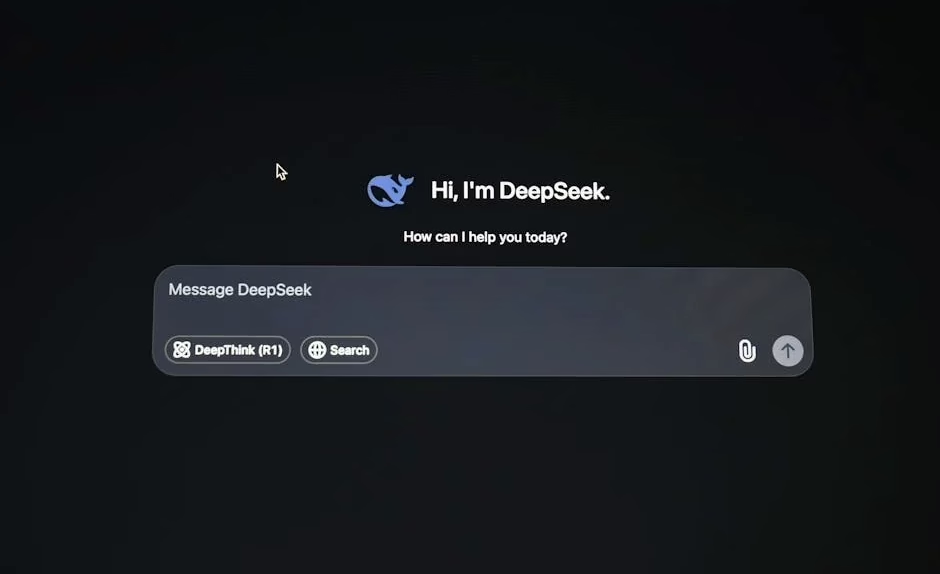

DeepSeek released its V4 model on Monday, delivering near state-of-the-art AI performance at approximately one-sixth the cost of competing systems like OpenAI’s GPT-5.5 and Anthropic’s Opus 4.7. The 1.6-trillion-parameter Mixture-of-Experts model is available under the MIT open source license and matches or exceeds closed-source systems on multiple benchmarks.
According to VentureBeat, the Chinese AI startup’s latest release marks what researchers are calling the “second DeepSeek moment” — 484 days after the company’s V3 launch that first disrupted the AI landscape in January 2025.
Performance Benchmarks Show Competitive Results
DeepSeek-V4 achieves performance parity with frontier models across reasoning and mathematical tasks while maintaining significantly lower operational costs. The model demonstrates particular strength in structured logical reasoning, an area where recent research from arXiv suggests LLMs should focus on latent-state trajectory formation rather than explicit chain-of-thought processes.
The timing coincides with emerging research into advanced reasoning techniques. New work on structured abductive-deductive-inductive reasoning introduces algebraic invariants to prevent logical inconsistencies in multi-step inference chains. These developments suggest the field is moving toward more robust reasoning architectures that could benefit from open-source implementations like DeepSeek-V4.
Cost Structure Disrupts Pricing Models
The most significant impact lies in DeepSeek-V4’s pricing through the company’s API, which undercuts major providers by substantial margins. This cost advantage stems from the model’s efficient architecture and China’s lower computational costs, creating pressure on closed-source providers to justify premium pricing.
Google’s recent compilation of 1,302 real-world generative AI use cases demonstrates widespread enterprise adoption, suggesting cost-effective alternatives like DeepSeek-V4 could accelerate deployment across organizations previously constrained by budget limitations.
The open-source MIT license allows commercial use without licensing fees, further reducing barriers to adoption for enterprises and developers building AI-powered applications.
Technical Architecture and Capabilities
The 1.6-trillion-parameter Mixture-of-Experts design allows DeepSeek-V4 to activate only relevant model sections for specific tasks, improving efficiency while maintaining performance. This architecture proves particularly effective for reasoning tasks that require sustained logical consistency.
Recent advances in prompt engineering, including techniques like String Seed-of-Thought (SSoT) for probabilistic instruction following, could enhance DeepSeek-V4’s capabilities in scenarios requiring randomness or simulation. According to Forbes, SSoT addresses longstanding challenges in getting LLMs to properly handle probabilistic tasks.
The model’s reasoning capabilities align with emerging research suggesting that effective LLM reasoning operates through latent-state dynamics rather than surface-level chain-of-thought processes. This understanding could inform how developers implement DeepSeek-V4 in production systems.
Market Impact and Industry Response
The release places immediate pressure on closed-source AI providers to demonstrate value beyond raw performance metrics. With DeepSeek-V4 matching frontier capabilities at significantly lower costs, companies like OpenAI and Anthropic must justify premium pricing through superior safety, reliability, or specialized features.
Industry observers noted that the “second DeepSeek moment” effectively resets the developmental trajectory of the entire AI field. The combination of open-source availability and competitive performance creates new opportunities for smaller organizations and researchers previously excluded from frontier AI access.
The model’s availability on Hugging Face facilitates rapid community adoption and experimentation, potentially accelerating innovation in AI applications across industries.
Open Source Implications for AI Development
DeepSeek-V4’s MIT license represents a significant shift toward open AI development, contrasting with the increasingly closed approaches of major U.S. AI companies. This licensing choice enables unrestricted commercial use, modification, and distribution.
The open-source nature allows researchers to study the model’s architecture, training methods, and reasoning capabilities in detail. This transparency could accelerate progress in understanding how large language models achieve complex reasoning, particularly in light of recent research questioning the role of explicit chain-of-thought in LLM reasoning.
For enterprises, the open-source model eliminates vendor lock-in concerns and provides greater control over AI infrastructure, addressing sovereignty and security considerations that have limited AI adoption in certain sectors.
What This Means
DeepSeek-V4 fundamentally alters the AI competitive landscape by proving that frontier-level capabilities can be delivered at dramatically lower costs through open-source models. This development challenges the assumption that cutting-edge AI requires massive capital investment and closed development approaches.
The release accelerates the democratization of advanced AI capabilities, potentially enabling smaller organizations and developing nations to access tools previously reserved for well-funded entities. This shift could drive innovation in AI applications across industries and geographical regions.
For the broader AI industry, DeepSeek-V4 forces a reckoning with pricing strategies and value propositions. Closed-source providers must now articulate clear advantages beyond raw performance to justify premium costs, likely focusing on safety, enterprise features, or specialized capabilities.
FAQ
How does DeepSeek-V4 compare to GPT-5.5 and Claude Opus 4.7?
DeepSeek-V4 matches or exceeds these models on multiple benchmarks while costing approximately one-sixth the price through API access. The performance parity covers reasoning, mathematical tasks, and general language capabilities.
What makes DeepSeek-V4’s pricing so competitive?
The combination of efficient Mixture-of-Experts architecture, lower computational costs in China, and open-source licensing eliminates many cost factors that drive up pricing for closed-source alternatives. The MIT license also removes licensing fees for commercial use.
Can enterprises use DeepSeek-V4 for commercial applications?
Yes, the MIT open-source license permits unrestricted commercial use, modification, and distribution. This provides enterprises with greater control over their AI infrastructure compared to proprietary alternatives with restrictive licensing terms.