
NVIDIA CEO Jensen Huang confirmed Monday that the company now holds zero market share in China following U.S. export restrictions on advanced semiconductors. Speaking at a Milken Institute event with MSNBC’s Becky Quick, Huang stated that China should not have access to NVIDIA’s most advanced chips, marking a stark shift from the company’s previously significant Chinese revenue.
The comments come as NVIDIA has pivoted from China-focused sales to domestic AI infrastructure investments. According to CNBC reporting, the company has pushed past $40 billion in equity investments this year, including recent commitments of $3.2 billion to glass manufacturer Corning and $2.1 billion to data center operator IREN.
NVIDIA’s $40 Billion Investment Strategy
NVIDIA has embraced an aggressive investment approach across the AI infrastructure stack, combining equity stakes with commercial partnerships. The strategy reflects what Wedbush Securities analyst Matthew Bryson described as a “circular” approach to building AI ecosystem dependencies.
Key recent investments include:
- Corning: Up to $3.2 billion for advanced glass manufacturing
- IREN: $2.1 billion in data center operations
- Multiple undisclosed stakes in AI infrastructure companies
The investment strategy allows NVIDIA to secure supply chain partnerships while potentially benefiting from portfolio company growth. According to CNBC, this approach helps NVIDIA maintain control over critical AI infrastructure components beyond just GPU manufacturing.
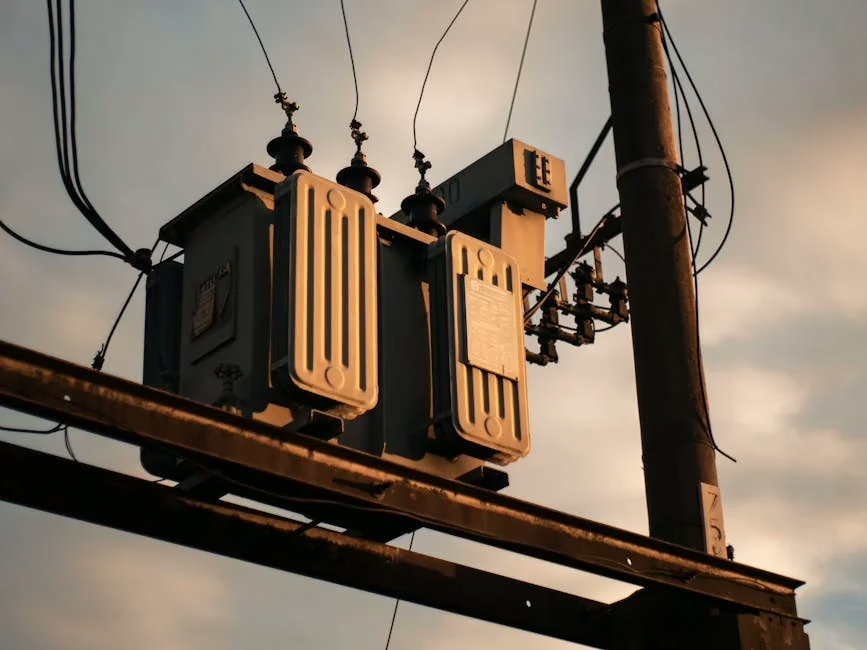
Energy Partnership Through Genesis Mission
NVIDIA is partnering with the U.S. Department of Energy on the Genesis Mission, applying AI to scientific discovery and energy infrastructure. Speaking at the SCSP AI+ Expo, NVIDIA VP Ian Buck emphasized the company’s commitment to the program.
“NVIDIA is 100% committed and invested in Genesis,” Buck said, according to NVIDIA’s official blog. “I’ve never seen more excitement across the lab and industry.”
U.S. Energy Secretary Chris Wright positioned American AI leadership as dependent on energy leadership, stating that “energy is life” and that affordable energy creates societal opportunities. The Genesis Mission builds on two decades of NVIDIA collaboration with national laboratories on supercomputing projects.
Huang Dismisses AI Job Displacement Fears
During the Milken Institute discussion, Huang pushed back against concerns about AI-driven unemployment, arguing that artificial intelligence creates more jobs than it eliminates. He characterized AI as America’s “best opportunity to re-industrialize” itself through new manufacturing requirements.
According to TechCrunch coverage, Huang argued that AI automation of specific tasks doesn’t eliminate entire job functions. He distinguished between individual tasks and broader job purposes, suggesting that employee roles evolve rather than disappear as AI capabilities expand.
Huang criticized “AI doomers” who predict mass unemployment, stating his greatest concern is “that we scare people” about AI’s economic impact. The CEO pointed to AI-powered industrial facilities and hardware manufacturing as job creation engines, particularly benefiting NVIDIA’s core business of AI infrastructure sales.
Anthropic Regulatory Comments
Huang also addressed recent regulatory scrutiny of AI companies, specifically mentioning Anthropic’s interactions with the U.S. government. “Hope the U.S. government and Anthropic work it out,” Huang told CNBC, without elaborating on specific regulatory concerns.
The comment comes as AI companies face increasing government oversight around safety standards, export controls, and competitive practices. NVIDIA’s own business has been significantly impacted by semiconductor export restrictions to China, contributing to the company’s zero market share statement.
What This Means
NVIDIA’s strategic pivot from China sales to domestic AI investments reflects broader geopolitical tensions around semiconductor technology. The $40 billion investment spree positions NVIDIA as both a chip supplier and ecosystem investor, potentially creating competitive moats through financial relationships.
The company’s partnership with the Department of Energy through Genesis Mission signals deeper integration with U.S. government priorities around AI and energy infrastructure. This alignment may provide regulatory advantages as AI oversight increases.
Huang’s optimistic messaging about AI job creation serves NVIDIA’s business interests while addressing public concerns about automation. However, the company’s massive investments in AI infrastructure suggest preparation for significant economic disruption, regardless of net job impacts.
FAQ
Why does NVIDIA now have zero market share in China?
U.S. export restrictions prevent NVIDIA from selling its most advanced chips to Chinese customers. The company previously derived significant revenue from China before these semiconductor export controls took effect.
What is NVIDIA’s $40 billion investment strategy?
NVIDIA is taking equity stakes in companies across the AI infrastructure stack, from glass manufacturers to data centers. This creates supply chain partnerships while potentially generating returns from portfolio company growth.
What is the Genesis Mission partnership with the Department of Energy?
Genesis Mission applies AI to scientific discovery and energy research. NVIDIA provides computing infrastructure and expertise, building on two decades of collaboration with U.S. national laboratories on supercomputing projects.
Related news
- Nvidia has already committed $40B to equity AI deals this year – TechCrunch
- NVIDIA Isaac GR00T N1.7: Open Reasoning VLA Model for Humanoid Robots – HuggingFace Blog
- Prediction: This Nvidia-Backed Artificial Intelligence (AI) Company Might Be the Next Meme Stock. Here’s Why It’s Actually a Buy at $13 Per Share. – The Motley Fool – Google News – AI
Sources
- Nvidia’s Jensen Huang says China should not have its most advanced chips – Nikkei Asia – Google News – NVIDIA
- As workers worry about AI, Nvidia’s Jensen Huang says AI is ‘creating an enormous number of jobs’ – TechCrunch
- After Nvidia share falls to zero in China, CEO Jensen Huang says: China should not have … – The Times of India – Google News – NVIDIA
- Nvidia embraces role of AI investor, pushing past $40 billion in equity bets this year – CNBC Tech
- Powering the Next American Century: US Energy Secretary Chris Wright and NVIDIA’s Ian Buck on the Genesis Mission – NVIDIA AI Blog