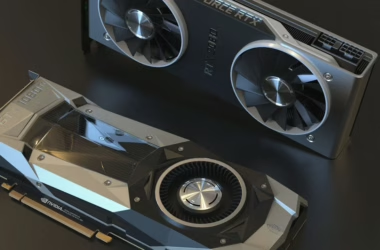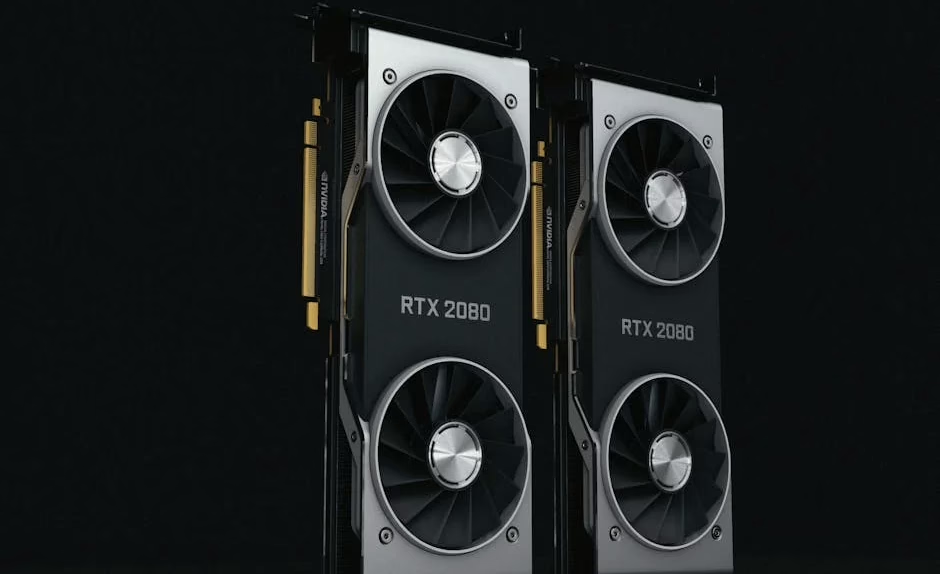

NVIDIA continues to push the boundaries of AI hardware capabilities, with recent developments showing how artificial intelligence can now compress a 10-month, eight-engineer GPU design task into an overnight job. According to Tom’s Hardware, while this represents a dramatic efficiency gain, the company acknowledges being “a long way” from AI designing chips without human input. Meanwhile, NVIDIA’s focus on cost per token optimization as the primary metric for AI infrastructure evaluation signals a fundamental shift in how enterprises measure AI value.
The Democratization Dilemma in AI Hardware Access
NVIDIA’s emphasis on cost per token rather than traditional metrics like FLOPS per dollar represents more than a technical shift—it’s a philosophical reframing of AI value that carries significant societal implications. As enterprises increasingly focus on token output efficiency, this metric becomes a gatekeeper determining which organizations can afford to deploy AI at scale.
The accessibility challenge is stark:
- Small businesses and research institutions may find themselves priced out of competitive AI capabilities
- Cost per token optimization favors large-scale deployments, potentially concentrating AI power among tech giants
- Developing nations risk falling further behind in the AI race due to infrastructure costs
This concentration of AI capabilities raises fundamental questions about technological equity. When AI becomes essential for economic competitiveness, hardware accessibility becomes a matter of social justice. The communities and organizations unable to afford optimal cost-per-token infrastructure may find themselves systematically disadvantaged in an AI-driven economy.
Labor Displacement and the Future of Engineering Work
The revelation that AI can compress months of engineering work into hours represents both a technological triumph and an ethical challenge. While NVIDIA maintains that human oversight remains essential, the trajectory toward AI-assisted design raises profound questions about the future of technical employment.
Key considerations for the workforce include:
- Skill obsolescence: Traditional GPU design expertise may become less valuable
- Job transformation: Engineers may shift from hands-on design to AI supervision roles
- Educational implications: Engineering curricula must evolve to prepare students for AI-augmented workflows
The ethical imperative here extends beyond individual career concerns. Society must grapple with how to manage transitions when AI capabilities advance faster than workforce adaptation. The semiconductor industry, which employs millions globally, faces a fundamental restructuring that could leave entire communities economically displaced without proper planning and support systems.
Transparency and Accountability in AI-Driven Development
As AI takes on more responsibility in hardware design, questions of accountability become increasingly complex. When an AI system designs a chip component that later fails, who bears responsibility—the AI developers, the supervising engineers, or the companies deploying the technology?
Critical transparency gaps include:
- Limited visibility into AI decision-making processes in chip design
- Unclear liability frameworks for AI-generated designs
- Potential for systemic biases in AI-designed hardware architectures
The integration of AI acceleration in creative workflows, such as Adobe Premiere’s new Color Mode, demonstrates how AI hardware capabilities are becoming embedded in everyday professional tools. This ubiquity makes transparency even more crucial, as professionals across industries become dependent on AI-optimized systems they may not fully understand.
Market Concentration and Competition Concerns
NVIDIA’s dominance in AI hardware creates significant market concentration risks that extend beyond typical antitrust concerns. When a single company controls the infrastructure that enables AI development, it wields unprecedented influence over the direction of technological progress.
Regulatory considerations include:
- Export controls: NVIDIA’s chips are subject to geopolitical restrictions that can limit global AI development
- Pricing power: Market dominance allows for pricing strategies that may exclude smaller players
- Innovation direction: NVIDIA’s hardware priorities shape the entire AI research landscape
Analyst predictions that NVIDIA could become a $22 trillion company underscore the extraordinary market power at stake. Such concentration raises questions about whether critical AI infrastructure should be treated as a public utility rather than a private commodity.
Environmental and Resource Implications
The push for ever-more-powerful AI hardware carries significant environmental costs that are often overlooked in discussions of technological progress. NVIDIA’s H100 and upcoming H200 chips consume enormous amounts of energy, contributing to the carbon footprint of AI operations.
Sustainability challenges include:
- Energy consumption: AI training and inference require massive computational resources
- Manufacturing impact: Semiconductor production involves environmentally intensive processes
- E-waste concerns: Rapid hardware obsolescence creates disposal challenges
The cost-per-token optimization framework, while economically rational, may inadvertently encourage energy-intensive approaches if they prove more cost-effective. Society needs frameworks that balance economic efficiency with environmental responsibility, potentially requiring regulatory intervention to internalize environmental costs.
What This Means
NVIDIA’s hardware advances represent a critical juncture for AI ethics and society. The company’s technological capabilities are reshaping not just computing, but fundamental questions about work, equity, and power in the digital age. The shift toward cost-per-token optimization, while technically sound, risks creating new forms of digital divide based on AI infrastructure access.
The challenge for policymakers, ethicists, and society is to harness these technological capabilities while mitigating their potential for harm. This requires proactive governance frameworks that address market concentration, ensure equitable access, protect workers during transitions, and maintain environmental sustainability.
As AI hardware becomes the foundation of economic competitiveness, the decisions made today about regulation, access, and accountability will shape the distribution of power and opportunity for generations. The stakes extend far beyond technical specifications to encompass fundamental questions about the kind of AI-powered society we want to build.
FAQ
How does NVIDIA’s cost-per-token metric affect AI accessibility?
The cost-per-token metric favors large-scale AI deployments, potentially making advanced AI capabilities less accessible to smaller organizations and developing regions that cannot achieve optimal token production efficiency.
What are the main ethical concerns with AI-assisted chip design?
Key concerns include job displacement for engineers, accountability questions when AI-designed chips fail, lack of transparency in AI decision-making processes, and potential systemic biases in hardware architectures.
How might NVIDIA’s market dominance impact AI development globally?
NVIDIA’s control over AI hardware infrastructure gives it significant influence over AI research directions, pricing, and access, while geopolitical export controls on its chips can limit AI development in certain regions.
For the broader 2026 landscape across research, industry, and policy, see our State of AI 2026 reference.
Related news
- Quantum stocks extend their gains. Why Nvidia’s new models could give the industry a boost. – MarketWatch – Google News – NVIDIA
- Cadence, Nvidia working together on developing AI for robotics – Yahoo Finance – Google News – NVIDIA
- ‘Nvidia’s SchedMD Purchase Could Pose Government Risks,’ Says Senator Warren – TipRanks – Google News – NVIDIA
Sources
- Here are Monday’s biggest analyst calls: Nvidia, Apple, Tesla, CoreWeave, Blackstone, Starbucks, Netflix & more – CNBC – Google News – NVIDIA
- New Adobe Premiere Color Grading Mode Accelerated on NVIDIA GPUs – NVIDIA AI Blog
- Nvidia says AI cuts 10-month, eight-engineer GPU design task to overnight job — company is still ‘a long way’ from AI designing chips without human input – Tom’s Hardware – Google News – NVIDIA