
Microsoft completed construction of its first datacenter facility in the Village of Mount Pleasant, Wisconsin on June 23, 2026, as CEO Satya Nadella publicly warned that a small number of AI companies should not be allowed to dominate the broader economy. The announcements arrive alongside a reported energy deal with Chevron to power a West Texas AI datacenter using natural gas.
Wisconsin Datacenter Marks First Racine County Facility
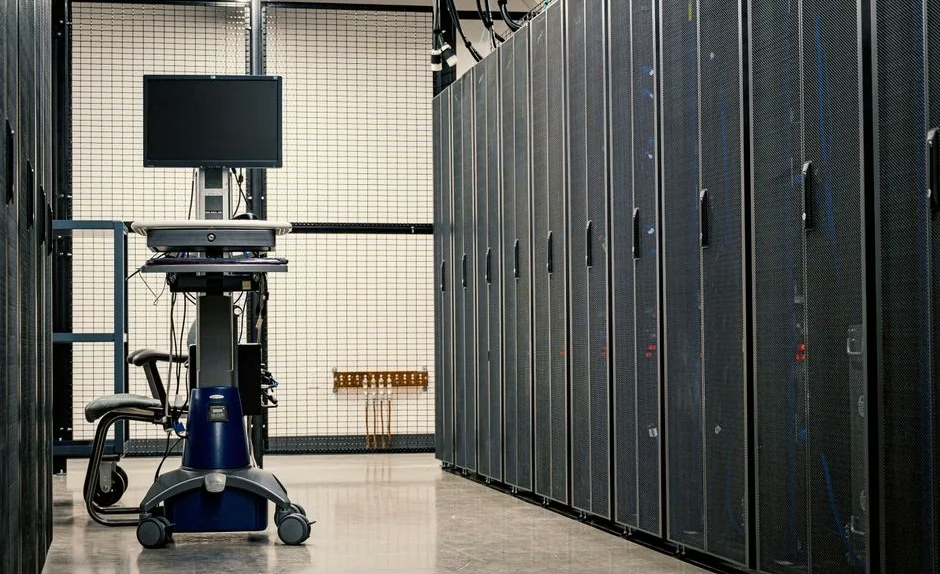
Microsoft finished building its inaugural datacenter in Mount Pleasant, Wisconsin — located in Racine County — on June 23, 2026, according to Microsoft’s official announcement. The facility represents the company’s first physical compute infrastructure in the state, part of a broader push to expand domestic AI capacity ahead of rising enterprise demand on Azure.
The Milwaukee Journal Sentinel reported the completion as a milestone for the region, which had long been slated for tech infrastructure investment. Microsoft did not disclose the facility’s total compute capacity or capital expenditure in the June 23 announcement.
Chevron Powers West Texas AI Datacenter
Separately, Microsoft struck a power supply agreement with Chevron to fuel a large-scale AI datacenter in West Texas, according to reporting by the Wall Street Journal. CNBC confirmed that Chevron will supply natural gas to fuel the facility.
The deal reflects a pattern across the industry of hyperscalers securing dedicated energy contracts to meet the power demands of AI inference and training workloads, which are significantly more electricity-intensive than conventional cloud computing. Neither Microsoft nor Chevron disclosed the contract’s duration, capacity, or financial terms in publicly available statements.
Nadella Warns Against AI Economic Concentration
CEO Satya Nadella told the Wall Street Journal in an exclusive interview that dominant AI companies should not be permitted to capture disproportionate shares of economic value — a position that carries notable weight given Microsoft’s own scale in the sector. Fox Business also covered the remarks as a warning about the AI race.
Nadella’s comments reflect a tension Microsoft itself navigates: the company has invested approximately $13 billion in OpenAI, making it the single largest backer of one of the most influential AI labs in the world, while simultaneously arguing publicly for distributed AI benefit. The WSJ interview did not detail specific policy proposals Nadella would support, but the remarks signal Microsoft is positioning itself as a responsible actor in ongoing regulatory debates around AI market structure.
Infrastructure Spending Accelerates in 2026
Microsoft’s Wisconsin completion and Texas energy deal are part of a capital expenditure cycle the company has been executing throughout 2025 and into 2026. Microsoft said in its fiscal year 2025 earnings that it planned to spend $80 billion on AI-enabled datacenters in fiscal year 2025 alone, with a majority of that spend directed toward U.S. facilities, according to a January 2025 blog post from the company.
The Mount Pleasant facility is part of a broader Wisconsin investment Microsoft announced in prior years. The campus is expected to expand with additional buildings over time, though Microsoft has not published a timeline for subsequent phases in the June 23 announcement.
Executive Changes at Microsoft
GeekWire reported that Microsoft named a new executive as part of recent leadership moves in the Seattle tech ecosystem, though specific details on the role were not available from the aggregated source. The report grouped the Microsoft appointment alongside other regional tech leadership changes.
What This Means
Microsoft is executing on two parallel tracks: physical infrastructure buildout and narrative positioning. The Wisconsin datacenter completion and the Chevron energy deal show a company moving aggressively to expand Azure’s AI compute footprint across the U.S., securing both land and power supply — two of the binding constraints on datacenter growth in 2026.
Nadella’s public warning about AI economic concentration is harder to evaluate in isolation. Microsoft’s deep financial and technical integration with OpenAI means the company is simultaneously a beneficiary of AI consolidation and a voice calling for broader distribution of its gains. Whether that position translates into concrete policy advocacy — or serves primarily as reputational positioning ahead of expected antitrust scrutiny — will become clearer as regulatory attention on AI market structure intensifies through 2026.
For enterprise customers, the infrastructure investments suggest Azure AI capacity constraints that plagued 2024 and early 2025 are being addressed at scale. More U.S.-based compute also reduces latency and data sovereignty concerns for regulated industries.
FAQ
What did Microsoft complete in Wisconsin in June 2026?
Microsoft completed construction of its first datacenter facility in the Village of Mount Pleasant, Racine County, Wisconsin on June 23, 2026. The facility is part of a larger planned campus, though Microsoft has not published a timeline for additional phases.
What is the Chevron and Microsoft power deal?
Chevron agreed to supply natural gas to power a large Microsoft AI datacenter in West Texas, according to the Wall Street Journal and CNBC. Financial terms, contract duration, and the facility’s power capacity were not disclosed in available reporting.
What did Satya Nadella say about AI companies and the economy?
In an exclusive Wall Street Journal interview, Nadella said AI giants should not be allowed to capture an outsized share of economic value from AI development. He did not outline specific policy remedies, and the remarks came despite Microsoft’s own approximately $13 billion investment in OpenAI.
Related news
- Microsoft’s $37 Billion AI Run Rate Points to 33% Upside Potential – Yahoo Finance – Google News – Microsoft
- Microsoft’s Revised Surface Laptop Is Cheaper—and Worse—Than Before – Gizmodo – Google News – Microsoft
- Microsoft Hasn’t Been This Cheap Since 2018 – And History Says This Comes Next (MSFT) – Seeking Alpha – Google News – Microsoft
Sources
- Exclusive | Microsoft’s Satya Nadella: We Can’t Let AI Giants Eat the Economy – WSJ – Google News – Microsoft
- Microsoft completes construction on first datacenter facility in Mount Pleasant, Wisconsin – Microsoft AI Source
- Chevron Strikes Power Deal With Microsoft for West Texas AI Data Center – WSJ – Google News – Microsoft
- Tech Moves: Microsoft names new exec; Remitly CPO/CTO departs; AWS leader to head Synthesia in Seattle – GeekWire – Google News – Microsoft
- Microsoft CEO has a warning about the AI race – Fox Business – Google News – Microsoft