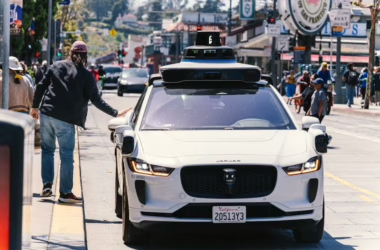

California Issues Comprehensive Robotaxi Regulations
California’s Department of Motor Vehicles this week released new autonomous vehicle testing and deployment regulations spanning 100 pages, establishing stricter requirements for companies operating self-driving cars in the state. The rules introduce novel enforcement mechanisms, including allowing law enforcement to issue traffic citations directly to robotaxi companies for violations committed by their vehicles.
Under the “Notice of Autonomous Vehicle Noncompliance” provision, manufacturers must report any traffic violation to the DMV within 72 hours of receiving it from law enforcement. According to TechCrunch, industry insiders indicate no monetary fines are attached to these violations. Instead, the citations serve as additional data points for the DMV to identify operational problems and take corrective action when necessary.
The regulations also mandate enhanced data collection and sharing requirements, expanded training protocols, and more robust operational standards for autonomous vehicle companies testing or deploying in California.
Uber Pivots Toward Everything App Strategy
Uber CEO Dara Khosrowshahi outlined the company’s expansion beyond ride-hailing into a comprehensive travel and services platform during the company’s annual GO-GET event in New York. The ride-sharing giant now offers hotel booking through a partnership with Expedia, in-car coffee and snacks, and personal shopping services directly through its app.
The Verge reported that Khosrowshahi is positioning Uber as an “everything app” while addressing potential disruption from AI chatbots that could automate ride booking. The CEO expressed openness to AI partnerships but emphasized the need for meaningful integration rather than superficial implementations.
Uber’s financial performance supported this strategic shift, with the company reporting 14% revenue growth in Q1 and issuing guidance for gross bookings between $56.25 billion and $57.75 billion for the current period, exceeding analyst expectations. CNBC noted that Uber shares jumped 7% following the earnings announcement, despite a $1.5 billion net income hit from equity investment revaluations.
Automotive Industry Embraces Real-Time Operations
The automotive sector is undergoing a fundamental shift from reactive to real-time operational models, particularly in finished vehicle logistics. This transformation leverages AI and connected vehicle technologies to optimize supply chain efficiency and reduce response times to market demands.
Traditional automotive logistics relied heavily on batch processing and scheduled deliveries, creating inefficiencies and inventory bottlenecks. Modern systems now employ predictive analytics and machine learning algorithms to anticipate demand patterns and adjust logistics operations dynamically.
Real-time tracking systems provide manufacturers with unprecedented visibility into vehicle movement from production facilities to dealerships. These systems enable immediate response to supply chain disruptions, weather-related delays, and changing market conditions, significantly reducing inventory carrying costs and improving customer satisfaction.
European AI Startups Target Defense and Specialized Markets
European AI startups are carving out niches in specialized sectors, with defense technology emerging as a particularly active area. Alta Ares, a Prague-based company, develops AI-powered counter-drone systems designed to detect and neutralize unauthorized drone incursions at significantly lower costs than traditional defense solutions.
The shift toward defense tech reflects broader geopolitical changes, particularly following the conflict in Ukraine, which highlighted the need for modernized military capabilities. TechCrunch identified 21 European startups worth monitoring, spanning various AI applications from early-stage ventures to established unicorns.
European investors are increasingly focusing on deep tech applications that leverage the region’s strong engineering talent. This approach contrasts with Silicon Valley’s consumer-focused AI applications, potentially giving European startups competitive advantages in specialized B2B markets.
Regulatory Challenges Shape Autonomous Vehicle Deployment
The California DMV’s new regulations reflect growing governmental scrutiny of autonomous vehicle operations as the technology approaches widespread commercial deployment. Industry engineers and policy experts, speaking anonymously to TechCrunch, expressed mixed reactions to the comprehensive rule changes, with some viewing increased oversight as necessary while others worry about implementation complexity.
The citation system represents a novel approach to autonomous vehicle accountability, effectively treating robotaxi companies as responsible parties for their vehicles’ actions. This regulatory framework could serve as a model for other states developing their own autonomous vehicle policies.
Data sharing requirements under the new rules will provide regulators with detailed operational information, potentially accelerating safety improvements across the industry. However, companies must balance compliance costs with development investments, particularly as competition intensifies in the robotaxi market.
What This Means
The convergence of stricter regulations, platform expansion strategies, and technological advancement signals a maturing autonomous vehicle ecosystem. California’s comprehensive regulatory framework establishes clear accountability standards that other jurisdictions will likely adopt, creating industry-wide compliance requirements.
Uber’s pivot toward an everything app strategy reflects broader industry recognition that ride-hailing alone may not sustain long-term growth, particularly as AI threatens to commoditize transportation booking. Companies that successfully integrate multiple services while maintaining user experience quality will likely capture larger market shares.
The emphasis on real-time operations across automotive logistics demonstrates how AI applications are moving beyond experimental phases into core business functions. This shift will accelerate as manufacturers seek competitive advantages through operational efficiency and customer responsiveness.
FAQ
How will traffic violations for robotaxis be enforced under California’s new rules?
Law enforcement can issue citations directly to robotaxi companies for traffic violations. Companies must report these violations to the DMV within 72 hours, though no monetary fines are currently attached. The citations serve as data points for regulatory oversight rather than financial penalties.
What services is Uber adding beyond ride-hailing?
Uber now offers hotel booking through Expedia partnership, in-car refreshments, and personal shopping services. CEO Dara Khosrowshahi describes this as an “everything app” strategy to expand beyond transportation into comprehensive travel and lifestyle services.
Why are European AI startups focusing on defense technology?
The Ukraine conflict highlighted military modernization needs, making defense tech more attractive to investors and entrepreneurs. European startups like Alta Ares are developing AI-powered solutions for drone defense, leveraging the region’s engineering talent in specialized B2B markets rather than competing directly with consumer-focused Silicon Valley companies.