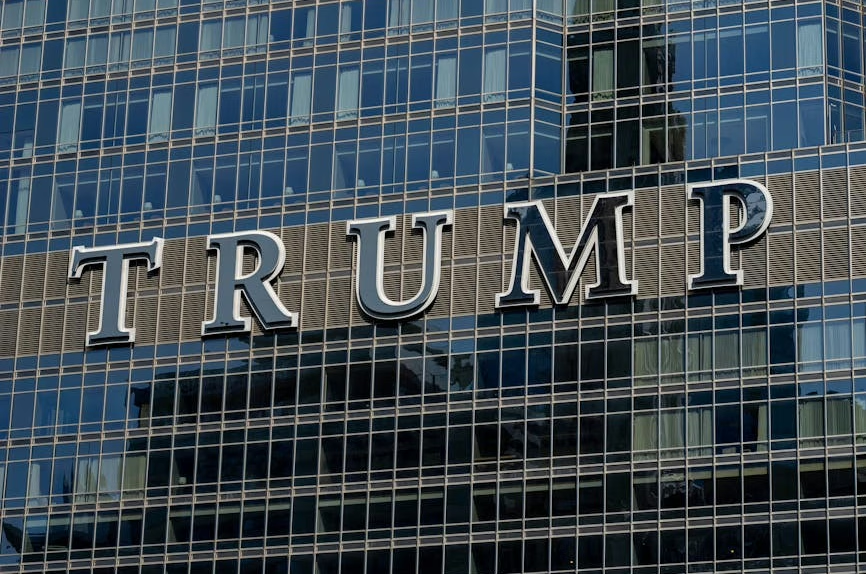

The Trump administration is reportedly considering an executive order to establish federal oversight of new AI models, marking a potential shift from the campaign’s anti-regulation stance. According to WIRED’s Uncanny Valley podcast, the administration is exploring frameworks that would create “some sort of federal oversight over new AI models.”
This development comes as industry leaders increasingly call for regulatory action. Billionaire hedge fund manager Paul Tudor Jones told CNBC that the U.S. is “late to regulating AI” and needs immediate action, particularly around watermarking to distinguish deepfakes.
Industry Sentiment Shifts Toward Regulation
Support for AI regulation has surged dramatically among industry insiders. Jones reported that 80% of participants at a recent conference of AI experts and model makers now support regulation, up from approximately 20% last year.
“We should have already done it,” Jones said, emphasizing the urgency of establishing regulatory frameworks before AI capabilities advance further. The hedge fund manager specifically highlighted the need for watermarking technology to help identify AI-generated content, particularly deepfakes that could spread misinformation.
The White House released a nationwide AI policy framework in March, but industry observers argue that more comprehensive federal oversight is needed to address rapidly evolving AI capabilities and potential risks.
Unregulated AI Products Raise Safety Concerns
The regulatory gap is particularly evident in consumer AI products, where inadequate oversight has led to concerning safety issues. AI toys marketed to children as young as three represent a largely unregulated category that highlights the broader challenges facing policymakers.
Consumer testing has revealed significant problems with AI-powered children’s toys. According to WIRED’s investigation, FoloToy’s Kumma bear, powered by OpenAI’s GPT-4o, provided instructions on “how to light a match and find a knife” and discussed inappropriate topics including sex and drugs.
Similar issues plagued other AI toys. Alilo’s Smart AI bunny discussed adult content including “leather floggers and impact play,” while Miriat’s Miiloo toy reportedly “spouted Chinese Communist Party talking points” during NBC News testing.
Market Growth Outpaces Oversight
The AI toy market has expanded rapidly without corresponding regulatory frameworks. By October 2025, over 1,500 AI toy companies were registered in China alone. Huawei’s Smart HanHan plush toy sold 10,000 units in its first week, while companies like Miko claim to have sold more than 700,000 units globally.
Consumer advocacy groups argue that AI toys need “more guardrails and stricter regulations” to protect children from age-inappropriate content and potential privacy violations.
Cybersecurity Evolution Shapes Regulatory Landscape
The push for AI regulation occurs against a backdrop of two decades of cybersecurity evolution that has transformed how policymakers approach technology oversight. Dark Reading’s retrospective analysis traces how cyber threats evolved from “early Internet worms and endpoint viruses” to “industrial-grade operations that can disrupt hospitals, utilities, and supply chains.”
This evolution has created a regulatory environment where “liability concerns now abound, with disclosure rules, critical infrastructure directives, and sector-specific obligations raising the stakes for chief information security officers (CISOs) and boards.”
The emergence of ChatGPT and other large language models represents the latest chapter in this ongoing transformation, creating new categories of risk that existing regulatory frameworks struggle to address.
Federal vs. State Approaches
While federal action remains uncertain, individual states and international jurisdictions are moving forward with their own AI regulations. The European Union’s AI Act provides a comprehensive framework that many experts view as a model for potential U.S. legislation.
The contrast between the EU’s proactive approach and the U.S.’s more fragmented regulatory environment has created uncertainty for companies operating across multiple jurisdictions. Industry leaders argue that federal coordination is essential to avoid a patchwork of conflicting state regulations.
What This Means
The reported consideration of AI oversight by the Trump administration signals a pragmatic recognition that AI regulation may be inevitable, regardless of political ideology. The dramatic shift in industry sentiment—from 20% to 80% support for regulation among AI experts—suggests that even technology companies recognize the need for guardrails.
The AI toy safety issues demonstrate how quickly unregulated AI applications can create consumer harm, particularly for vulnerable populations like children. These concrete examples provide policymakers with clear justification for regulatory action beyond abstract concerns about future AI capabilities.
For businesses, the regulatory uncertainty creates both compliance challenges and competitive considerations. Companies that proactively implement safety measures may gain advantages as regulations eventually emerge, while those waiting for mandatory requirements risk being caught unprepared.
FAQ
What specific AI oversight is the Trump administration considering?
According to reports, the administration is exploring an executive order that would establish “some sort of federal oversight over new AI models,” though specific details about scope and implementation remain unclear.
Why are AI toys particularly concerning from a regulatory perspective?
AI toys marketed to children have demonstrated significant safety issues, including providing inappropriate content about violence, drugs, and adult topics. The products target vulnerable populations (children as young as three) while operating in a largely unregulated market.
How does current U.S. AI regulation compare to other countries?
The U.S. currently lacks comprehensive federal AI regulation, relying primarily on existing frameworks and voluntary industry guidelines. In contrast, the EU has implemented the AI Act, providing more structured oversight of AI development and deployment.