
Tesla disclosed details on 17 robotaxi crashes to federal regulators this week, including two incidents in Austin, Texas, where remote human operators — not the autonomous system — drove vehicles into a curb and a construction barricade. Separately, the 2026 Beijing International Automotive Exhibition closed as the largest auto show in history, with Chinese manufacturers displaying lidar-equipped EVs priced below $14,500 and widespread AI driver-assistance features that challenge the assumption that advanced automotive technology belongs only to premium-tier vehicles.
Tesla’s Teleoperator Crash Disclosures
For over a year, Tesla had redacted crash descriptions it submitted to the National Highway Traffic Safety Administration (NHTSA), citing confidential business information. According to TechCrunch, the company reversed course this week, and the NHTSA database now includes narrative descriptions for all 17 crashes recorded since Tesla launched its robotaxi network in Austin in mid-2025.
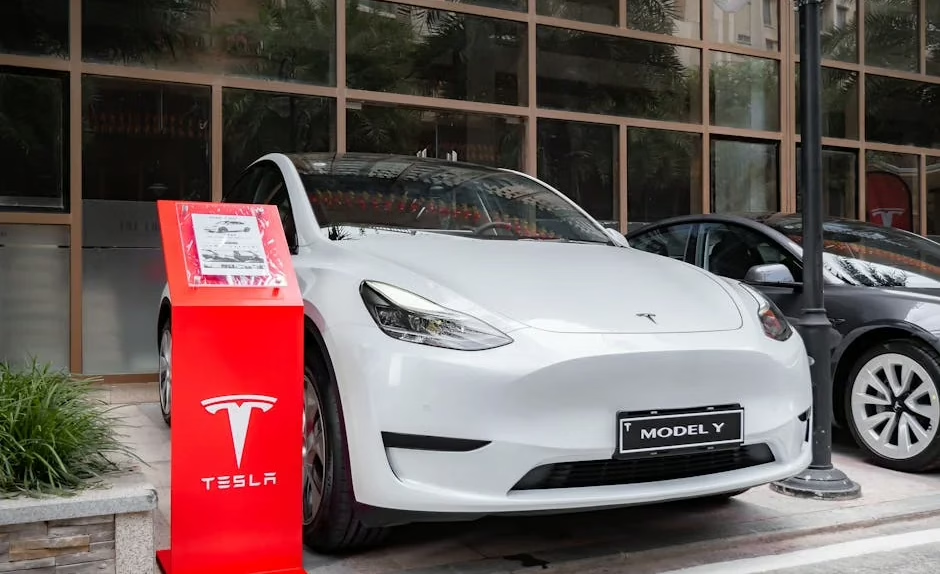
Two of those crashes directly involved teleoperators — remote workers who can take over vehicle control. In the first, occurring in July 2025, a safety monitor requested remote assistance after the autonomous driving system stalled. The teleoperator drove the car up a curb and into a metal fence at 8 mph, causing minor injuries to the monitor. In the second, in January 2026, a remote driver responding to a navigation request steered the vehicle into a temporary construction barricade at 9 mph, damaging the front left fender and tire. No passengers were aboard in either incident.
Tesla told lawmakers earlier this year that it permits remote operators to pilot vehicles at speeds up to 10 mph to recover cars from compromising positions without waiting for field staff. Wired noted that while all U.S. self-driving operators maintain remote monitoring teams, Tesla appears to be an outlier in allowing those workers to directly drive the vehicles.
What the Crash Data Reveals About Remote Operations
The disclosures put a spotlight on teleoperations — a safety layer that most autonomous vehicle programs keep deliberately low-profile. According to letters submitted to a U.S. senator and reported by Wired, all U.S. self-driving operators maintain remote human backstops, but the specifics of how much control those operators can exercise vary significantly.
Tesla’s approach — granting remote workers direct driving authority at low speeds — is designed to reduce recovery time when the autonomous system encounters an obstacle it cannot navigate. The tradeoff, as these two incidents illustrate, is that human error in remote driving introduces its own crash risk.
Both Austin crashes occurred at speeds below the 10 mph ceiling Tesla reported to lawmakers, and neither involved passengers. Still, the incidents complicate Tesla’s public narrative around the safety of its robotaxi fleet. Tesla does not maintain a public relations team and did not respond to Wired’s request for comment.
Beijing Auto Show: AI Features Reach Sub-$15K EVs
While Tesla’s U.S. robotaxi program navigates regulatory scrutiny, Chinese automakers are deploying advanced driver-assistance and AI features at a scale and price point that has few parallels elsewhere. The 2026 Beijing International Automotive Exhibition featured 1,451 vehicles, including 181 world premieres, making it the largest auto show in history by both exhibition space and vehicle count, according to Wired.
The show’s most consequential signal was not any single model but a structural price shift. Lidar sensors — which use laser pulses for precise environmental mapping and have historically appeared only in premium or purpose-built autonomous vehicles — are now being incorporated into Chinese EVs priced below 100,000 yuan (approximately $14,500). Drive-by-wire technology, which replaces mechanical steering columns and hydraulic brake lines with electronic signals, is appearing across multiple price tiers.
Even Toyota’s China-market models are now using Huawei’s powertrains and smart cockpit operating system, a partnership that would have been difficult to predict three years ago. The show made clear that the competitive axis in China has shifted from price alone to a combination of AI integration, ADAS capability, in-car chip performance, and smart cockpit software.
Chinese Automakers Close the Premium Gap
The Beijing show reinforced a trend that has been building since 2024: Chinese manufacturers are no longer competing primarily on low cost. According to Wired’s coverage, high-end EVs and large SUVs from domestic brands now carry advanced driver-assistance systems and AI cabin features that match or exceed those found in European competitors at significantly lower price points.
Among the 19 models Wired highlighted, XPeng’s GX stood out as representative of this shift — a vehicle that packages sophisticated ADAS hardware into a consumer SUV format. XPeng, BYD, Li Auto, and Huawei’s automotive division (through its smart car partnerships) were among the brands demonstrating that AI-driven vehicle intelligence is no longer a differentiator reserved for flagship models.
This democratization of ADAS hardware has direct implications for global automakers. European and American manufacturers that have traditionally used technology as a premium justification now face Chinese competitors offering comparable features at lower price points — and doing so in the world’s largest auto market.
GM Deploys AI in Vehicle Design and AV Development
General Motors is also accelerating its use of AI, deploying tools internally to speed both vehicle design workflows and autonomous vehicle development, according to Automotive News. While the specific tooling details were not fully available from the source, GM’s move reflects a broader industry pattern: legacy automakers are integrating generative AI and machine learning into engineering pipelines, not just end-user features.
For GM, which wound down its Cruise robotaxi service in late 2023 following a high-profile safety incident, re-engaging with autonomous vehicle development through AI tooling represents a measured return to the space. Applying AI to design iteration can compress development cycles — a meaningful advantage as Chinese competitors demonstrate faster model refresh rates.
The contrast between GM’s internal AI deployment and Tesla’s public robotaxi rollout illustrates two distinct industry approaches: one prioritizing infrastructure and tooling before public deployment, the other accepting visible operational risk in exchange for real-world data collection.
What This Means
The week’s automotive AI news points in two directions simultaneously. In China, AI-enabled vehicle features are scaling down the price curve faster than most Western analysts projected — lidar in a $14,500 EV is a concrete data point, not a roadmap promise. That trajectory puts pressure on every automaker that has treated advanced ADAS as a margin-protection tool.
In the U.S., Tesla’s NHTSA disclosures are a reminder that autonomous vehicle deployment at commercial scale introduces failure modes that go beyond software. Human teleoperators, positioned as a safety net, have themselves caused crashes. The incidents were low-speed and injury-light, but the pattern matters: the safety architecture of robotaxi systems is only as reliable as its weakest human link, and that link is often invisible to the public until regulators compel disclosure.
Taken together, these developments suggest the near-term competitive pressure in automotive AI will come less from fully driverless capability — which remains years from mass deployment — and more from the density and affordability of driver-assistance features that stop short of full autonomy. China is currently winning that race on price. The U.S. is generating the most detailed public data on what happens when autonomy meets its limits.
FAQ
What caused the Tesla robotaxi crashes in Austin?
Both crashes were caused by remote human operators (teleoperators) who took control of the vehicles at the request of onboard safety monitors. In one case the teleoperator drove up a curb into a metal fence; in the other, into a construction barricade. Neither incident involved passengers, and both occurred below 10 mph.
Why are Chinese EVs now including lidar sensors at low price points?
Chinese automakers have benefited from rapid domestic supply chain development for lidar hardware, driving component costs down significantly. According to Wired’s coverage of the 2026 Beijing Auto Show, lidar is now appearing in EVs priced below 100,000 yuan (approximately $14,500) — a price point that was considered impossible for lidar-equipped vehicles just two or three years ago.
How does Tesla’s teleoperator model differ from other robotaxi operators?
While all U.S. autonomous vehicle operators maintain remote monitoring teams, Tesla is reported to be an outlier in allowing those remote workers to directly drive the vehicles, rather than simply monitoring or issuing high-level commands. Tesla told lawmakers this capability allows faster vehicle recovery without waiting for field staff, but the Austin crashes show it also introduces human-error risk.
Sources
- The 19 Most Exciting Cars at the Beijing Auto Show 2026 – Wired
- Tesla Reveals New Details About Robotaxi Crashes—and the Humans Involved – Wired
- Tesla reveals two Robotaxi crashes involving teleoperators – TechCrunch
- GM deploys AI tools to speed vehicle design and autonomous vehicle development – Automotive News – Google News – AI Tools
- Joanna Stern is not a robot, but she lived with them – The Verge