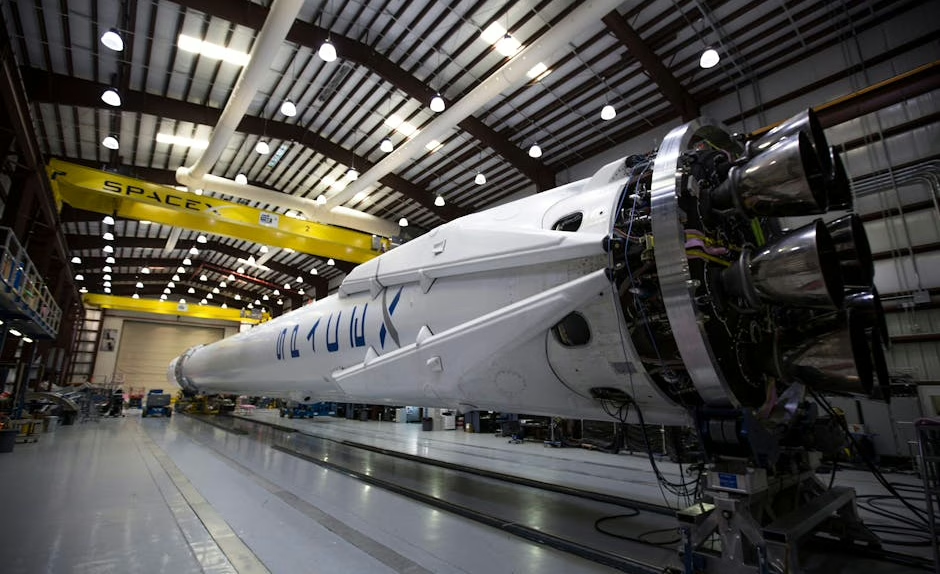

SpaceX Positions for Massive AI Acquisition
SpaceX has announced a strategic partnership with AI coding platform Cursor that includes an unprecedented $60 billion acquisition option, marking one of the largest potential AI deals in history. The arrangement gives SpaceX the choice to either pay Cursor $10 billion for development work or acquire the entire company for $60 billion later this year, according to TechCrunch.
The deal represents a significant premium over Cursor’s recent $50 billion private valuation target, highlighting the explosive growth in AI company valuations. Cursor’s meteoric rise from a $2.5 billion valuation in January 2023 to $29.3 billion post-money after its $2.3 billion Series D in November demonstrates the market’s appetite for AI development tools.
AI Enterprise Adoption Drives Market Expansion
The broader AI market continues to show remarkable momentum, with Google Cloud reporting over 1,302 real-world generative AI use cases from leading organizations. This represents massive growth from the original 101 use cases documented two years ago, signaling widespread enterprise adoption of AI technologies.
Microsoft has simultaneously announced its “Frontier Transformation” initiative, focusing on moving AI from experimentation to production-scale deployment. According to Microsoft’s blog, the company is emphasizing two critical elements: intelligence grounded in customer data and trust through comprehensive governance frameworks.
Key market indicators include:
- Production AI deployment across thousands of organizations
- Agentic enterprise systems becoming standard
- Partner ecosystem expansion driving implementation
- Governance frameworks enabling scale deployment
Venture Capital Adapts to New AI Reality
The AI boom is forcing venture capital firms to rewrite traditional investment playbooks. General Catalyst’s first quarterly investor letter reveals that software buyouts structured around terminal value rather than cash flow are delivering negative returns, even when underlying businesses perform well.
Forbes reports that General Catalyst CEO Hemant Taneja argues public software multiples have compressed to 12.7x EBITDA compared to 25x entry multiples from 2019-2021. This compression destroys equity value even in businesses that grew EBITDA by 50%, with hypothetical deals returning just 0.68x MOIC and negative 7% IRR.
General Catalyst is betting its $43 billion in assets under management that the next era of private markets will look fundamentally different, focusing on cash flow generation rather than pure growth metrics.
Strategic Consolidation Reshapes Competitive Landscape
The Stripe-Airwallex relationship exemplifies how AI-era financial technology is driving strategic decisions. According to TechCrunch, Stripe once offered to acquire Airwallex for $1.2 billion when the Melbourne company had just $2 million in annualized revenue—a 600x revenue multiple that founder Jack Zhang ultimately rejected.
Today, Airwallex claims more than $1.3 billion in annualized revenue with 85% year-over-year growth, processing nearly $300 billion in annualized transaction volume. The decision to remain independent has proven prescient as both companies now compete directly in global financial infrastructure.
Strategic implications:
- Revenue multiples reaching unprecedented levels
- Geographic expansion driving competitive positioning
- Infrastructure plays becoming critical differentiators
- Independent growth sometimes outperforming acquisition scenarios
Investment Patterns Signal Market Maturation
The rapid evolution of AI company valuations reflects broader market maturation patterns. Cursor’s valuation trajectory—from $2.5 billion to potentially $60 billion in under two years—demonstrates how quickly AI development tools can scale when they achieve product-market fit.
SpaceX’s willingness to pay such a premium suggests strategic value beyond current metrics. The company’s Colossus supercomputer, equivalent to a million Nvidia H100 chips, positions the acquisition as infrastructure consolidation rather than pure technology play.
Meanwhile, partnerships between xAI and Cursor, including senior talent migration and computing resource sharing, indicate ecosystem consolidation around Elon Musk’s expanding technology portfolio ahead of SpaceX’s anticipated public offering.
Revenue Models Drive Sustainable Growth
Successful AI companies are demonstrating sustainable revenue models beyond pure venture funding. Airwallex’s path from $2 million to $1.3 billion in annualized revenue showcases how financial infrastructure companies can scale globally while maintaining growth rates.
Google’s documentation of 1,302 enterprise AI use cases suggests that production deployment, rather than experimentation, is driving revenue generation. Organizations are moving beyond pilot programs to implement AI across core business processes, creating recurring revenue opportunities for platform providers.
Key revenue drivers include:
- Enterprise software licensing for production AI systems
- Computing infrastructure services and cloud platforms
- Professional services for AI implementation and governance
- Transaction processing fees from AI-enabled financial services
What This Means
The AI market is experiencing a fundamental shift from experimental investments to production-scale deployments with measurable business outcomes. SpaceX’s $60 billion Cursor option represents the new reality where AI development tools command premium valuations based on strategic infrastructure value rather than traditional metrics.
Venture capital firms are adapting their models to focus on cash flow generation and sustainable growth patterns, moving away from growth-at-all-costs strategies that characterized the previous investment cycle. This maturation benefits companies with proven revenue models and clear paths to profitability.
For investors and market participants, the key insight is that AI companies with strong enterprise adoption, sustainable revenue models, and strategic infrastructure value are commanding unprecedented valuations. However, the compression in public market multiples suggests that private market valuations must eventually align with cash flow fundamentals.
FAQ
What makes the SpaceX-Cursor deal significant?
The $60 billion potential acquisition price represents one of the largest AI deals in history and demonstrates how development tools are becoming critical infrastructure worth premium valuations.
Why are software buyout returns turning negative?
Public market multiple compression from 25x to 12.7x EBITDA means that even successful businesses generate negative returns when entry valuations remain elevated, forcing investors to focus on cash flow rather than growth metrics.
How quickly are AI companies scaling revenue?
Cursor grew from $2.5 billion to potentially $60 billion valuation in under two years, while Airwallex scaled from $2 million to $1.3 billion in annualized revenue, showing that successful AI companies can achieve unprecedented growth rates.
Related news
- Microsoft looked at buying Cursor before SpaceX deal, sources say – CNBC Tech
- Microsoft looked at buying Cursor before SpaceX deal, sources say – CNBC – Google News – Microsoft
- How SpaceX preempted a $2B fundraise with a $60B buyout offer – TechCrunch