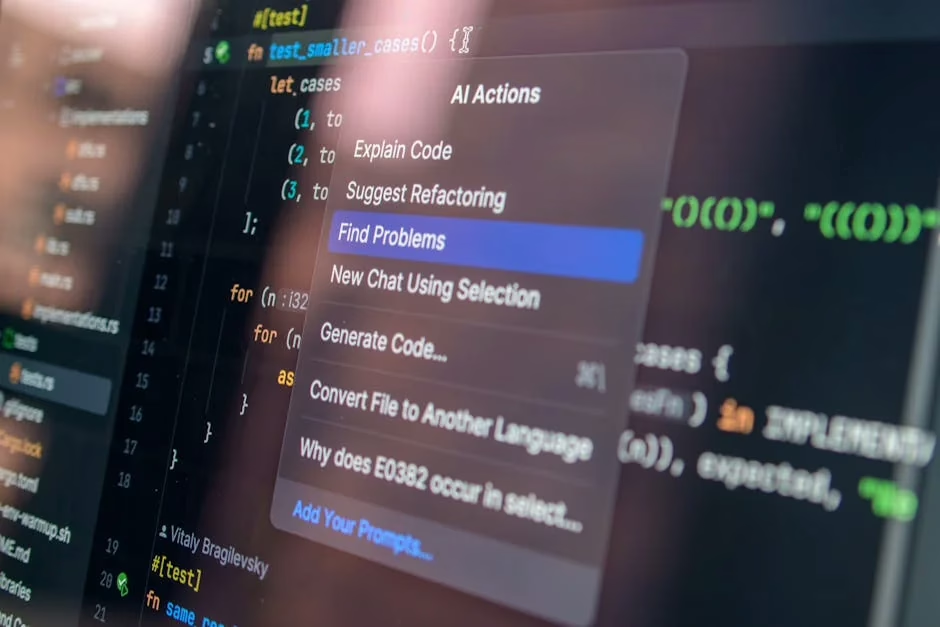

AI coding startup Cursor is in advanced talks to raise at least $2 billion in fresh capital at a staggering $50 billion pre-money valuation, according to TechCrunch. The four-year-old company’s funding round, led by returning investors Thrive and Andreessen Horowitz, would nearly double its previous $29.3 billion post-money valuation from just six months ago. This massive funding round exemplifies the unprecedented capital flowing into AI startups as enterprise adoption accelerates and revenue models mature.
The Cursor deal represents one of the largest startup funding rounds in recent memory, highlighting how investors are betting big on AI infrastructure companies that demonstrate clear revenue traction. With Battery Ventures joining as a new investor and strategic backing from Nvidia, the round signals strong institutional confidence in AI coding tools’ commercial viability.
Enterprise AI Revenue Models Reach Maturity
Cursor’s financial trajectory showcases how AI startups are transitioning from cash-burning growth to sustainable business models. The company forecasts ending 2026 with an annualized revenue run rate exceeding $6 billion, implying it expects to at least triple its current revenue over the next 10 months.
This growth comes after Cursor achieved a critical milestone: gross margin profitability. Like many AI-coding startups reliant on third-party models, Cursor previously operated at negative gross margins, spending more on compute costs than it could charge customers. The introduction of its proprietary Composer model in November, combined with access to less expensive models like China’s Kimi, helped the company cross into positive territory.
Key financial metrics driving investor interest:
- Current annualized revenue: $2 billion (as of February 2024)
- Projected 2026 revenue run rate: $6+ billion
- Recent achievement of gross margin profitability
- Revenue multiple of approximately 8.3x based on current metrics
The shift to profitability addresses a fundamental concern among enterprise software investors: whether AI startups can build sustainable unit economics while competing against tech giants with deeper pockets.
Venture Capital Market Shows Sector Divergence
While AI coding tools attract massive valuations, other emerging technology sectors face funding challenges. The fusion energy space, despite raising $1.6 billion over the past 12 months, shows signs of investor fatigue and strategic disagreement.
TechCrunch reports that fusion startups TAE Technologies and General Fusion are pursuing public market exits earlier than many industry observers consider optimal. TAE’s merger with Trump Media & Technology Group netted $200 million of a potential $300 million, while General Fusion’s SPAC deal could raise $335 million at a $1 billion valuation.
This divergence reflects varying investor sentiment across technology sectors:
High-confidence sectors:
- AI coding and development tools
- Enterprise AI infrastructure
- Autonomous vehicle technology
Cautious investor sentiment:
- Fusion energy (long development timelines)
- Hardware-intensive deeptech
- Unproven revenue models
The contrast demonstrates how venture capital flows toward technologies with clearer paths to commercialization and shorter time-to-market cycles.
Strategic Positioning in Competitive AI Landscape
Cursor’s funding success comes despite intense competition from well-funded rivals including Anthropic’s Claude Code and OpenAI’s revamped Codex. The company’s ability to command a $50 billion valuation reflects several strategic advantages:
Competitive differentiation:
- Proprietary Composer model reducing third-party dependency
- Strong enterprise customer adoption
- Rapid revenue scaling demonstrating product-market fit
- Strategic partnerships with major technology vendors
Meanwhile, established fintech companies like Airwallex demonstrate how strategic decisions impact long-term valuation trajectories. TechCrunch details how Airwallex CEO Jack Zhang rejected Stripe’s $1.2 billion acquisition offer in 2018 when the company had just $2 million in annualized revenue.
That decision proved prescient: Airwallex now claims $1.3 billion in annualized revenue with 85% year-over-year growth, processing nearly $300 billion in transaction volume. The company’s current implied valuation significantly exceeds Stripe’s original offer, validating the strategic decision to remain independent.
Market Implications and Investor Strategy
The massive funding rounds signal a broader shift in how institutional investors approach AI infrastructure investments. Rather than spreading capital across numerous early-stage bets, VCs increasingly concentrate larger amounts in companies showing clear revenue traction and defensible market positions.
This trend appears across multiple sectors. TechCrunch reports that Uber has committed over $10 billion to autonomous vehicle investments and purchases, with $2.5 billion in direct investments and $7.5 billion allocated for robotaxi acquisitions over the coming years.
Investment pattern indicators:
- Larger average round sizes for proven AI companies
- Strategic corporate participation (Nvidia in Cursor)
- Focus on companies with proprietary technology stacks
- Preference for businesses showing path to profitability
These developments suggest venture capital is maturing beyond pure growth metrics toward sustainable business fundamentals, particularly in capital-intensive technology sectors.
What This Means
Cursor’s $50 billion valuation represents more than just another large funding round—it signals venture capital’s evolution toward backing AI companies with proven revenue models and clear paths to profitability. The stark contrast between AI coding tools’ investor enthusiasm and fusion energy’s cautious reception demonstrates how market timing and commercial readiness drive funding decisions.
For enterprise software companies, Cursor’s success validates the strategy of developing proprietary technology to reduce dependency on third-party AI models while achieving sustainable unit economics. The company’s transition from negative to positive gross margins provides a blueprint for other AI startups facing similar challenges.
The broader implications suggest we’re entering a new phase of AI investment where revenue quality matters as much as growth velocity. Companies that can demonstrate both rapid scaling and improving margins will command premium valuations, while those burning cash without clear monetization paths may face increased scrutiny from investors.
FAQ
What makes Cursor worth $50 billion?
Cursor combines rapid revenue growth ($6+ billion projected run rate by 2026), recent achievement of gross margin profitability, and proprietary technology that reduces dependency on expensive third-party AI models. The company’s enterprise customer adoption and competitive positioning against major tech giants justify the premium valuation.
How does AI startup funding compare to other tech sectors?
AI infrastructure companies with proven revenue models are attracting significantly larger funding rounds than other emerging technologies. While Cursor raises $2 billion at a $50 billion valuation, fusion energy companies struggle with investor skepticism despite raising $1.6 billion collectively over 12 months.
What does this mean for AI startup competition?
Large funding rounds like Cursor’s create competitive advantages through extended runway, talent acquisition capabilities, and strategic partnerships. However, they also raise performance expectations and pressure companies to justify massive valuations through sustained growth and market share gains.
Related news
- Revolut eyes valuation of up to $200B in eventual IPO – TechCrunch
- Loop: Scaling Across the Supply Chain With $95M Funding – Procurement Magazine – Google News – Logistics
- Revolut aims for $200bn valuation in stock market listing – Financial Times Tech