
Artificial General Intelligence (AGI) research hit several key milestones in recent months as labs demonstrate new reasoning capabilities, creative problem-solving benchmarks, and efficient model architectures that challenge assumptions about the path to human-level AI.
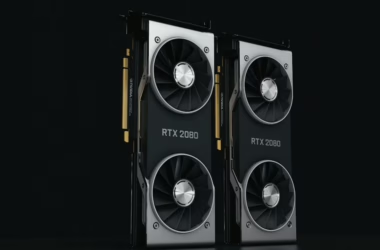
Zyphra released ZAYA1-8B, an 8-billion parameter reasoning model that matches GPT-5-High and DeepSeek-V3.2 performance while using only 760 million active parameters. According to Zyphra’s announcement, the model was trained entirely on AMD Instinct MI300 GPUs, demonstrating viable alternatives to NVIDIA’s dominance in AI training infrastructure.
Efficient Reasoning Architecture Breaks Parameter Scaling Assumptions
ZYAYA1-8B employs a mixture-of-experts (MoE) architecture that activates only a fraction of its total parameters during inference. The model achieves competitive reasoning performance despite being orders of magnitude smaller than trillion-parameter models from major labs.
VentureBeat reported that Zyphra’s “intelligence density” approach spans the full AI stack, from novel training techniques to hardware optimization. The company released ZAYA1-8B under an Apache 2.0 license, making it immediately available for enterprise deployment and customization.
The model’s training on AMD hardware represents a significant validation of non-NVIDIA platforms for serious AI development. AMD’s Instinct MI300 GPUs, released nearly three years ago, had struggled to gain adoption among AI researchers who typically defaulted to NVIDIA’s ecosystem.
Test-Time Compute Creates New Cost-Performance Trade-offs
Reasoning models like OpenAI’s o1 series and GPT-5.5 achieve higher performance by spending additional compute resources during inference rather than just increasing training-time parameters. According to analysis from Towards Data Science, this “inference scaling” approach fundamentally changes the economics of AI deployment.
These models generate hidden reasoning tokens that never appear in user responses but create massive surges in billable compute. Product teams must now navigate a “Cost-Quality-Latency triangle” where better reasoning comes at the expense of response time and infrastructure costs.
Operational Implications for AI Deployment
The shift to test-time compute forces organizations to categorize tasks into “use,” “maybe,” and “avoid” buckets for reasoning models. Simple queries get routed to efficient models, while complex logical problems justify the higher compute costs of reasoning-enabled systems.
Finance teams monitor shrinking margins as reasoning tokens can increase costs by 10-30x per response. Infrastructure engineers manage p95 latency to prevent system timeouts during extended reasoning phases that can last 30+ seconds.
Creative Problem-Solving Remains Major AGI Challenge
Researchers introduced CreativityBench, a new benchmark specifically designed to test creative tool use and affordance-based reasoning in large language models. The benchmark builds on a knowledge base with 4,000 entities and 150,000+ affordance annotations.
The arXiv paper describes 14,000 grounded tasks requiring models to identify non-obvious but physically plausible solutions under constraints. Evaluations across 10 state-of-the-art models revealed significant gaps in creative reasoning capabilities.
Models can often select plausible objects for creative repurposing but fail to identify correct parts, their affordances, and underlying physical mechanisms. Performance improvements from model scaling quickly saturate, and strong general reasoning does not reliably translate to creative affordance discovery.
Chain-of-Thought Provides Limited Creative Gains
Common inference strategies like Chain-of-Thought prompting yielded only marginal improvements on CreativityBench tasks. This suggests that current reasoning architectures may be fundamentally limited in their ability to perform the kind of flexible, context-dependent thinking that characterizes human creativity.
Model Convergence Points to Universal Reality Representation
Research from MIT and other institutions suggests that as AI models improve at reasoning and world modeling, they converge toward similar internal representations of reality. Analysis published in Towards Data Science indicates this convergence occurs regardless of training data type or model architecture.
Models trained purely on images versus text develop increasingly similar “thinking cores” as they scale and improve performance. Researchers draw parallels to Plato’s “Allegory of the Cave,” suggesting that sufficiently capable models must arrive at similar representations if they accurately model the same underlying reality.
This convergence phenomenon becomes more evident as models develop stronger reasoning capabilities. Early models showed greater architectural diversity, but advanced reasoning models appear to settle on similar internal structures for representing world knowledge and logical relationships.
What This Means
These developments suggest AGI progress is following multiple parallel tracks rather than a single scaling curve. Efficiency breakthroughs like ZAYA1-8B demonstrate that reasoning capabilities don’t require massive parameter counts, while test-time compute shows that inference-time optimization can substitute for training-time scale.
However, creative problem-solving remains a significant bottleneck. Current reasoning models excel at logical inference within well-defined domains but struggle with the flexible, context-dependent thinking that characterizes human intelligence. The gap between benchmark reasoning and creative affordance discovery suggests that additional architectural innovations may be necessary for true AGI.
The convergence of model representations toward similar reality models could indicate that we’re approaching fundamental limits in how intelligence can be organized. If this trend continues, future AGI systems may be more similar to each other than current models, regardless of their training approaches.
FAQ
What makes ZAYA1-8B different from other reasoning models?
ZYAYA1-8B achieves competitive reasoning performance with only 760 million active parameters out of 8 billion total, using a mixture-of-experts architecture. It was also trained entirely on AMD GPUs rather than NVIDIA hardware, demonstrating platform diversity in AI development.
How do reasoning models increase compute costs?
Reasoning models generate hidden “thinking” tokens during inference that don’t appear in responses but consume billable compute resources. These models can increase per-response costs by 10-30x compared to standard language models, while also adding significant latency.
Why is creative problem-solving challenging for current AI models?
Models excel at selecting plausible objects for creative tasks but fail to identify the correct parts, affordances, and physical mechanisms needed for novel solutions. This suggests current architectures may be fundamentally limited in flexible, context-dependent reasoning that characterizes human creativity.
Sources
- Inference Scaling (Test-Time Compute): Why Reasoning Models Raise Your Compute Bill – Towards Data Science
- How Major Reasoning Models Converge to the Same “Brain” as They Model Reality Increasingly Better – Towards Data Science
- CreativityBench: Evaluating Agent Creative Reasoning via Affordance-Based Tool Repurposing – arXiv AI